Disclosure: Tech & Real Estate is affiliated with RealEstage.ai. Some links in this article are affiliate links, and we may receive compensation if you sign up through them. Our editorial opinions remain independent.
Most real estate agents frame virtual staging as a marketing expense — a line item that makes photos look better. Top-producing agents frame it as a conversion investment — a system that moves buyers through a defined journey from first online impression to signed contract.
The difference in framing produces dramatically different results. Agents who think about virtual staging as a photo upgrade apply it inconsistently, measure it loosely, and often abandon it when budgets tighten. Agents who think about it as a conversion system apply it strategically to every listing, measure outcomes at each stage of the buyer journey, and scale it because the numbers justify it.
This guide maps the full conversion funnel for a modern real estate listing — from the moment a buyer first encounters a property online to the moment they schedule a showing and write an offer — and shows exactly how AI-powered virtual staging influences each stage.
Understanding the Listing Conversion Funnel
Before AI staging became accessible, agents thought about marketing in linear terms: list the home, take good photos, hold an open house, get offers. The digital buying journey has made that model obsolete.
Today’s buyer funnel has five distinct stages, and virtually every one of them happens online before a buyer ever sets foot inside a property:
- Discovery — The buyer encounters the listing through a portal, social media, or search
- Engagement — The buyer clicks, views photos, reads the description, spends time with the listing
- Consideration — The buyer saves the listing, shares it, returns to it
- Action — The buyer schedules a showing or contacts the agent
- Conversion — The buyer makes an offer
Professional photography and compelling copy have always influenced the middle stages. What AI virtual staging does differently — and what makes it a conversion system rather than just a visual upgrade — is that it operates powerfully across every stage simultaneously.
Stage 1: Discovery — Winning the Scroll
The real estate search experience on Zillow, Realtor.com, and Redfin is fundamentally a visual competition. Buyers scroll through thumbnails, and their attention is captured or lost in under a second per listing. The primary click driver is the hero photo.
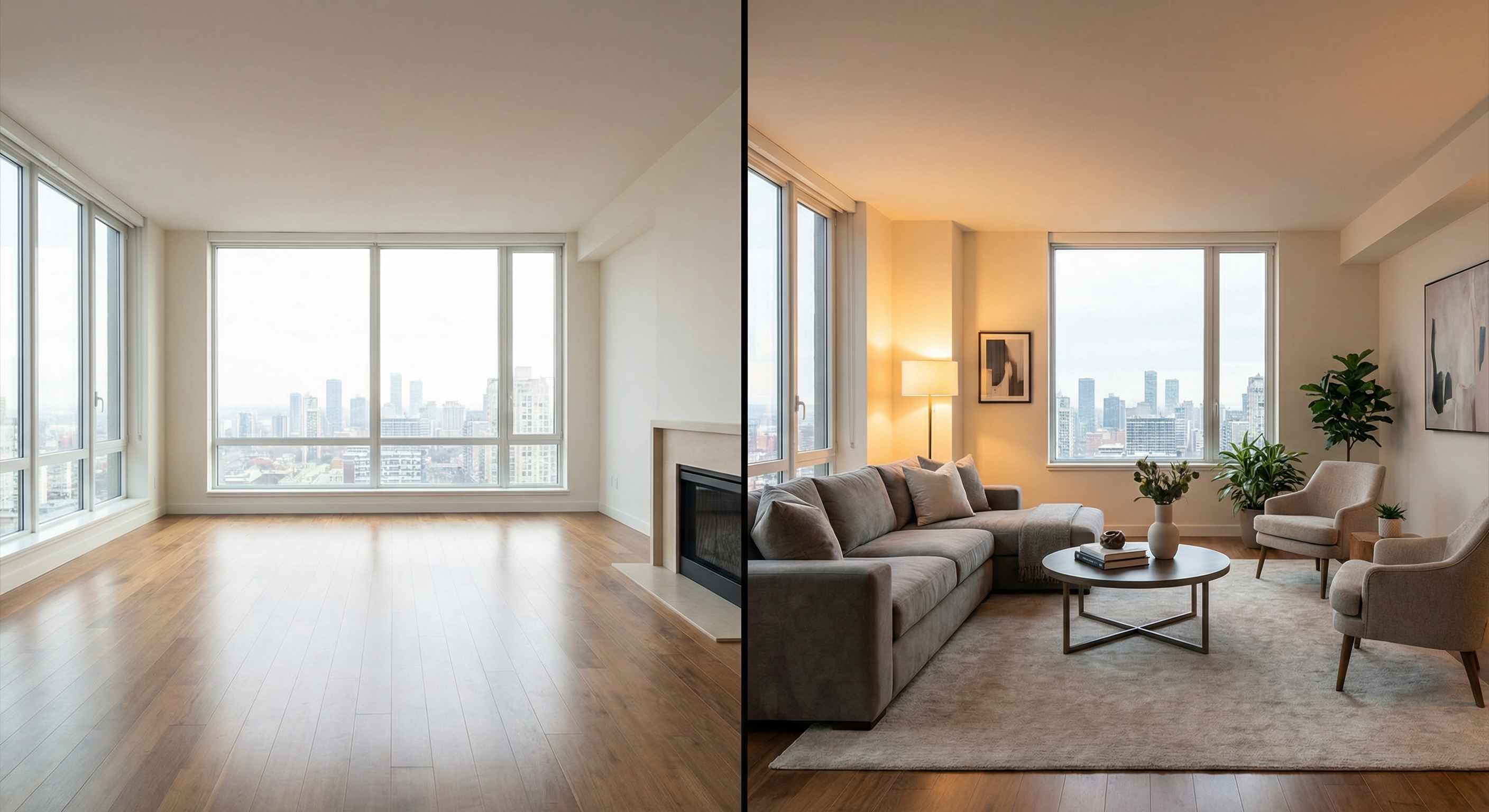
Empty rooms lose this competition badly. Vacant properties look smaller, colder, and harder to imagine living in. Cluttered rooms with dated furniture fail even faster. Neither competes effectively in a thumbnail environment where the eye moves quickly toward spaces that feel warm, proportioned, and livable.
AI-staged listings consistently outperform unstaged ones in click-through rates. When a buyer is scanning a grid of listings and one property shows a beautifully designed, sun-lit living room while comparable listings show bare walls and bare floors, the click differential isn’t subtle — it’s dramatic.
This is where AI virtual staging tools like RealEstage.ai create their first measurable advantage: more clicks from the same search position. Better search placement gets you in front of buyers; AI staging converts that placement into traffic.
Stage 2: Engagement — Keeping Buyers in Your Listing
Getting the click is only the beginning. What happens when a buyer enters your listing detail page determines whether they spend 12 seconds or 12 minutes with the property.
Listing portals track dwell time, photo views, and engagement signals. More importantly, those signals correlate strongly with showing requests. A buyer who scrolls through all 25 photos, returns to three or four of them, and reads the full description is fundamentally more likely to schedule a showing than one who bounces after the first two images.
AI-staged photos drive engagement by doing something that vacant rooms cannot: they tell a story in each frame. A staged primary bedroom communicates lifestyle, proportions, and possibility. A staged kitchen with styled counters communicates how the space functions. A staged living room anchors the buyer’s imagination in the property.
Multiple photos in a staged sequence compound this effect. Where a buyer scrolling through empty rooms has nothing to emotionally anchor to, a buyer scrolling through consistently staged rooms builds a mental model of the home — and that mental model is what creates the motivation to visit.
Agents using RealEstage.ai’s multi-room virtual staging capabilities can stage an entire property — every room that photographs — for a fraction of the cost of traditional staging, and deliver a listing-detail experience that maintains buyer engagement across the full photo set.
Stage 3: Consideration — The Save, the Return, the Share
The consideration stage is often invisible to agents, but it’s where purchase decisions are actually incubating. A buyer who saves a listing is telling you something: this property is in their active evaluation set. A buyer who returns to a listing two or three times over a week is a buyer who is working toward a decision.
What drives saves and returns? Emotional connection to the property — a genuine, felt sense of “I could see myself there.” That emotional connection is almost impossible to generate from an empty room. It requires context, warmth, and the suggestion of life.
This is where AI staging’s ability to render multiple design styles becomes especially powerful. Tools like RealEstage.ai allow agents to present the same space in different aesthetic styles — contemporary, transitional, traditional, Scandinavian — giving buyers visual permission to imagine the home in their own aesthetic vocabulary, rather than having to project their taste onto bare walls.
When a buyer saves a listing and returns to it, they’re usually imagining themselves in the space. AI staging gives them something to imagine.
Stage 4: Action — Driving the Showing Request
The gap between consideration and action is where most listing marketing fails. Buyers often sit in the consideration stage for days or weeks before either scheduling a showing or moving on. The factors that push them toward action are urgency, excitement, and clarity of decision.
Urgency comes from market signals: days on market, competitive offers, price adjustments. Agents have limited control over these.
Excitement comes from emotional investment in the property — the sense that this specific home offers something the buyer wants badly enough to act on. AI staging builds this more effectively than any other presentation tool because it makes the property feel real and desirable long before the in-person visit.
Clarity comes from the buyer feeling like they have enough information to take the next step. Virtual staging eliminates a major source of uncertainty: buyers struggling to visualize scale, proportion, and livability in an empty or poorly staged space. When every room is clearly presented as a functional, well-designed space, the showing request feels less like a leap of faith and more like a natural next step.
Agents who stage consistently with AI report more qualified showing requests and shorter average time-to-offer, because the buyers who arrive at showings have already done their emotional work online. The in-person visit confirms what they’ve already decided to feel — rather than starting the decision process from scratch.
Stage 5: Conversion — From Showing to Signed Offer
Here’s where the conversion funnel framing pays off most clearly: buyers who arrive at showings having already engaged deeply with AI-staged photos are demonstrably more purchase-ready than buyers who are encountering the property for the first time in person.
This is because the online journey has already done substantial emotional and cognitive work. The buyer has imagined the living room with furniture. They’ve placed themselves in the primary suite. They’ve envisioned Sunday mornings in the kitchen. When the physical showing confirms the quality of the property, the emotional groundwork has already been laid.
The result — consistent with what experienced agents report — is faster offers, less seller concession negotiation, and higher buyer commitment coming into the process. A buyer who has spent time with an AI-staged listing doesn’t need to be sold at the showing; they need to be confirmed.
Virtually staged listings consistently outperform unstaged equivalents in agent-reported outcomes. The National Association of Realtors’ Profile of Home Staging reports that staging can meaningfully reduce time on market and support stronger sale prices — findings consistent with what agents who have built systematic staging practices report anecdotally. The mechanism makes sense once you understand how staging functions at each stage of the conversion funnel: it accelerates buyer decision-making at every step.
Building Your AI Staging Conversion System
The agents who capture the full conversion value of virtual staging don’t treat it as a tactical decision on a per-listing basis. They build a system:
Establish a Staging Protocol for Every Listing
Define which rooms get staged for every property — at minimum, the primary living areas, the primary bedroom, and any challenging spaces (unfinished rooms, dated kitchens, rooms with awkward proportions). Apply the protocol consistently regardless of price point.
Align Design Style to Target Buyer
Before ordering staging, identify the likely buyer profile for the property and request staging in styles that align with that buyer’s aesthetic preferences. A first-time buyer in an urban condo market responds differently than a move-up buyer in a suburban neighborhood. RealEstage.ai’s style library makes it easy to request and preview different design directions before finalizing.
Measure Engagement at Each Funnel Stage
Most listing portals give agents access to engagement data: views, saves, shares, and photo interactions. Track these metrics for staged versus unstaged listings and build a data set that lets you quantify the conversion impact in your specific market.
Incorporate Staging Into Your Listing Presentation
When you’re competing for a listing, showing sellers concrete data on how AI staging influences click-through rates, engagement, and time-to-offer gives you a competitive edge in the listing presentation meeting. Most agents present staging as an optional add-on; top producers present it as a core component of their listing system.
Use Staged Photos in Every Paid Channel
AI-staged photos shouldn’t just live on listing portals. Use them in social media ads, email campaigns, and retargeting to reinforce the property’s brand across every buyer touchpoint. The same emotional impact that drives engagement on Zillow drives engagement in a Facebook feed — and consistent visual storytelling across channels compounds the conversion effect.
The Compounding Math of Better Conversion
Here’s what the conversion funnel framing ultimately reveals: AI staging doesn’t just make listings look better. It improves the efficiency of every marketing dollar you spend.
A listing with a higher click-through rate generates more showing traffic from the same portal position. A listing with higher engagement metrics receives more saves and repeat visits from the same buyer pool. A listing with pre-warmed buyers closes faster and with fewer negotiation cycles.
When you apply those improvements across a full listing inventory, the compounding effect on agent productivity and revenue is substantial. You’re not just getting better photos — you’re getting a better conversion rate at every stage of the pipeline.
Agents who are ready to build this system into their practice can start with RealEstage.ai, which delivers professional-quality virtual staging without the lead time or cost structure of traditional staging services.
Key Takeaways
- Virtual staging is a conversion system, not just a visual upgrade — it influences buyer behavior at every stage from discovery to offer
- Vacant and unstaged rooms underperform at the discovery stage because they lose the scroll competition on listing portals
- Engagement depth correlates with showing quality — buyers who interact extensively with a staged listing arrive at showings more emotionally invested and more purchase-ready
- The AI staging ROI is cumulative — better click-through → better engagement → better showing quality → faster offers at higher prices
- A system beats ad hoc application — agents who stage every listing consistently capture far more value than those who stage selectively
The listing photos that convert the most buyers aren’t the ones with the most expensive photography equipment. They’re the ones that do the best job of helping buyers answer the question they’re always silently asking: Can I see myself living here? AI virtual staging answers that question at every stage of the funnel — and the agents building systems around it are closing faster because of it.