Every agent has them in their pipeline: the vacant listings. Move-out complete. Furniture gone. Walls bare. And a listing presentation looming.
These are, statistically, your hardest properties to sell. Empty rooms look smaller on camera. Cold, echoing spaces fail to evoke the emotional connection buyers need to say “this is home.” Without furniture to define scale and purpose, buyers scroll past — or arrive at a showing and struggle to visualize living there.
The result is predictable: longer days on market, more price reductions, and a client who wonders why you’re not doing more.
But that calculus has changed. AI virtual staging tools have made it possible to transform empty rooms into beautifully furnished, buyer-ready spaces in hours — not days — at a cost that’s a fraction of traditional staging. Agents who understand how to deploy these tools are turning their most challenging vacant listings into some of their fastest sales.
Here’s exactly how it works, what the data says, and how to build this capability into your listing marketing system.
The Real Cost of Selling a Vacant Home
The numbers are clear. The National Association of Realtors’ 2025 Profile of Home Staging found that 49% of sellers’ agents reported staging reduced time on market — and nearly 29% saw a 1%–10% increase in the dollar value offered. With the median U.S. home price hovering around $400,000, a 1% improvement in sale price equals $4,000 in a seller’s pocket.
Vacant homes face a structural disadvantage in this equation. Without furniture, buyers can’t gauge room size or functionality. A 12-by-14 master bedroom that would feel spacious and inviting with a king bed and nightstands reads as cramped or awkward when empty. Online listing photos — the first stop for the vast majority of today’s buyers — simply don’t do the space justice.
The consequence isn’t abstract. Industry data consistently shows vacant properties spend more time on market than staged counterparts. Sellers carry carrying costs — mortgage, taxes, insurance, utilities — the entire time. Meanwhile, the longer a home sits, the more buyers wonder what’s wrong with it, creating a perception spiral that makes a bad situation worse.
Traditional staging solves this. But at $1,500–$4,000 or more for a full-home staging job, it’s a hard conversation with sellers who’ve already moved out and are managing two properties. AI virtual staging changes the economics entirely.
What AI Virtual Staging Actually Delivers
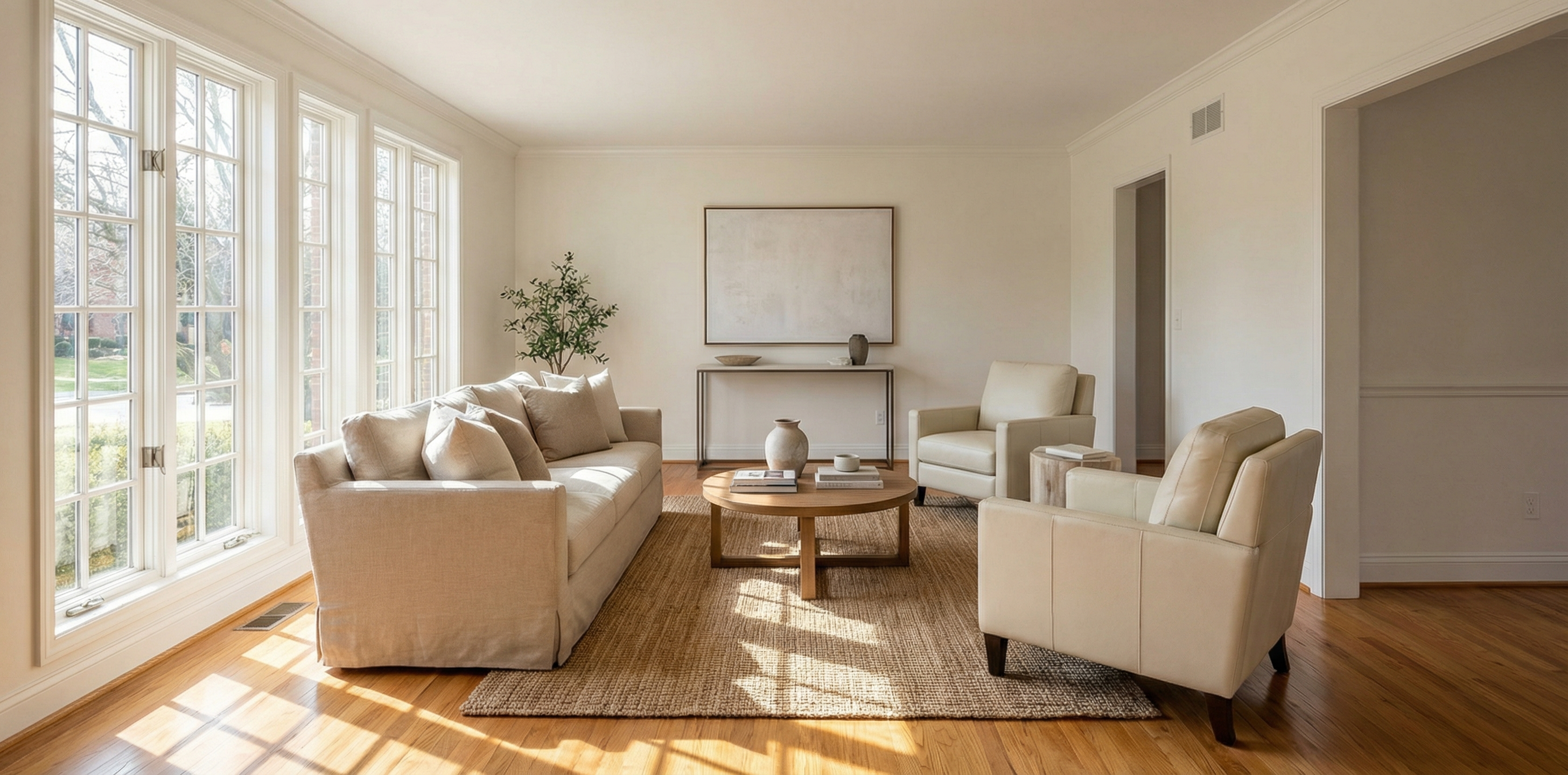
AI virtual staging uses machine learning to digitally furnish and style interior photos. You upload a photo of an empty room. Within minutes — sometimes seconds — you receive a photorealistic image showing the space furnished with appropriate furniture, decor, and lighting that matches the home’s architecture and target market.
The quality of modern AI staging has advanced dramatically. The blurry, obviously-digital renders of five years ago have been replaced by images that are genuinely indistinguishable from photographs of physically staged spaces — complete with realistic shadows, light reflections, and natural material textures.
What does this unlock for agents?
Speed: You can have a full set of staged listing photos ready within hours of securing a vacant property — far faster than scheduling, coordinating, and paying for physical staging.
Cost efficiency: Virtual staging via AI cuts costs by up to 97% compared to traditional staging, according to Florida Realtors. Where physical staging might run $2,000–$4,000, AI tools can produce a complete set of styled room images for a small fraction of that.
Flexibility: You can generate multiple style variations — modern minimalist, warm transitional, upscale contemporary — and choose the one that best matches your target buyer demographic. If the home doesn’t sell in two weeks, you can refresh the style without any physical work.
Scale: Unlike physical staging, which requires furniture, labor, and logistics, AI staging scales instantly. You can stage a 6-room vacant property in the same afternoon you’d stage one room traditionally.
Platforms like RealEstage.ai are built specifically for real estate agents who need this workflow to be fast, intuitive, and reliably high-quality. The system is designed around the realities of an agent’s schedule — no design degree required, no complicated software to learn.
The Buyer Psychology Behind the Results
There’s a reason staged homes consistently outperform vacant ones beyond pure aesthetics: buyer psychology.
When buyers view a vacant room, they’re forced to do all the imaginative heavy lifting themselves. They have to mentally populate the space, determine if their furniture fits, decide if the room layout works for their lifestyle. That’s cognitive work — and most buyers aren’t up for it. They see bare walls and empty corners and subconsciously discount the property.
Staged rooms remove this friction entirely. When a buyer sees a living room furnished with a sectional sofa, a coffee table, and art on the walls, their brain does something powerful: it projects them into the space. “I could see myself here.” That emotional click is what drives offers.
The NAR 2025 data backs this up: 83% of buyers’ agents said staging helped buyers visualize the property as a future home. That’s not a marginal effect — it’s a near-universal response. Staging is the difference between a buyer imagining the life they’d build there versus seeing an empty investment property they’d have to “figure out.”
AI staging delivers this psychological trigger without requiring physical furniture, movers, or a three-week scheduling window.
Room-by-Room: Where AI Staging Has the Highest ROI
Not every room in a vacant home is equally critical to stage. Here’s where to focus your AI staging effort for maximum impact:
Living Room (Priority 1) The living room is the heart of any home sale. It’s the primary photo in 90% of listings, and it’s the first space buyers visualize themselves spending time. A vacant living room feels cold and purposeless. A staged one — furnished, warm, and thoughtfully styled — anchors the entire showing experience.
Primary Bedroom (Priority 2) After the living room, the primary bedroom is the space buyers most need to emotionally connect with. Empty bedrooms feel institutional. A well-staged master with a styled bed, appropriate nightstands, and warm lighting creates the aspiration that drives offers.
Kitchen/Dining Area (Priority 3) While kitchen cabinetry and appliances don’t require staging, the dining area adjacent to the kitchen can feel adrift without a table and chairs. A simple staged dining setup transforms how buyers perceive the entire open-plan kitchen/dining zone.
Home Office / Flex Space (Priority 4) In a post-pandemic market, buyers want to see at least one functional home office. A spare bedroom shown as an empty box communicates nothing. The same room shown as a well-appointed home office — desk, shelving, good lighting — positions it as a premium feature.
Tools like RealEstage.ai allow you to generate staged variations for each room type, letting you build a complete photorealistic listing presentation that tells a coherent story across every space.
How to Use AI Staging in Your Vacant Listing Process
Here’s a practical workflow for integrating AI virtual staging into your vacant listing process:
Step 1: Photograph the vacant property with purpose Clean, well-lit photographs are the foundation. Open blinds, turn on all lights, and use a wide-angle lens to capture rooms at their most spacious. Good input photos = great staged output.
Step 2: Identify your staging priorities You don’t always need to stage every room. Identify the three to five spaces that will do the most work in online photos — usually living room, primary bedroom, and kitchen/dining area.
Step 3: Choose your style based on the target buyer Consider who is most likely to buy this specific home. A downtown condo targets a different buyer than a suburban four-bedroom. Choose a staging style that speaks to that buyer’s lifestyle aspirations: modern and minimal for urban buyers, warm and family-oriented for suburban ones.
Step 4: Generate and review your staged images Upload your photos to your AI staging platform and generate styled options. Review the results with your seller — this is also a great touchpoint to reinforce your tech-forward approach to marketing.
Step 5: Lead your MLS listing with staged photos Post staged photos as your primary listing photos. Always disclose that photos are virtually staged per NAR guidelines — most MLS systems have a simple checkbox for this. Buyers appreciate transparency, and it doesn’t diminish the appeal of the photos.
Step 6: Include an “empty room” photo set As a best practice and per NAR guidance, include a supplemental set of empty room photos so buyers have an accurate baseline. Many agents post the staged photos first and include the empty versions at the end of the gallery.
The Disclosure Question: What Agents Need to Know
Virtual staging is legal, ethical, and widely accepted — with one important caveat: disclosure. NAR standards and most state real estate boards require that virtually staged photos be labeled as such.
This isn’t a liability trap — it’s a simple, transparent practice. You can include a caption like “Photo virtually staged for illustrative purposes” on each staged image. Most MLS platforms support staging disclosure flags. Buyers see exactly what the empty room looks like; the staged photo just helps them see the possibility.
When done correctly, disclosure actually builds trust. It signals that you’re using modern tools to market the home professionally while being transparent about what buyers will see in person.
The Competitive Advantage Is Real
Here’s the practical reality: in any competitive market, the agent who presents a vacant home with professionally staged photos will consistently outperform the agent who lists bare photos and hopes buyers can imagine the rest.
Buyers don’t buy empty rooms. They buy the life they imagine living in them. AI virtual staging is the tool that makes that life vivid — affordably, quickly, and at a quality level that was previously only accessible to luxury listings with large marketing budgets.
If you’re not already building AI staging into your vacant listing workflow, you’re leaving both listings and commissions on the table. Platforms like RealEstage.ai have made this capability accessible to every agent, regardless of budget or technical skill level.
The hardest listings on your list don’t have to be hard. With the right AI staging tools and a systematic approach, vacant properties can become some of your most compelling — and fastest-selling — listings.
Start Staging Smarter
Ready to see what AI virtual staging can do for your next vacant listing? RealEstage.ai lets you upload photos and generate professional staged variations in minutes. No design experience needed — just upload, stage, and publish.
Your next vacant listing is waiting. Don’t make buyers imagine the potential — show them.