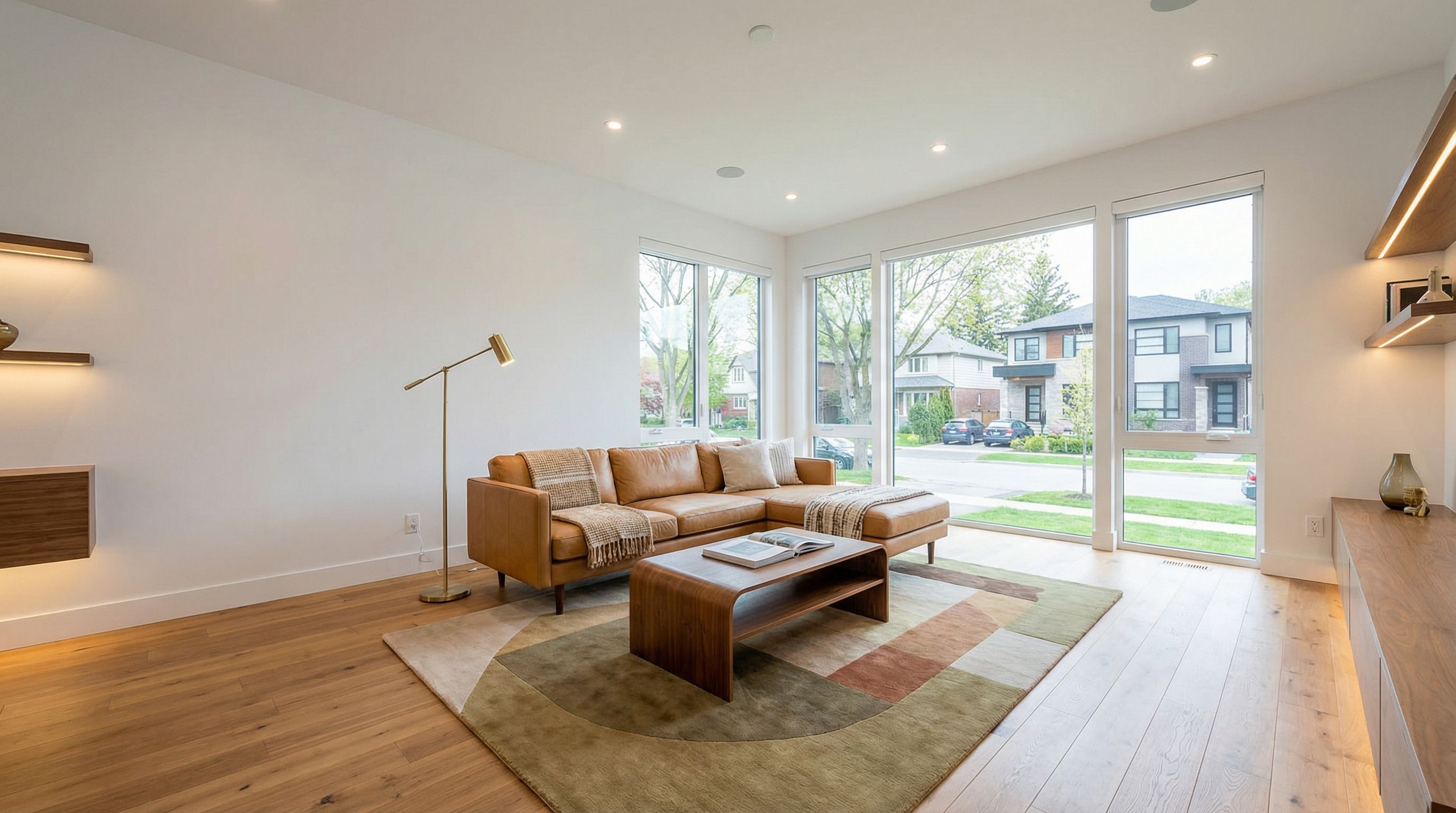
Your listing has eight seconds to earn a buyer’s attention before they scroll past. Not eight minutes — eight seconds. That’s the reality of a market where 97% of buyers begin their home search online, where dozens of listings compete for the same buyer’s gaze in the same browser session. The agents winning in this environment aren’t just hiring better photographers — they’re building a complete visual marketing stack, layering professional photography with AI virtual staging into a unified presentation that commands attention and drives showings.
This guide breaks down exactly how that stack works, what it costs, when each layer is needed, and how to build the workflow that delivers it consistently across every listing you take.
Why Visual Presentation Is Now a Non-Negotiable Competitive Skill
The shift happened gradually, then all at once. Real estate has always valued curb appeal — but digital curb appeal, the quality of a listing’s photos on Zillow, Realtor.com, or your brokerage’s website, is now the primary filter buyers use before requesting a showing.
According to the NAR 2025 Profile of Home Buyers and Sellers, buyers who used the internet during their home search — which represents 97% of all buyers — spent weeks of active online research before engaging with an agent. By the time a buyer contacts you, they’ve already formed opinions about dozens of properties purely based on listing photos. Your visual presentation is doing sales work you’ll never see.
The consequence for agents who underinvest in visuals is brutal: listings that fail the scroll test attract fewer inquiries, spend more days on market, and ultimately achieve lower sale prices. The NAR survey also found that buyers view a median of just seven homes before making an offer — meaning competition for the showing slot itself is fierce. The visual package isn’t decoration. It’s the entry qualification test.
The Two Pillars: What Professional Photography and AI Staging Each Do
These two tools are not interchangeable, and the mistake many agents make is treating them as alternatives rather than complements.
Professional photography captures reality with precision. A skilled real estate photographer brings lighting expertise, wide-angle lenses, and post-processing techniques that make even modest spaces feel open, bright, and inviting. Great photography makes a furnished, move-in-ready home look its absolute best. It’s also the foundation on which everything else in your visual stack is built.
AI virtual staging, on the other hand, solves a fundamentally different problem. Empty rooms feel cold and small in photos — even with expert lighting and composition. Buyers struggle to visualize scale and layout without furniture. Occupied homes with dated, personal, or cluttered furnishings can actively hurt buyer perception. AI virtual staging addresses all of these situations by digitally furnishing and styling rooms directly within the photograph, transforming blank or underperforming spaces into aspirational, buyer-ready environments in hours rather than days.
The power of the combined stack is this: professional photography makes your property look real. AI virtual staging makes it look desirable.
Building the Visual Marketing Stack: A Layer-by-Layer Breakdown
Layer 1 — The Photography Foundation
Every listing, regardless of price point or condition, starts with professional photography. This means a licensed real estate photographer (not smartphone photos, not the agent’s DSLR on a tripod) who understands the unique demands of architectural interior work: HDR blending for high-contrast rooms, proper vertical correction for wide-angle distortion, and natural-looking artificial lighting to compensate for rooms with poor window orientation.
Budget for photography realistically: in most markets, a competent real estate photographer charges between $150 and $400 for a standard shoot depending on square footage. In high-cost metro markets and for luxury listings, $500–$900 is common for a full-service shoot that includes dusk exteriors, aerial drone shots, and same-day delivery.
This is not a cost to cut. Photography is the only component of your visual stack that cannot be created synthetically — AI can stage a room, but it needs a properly captured photograph to work from.
Layer 2 — AI Virtual Staging for Vacant and Transitional Rooms
Once your photos are captured, evaluate each room through a buyer’s lens: does this space communicate warmth, scale, and a lifestyle the target buyer wants to inhabit?
Vacant rooms almost always benefit from AI staging. The psychological research on this is clear — buyers systematically underestimate the size of empty rooms compared to furnished ones, and they have difficulty emotionally connecting with blank white walls and bare floors. For a listing where sellers have already moved out, or for new construction where the developer needs to market before move-in, AI virtual staging is the highest-leverage investment you can make in the visual stack.
Platforms like RealEstage.ai make this process fast and accessible: upload your professional photos, select a staging style matched to your target buyer demographic (modern minimalist, transitional, farmhouse, luxury contemporary), and receive photorealistic staged versions within minutes. The turnaround is fast enough to stage a full home before the MLS listing goes live, and the per-room cost is a fraction of traditional physical staging.
Layer 3 — Style and Aesthetic Alignment
One dimension that separates agents who use AI staging effectively from those who don’t is deliberate style selection. The choice of staging aesthetic should be driven by your target buyer profile, not personal preference or default platform settings.
A downtown condo targeting young professional buyers calls for a different staging aesthetic — clean lines, monochromatic palettes, smart home accents — than a four-bedroom suburban home targeting families with school-age children, where warm neutrals, functional spaces, and a sense of room-for-everyone matter more. Luxury listings in resort markets benefit from aspirational resort-casual styling that emphasizes lifestyle over floor plan.
Most AI virtual staging platforms give you control over style, color palette, and furniture density. Take the time to use these controls intentionally. The right aesthetic doesn’t just make the room look better — it makes the right buyer feel like the listing was made for them.
The Workflow: From Photo Shoot to Published Listing
The most efficient agents run this workflow as a standardized system, not an improvised scramble before each listing launch:
Day of shoot: Coordinate with the seller to clear personal items, ensure all lights are functional, and — for occupied listings — have rooms in their cleanest, most organized state. Brief the photographer on which rooms are vacant and will need AI staging, and which occupied rooms require declutter staging notes for virtual cleanup.
Day 1 post-shoot: Receive final edited photos from photographer. Review all images for composition, lighting quality, and MLS compliance. Identify the rooms that need AI staging (vacant rooms, dated furnished rooms, awkward transitional spaces).
Day 1–2: Upload qualifying photos to an AI virtual staging platform and process each room. Select staging styles aligned to your target buyer profile. Review outputs for photorealism and spatial accuracy — most AI staging tools allow regeneration or style refinement if the first output misses the mark.
Day 2–3: Assemble the complete photo set. Lead with your best exterior shot, then sequence interior photos in a logical walkthrough order. For listings with AI-staged versions, decide whether to show staged-only, unstaged-only, or both (for transparency with buyers). Ensure all staged photos carry proper disclosure language per your MLS rules.
Day 3: Publish to MLS with the complete visual package. Simultaneously push the photo set to your social media channels, email list, and listing website. The visual stack should look consistent across every channel — same photos, same staging style, same aesthetic message.
Where AI Staging Pays the Biggest Dividends
Not every room in every listing needs AI staging. Prioritizing your staging budget toward the highest-impact spaces produces better ROI than blanket staging of every room.
Prioritize these rooms:
- Living rooms and great rooms: The primary emotional anchor for most buyers. A blank, empty living room kills buyer imagination. A beautifully staged one invites them to picture themselves living there.
- Primary bedrooms: Buyers are buying a home, not just a floor plan. The primary bedroom is where emotional purchase decisions get made. A staged bedroom that communicates sanctuary and retreat converts significantly better than an empty room with bare carpet.
- Kitchens with dated finishes: If the kitchen can’t be renovated before listing, strategic AI staging can add visual warmth (textiles, accessories, coordinated small appliances) that softens the visual impact of dated cabinets or countertops.
- Awkward or irregular spaces: Bonus rooms, converted basements, and unusual floor plan configurations confuse buyers when empty. AI staging that assigns a clear purpose to these spaces — home office, gym, reading nook — resolves that confusion and preserves perceived value.
For occupied homes where sellers’ own furniture is serviceable and reasonably neutral, professional photography alone may be sufficient. The decision rule: would a first-time buyer walking through this room immediately understand what it’s for and feel positively about it? If the answer is no, AI staging is the cost-effective solution.
Visual Consistency Across All Listing Channels
A visual marketing stack that performs in MLS but falls apart on Instagram or your brokerage website is a missed opportunity. Modern listing marketing requires photo assets that work across multiple aspect ratios, file size constraints, and platform contexts.
Your hero image — the first photo a buyer sees in any listing view — should be your best exterior shot or most compelling interior, chosen to maximize click-through from search results. This image will appear in MLS grid views, social media previews, Google search snippets, and email marketing campaigns. It should be striking enough to earn a click even at thumbnail size.
Tools like leading AI staging software allow agents to generate multiple styled versions of the same room, giving you the flexibility to match platform context — a lifestyle-oriented version for social media, a clean and uncluttered version for MLS, and a premium high-contrast version for property websites and email headers.
Measuring the Impact: What a Complete Visual Stack Delivers
The business case for investing in a complete visual marketing stack comes down to three measurable outcomes:
Faster time to offer: Listings with high-quality professional photography and well-staged rooms generate more showing requests in the first 72 hours after launch — the window that statistically drives the best offers. Days on market is the clearest single indicator of listing health, and the visual package is one of the few variables entirely within your control.
Higher sale price relative to list: A listing that earns competitive offers can hold price. A listing that sits, generates low showing volume, and collects price reduction history loses negotiating leverage. The visual stack is a defense against the “let’s just reduce the price” conversation with sellers.
More listing appointments won: When you show prospective seller clients the before-and-after results of AI virtual staging applied to comparable properties, you’re demonstrating both competence and a concrete competitive advantage. Agents who present a defined visual marketing stack in their listing appointment win more business — not because sellers don’t understand the technology, but because they can immediately see the value it creates for their listing. AI virtual staging tools that offer instant demo renders during the listing presentation are particularly effective for this purpose.
The NAR 2025 REALTOR® Technology Survey reported that 82% of real estate clients responded positively or very positively to tech integration in the buying and selling process. The visual marketing stack isn’t just a production tool — it’s a signal to your clients that you’re operating at the highest level of professional practice. In a market where 91% of sellers use an agent, the differentiation that earns the listing appointment is increasingly about the systems and tools you bring to the table.
Build your visual stack intentionally. The eight-second scroll test waits for every listing you take.
Related Articles
- AI Virtual Staging for Real Estate Listings: The 2026 Complete Guide
- Buyer Psychology and Virtual Staging: Why Great Photos Drive More Showings
- The First 72 Hours: AI Staging and Listing Launch Strategy That Drives Competitive Offers
- AI Property Presentation Playbook for Listing Agents in 2026
- Virtual Staging vs. Traditional Staging: Full Cost and ROI Guide for 2026
- AI Listing Optimization: How to Convert More Online Views into Showings