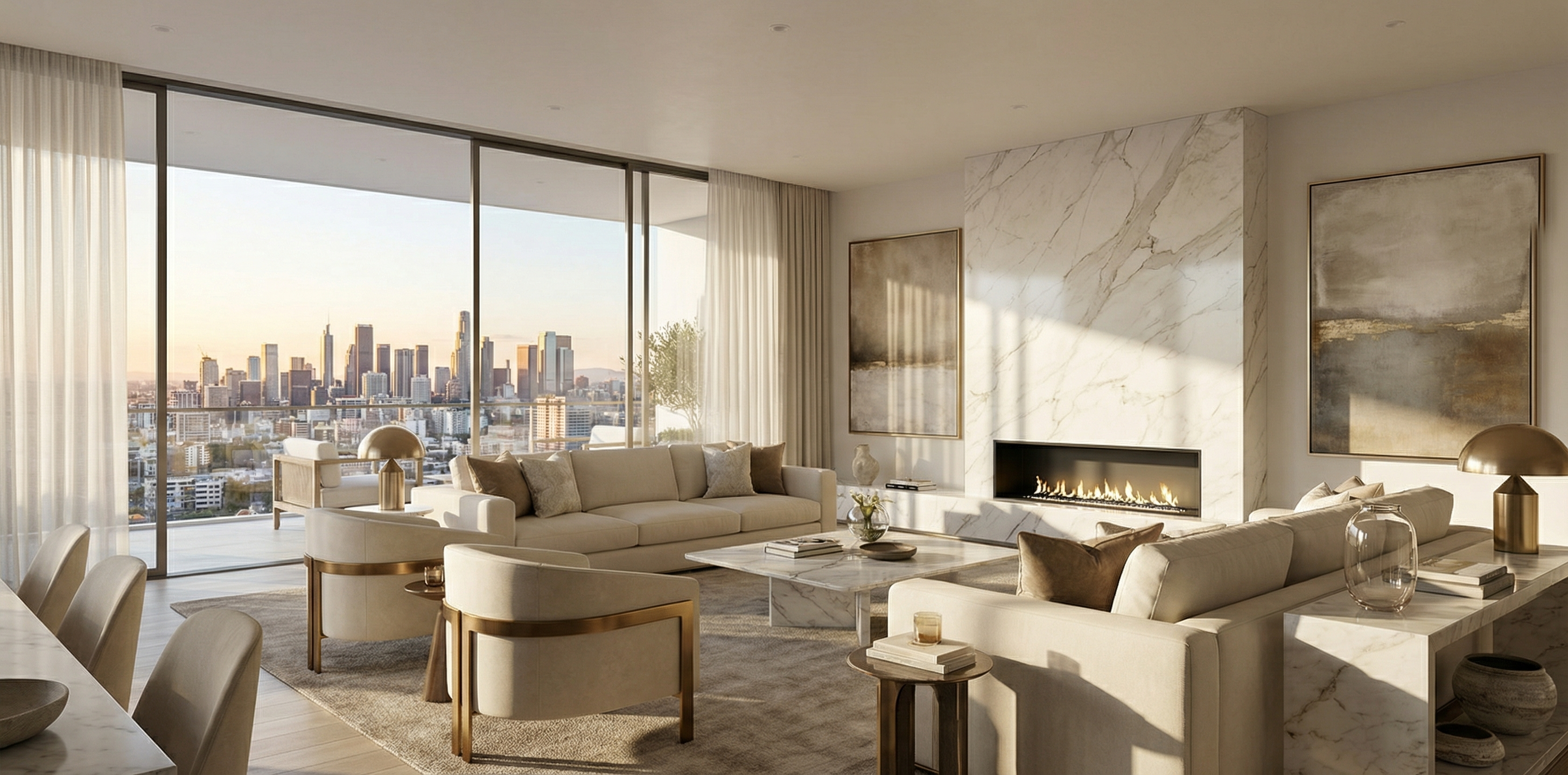
In the luxury real estate market, the gap between a property that sells in weeks and one that sits for months often comes down to a single factor: presentation. Buyers at the $1 million, $3 million, and $10 million price points are sophisticated. They browse dozens of listings on high-resolution screens. They form opinions in seconds. And they do not forgive empty rooms or dated interiors — no matter how exceptional the architecture.
That dynamic has made AI virtual staging one of the most powerful tools available to luxury agents today. Not because the technology is novel, but because it’s matured to a point where the quality of AI-staged imagery can match — and in some cases exceed — what physical staging studios deliver, at a fraction of the cost and timeline.
This article covers how luxury real estate agents are integrating AI staging into their marketing workflows, what separates high-end AI staging from generic approaches, and why platforms like RealEstage.ai are becoming essential infrastructure for agents who compete in premium markets.
Why the Luxury Market Has a Higher Staging Imperative
Every real estate agent understands that staging sells homes. But the stakes scale dramatically with price point.
At entry-level and mid-range properties, buyers are more forgiving of vacant rooms. They project their own vision onto a space. At the luxury tier, that projection fails — because luxury buyers are purchasing an aspirational lifestyle, not just square footage. They need to see the space inhabited, elegantly, before they can commit emotionally.
Traditional physical staging for a luxury property is expensive. A 5,000-square-foot home with seven rooms to stage can cost $7,000 to $15,000 or more per month for a quality staging company, plus logistics and installation fees. That’s a meaningful line item even on a multi-million-dollar commission.
AI virtual staging disrupts this economics entirely. With platforms designed for high-resolution output, agents can produce photorealistic staged images of an entire luxury property — multiple rooms, multiple style directions — for a fraction of the cost of a single month of physical staging. The turnaround is hours, not days or weeks. And if the client wants to explore a different aesthetic, you iterate immediately, not after another week-long scheduling cycle.
What High-End AI Staging Actually Looks Like
The most important thing to understand about AI staging quality in 2026 is that the entry-level tier looks like generic output — and sophisticated luxury buyers can spot it instantly.
Generic AI staging is characterized by:
- Off-proportion furniture that doesn’t respect the room’s actual scale
- Flat or inconsistent lighting that doesn’t match the room’s natural light sources
- Generic decor that reads as stock imagery rather than curated design
- Visible artifacts around furniture edges where the AI compositing failed
Premium AI staging — delivered by purpose-built platforms that optimize for photorealistic fidelity — avoids all of these issues. The best outputs use furniture that’s dimensionally accurate to the room, shadows that fall correctly based on window placement, and design selections that communicate a coherent lifestyle aesthetic rather than a utilitarian floor-plan illustration.
For luxury listings, this distinction isn’t cosmetic — it’s commercial. An agent who presents a $3 million property with low-quality AI staging may actually harm their client’s perception of the home’s caliber. The reverse is equally true: exceptional AI staging can elevate a property beyond what physical staging achieves, particularly for properties with unusual architecture or panoramic views where physical furniture becomes secondary to the visual story.
Style Direction as Competitive Advantage
One of the underrated capabilities of modern AI virtual staging is the ability to rapidly test multiple design directions for the same space. This has particular strategic value in the luxury market.
When you’re marketing a contemporary penthouse, the question isn’t just “should we stage this?” It’s “which aesthetic tells the most compelling story for the buyer persona most likely to purchase this property?” A minimalist Scandinavian treatment communicates one lifestyle. A warm, curated Italian-influenced design communicates another. An ultra-modern statement interior with gallery-quality art speaks to a third buyer profile.
With AI staging, an agent can produce all three interpretations, present them to the seller, and choose the direction most likely to convert the right buyer — before the listing ever goes live. This kind of strategic optionality was effectively impossible with physical staging and prohibitively expensive even with rendering studios.
Tools like RealEstage.ai allow agents to generate multiple styled variations of the same room and compare them side by side, making this creative strategy session a fast, data-informed decision rather than a costly guessing game.
The Luxury Agent’s AI Staging Workflow
Elite agents who’ve integrated AI virtual staging into their luxury listing process follow a workflow that’s more sophisticated than what’s typical at entry-level price points.
Pre-Listing Strategy Session
Before photography is even scheduled, the agent and client discuss aesthetic direction. Using AI staging tools to mockup a reference room from the property (or a comparable property), the agent demonstrates how different design styles will read to buyers. This conversation positions the agent as a strategic marketing partner, not just a transaction facilitator.
High-Quality Source Photography
AI staging is only as good as the photography it works with. For luxury listings, professional photography is non-negotiable — and wide-angle, well-lit shots of each key room are essential inputs. Poor source photography produces poor staging output, regardless of how sophisticated the AI is.
Selective Staging Strategy
Not every room in a luxury property needs to be staged. A skilled agent prioritizes the rooms that buyers weight most heavily: the primary suite, the main living area, the kitchen and dining zone, and any signature feature space (library, home theater, outdoor entertaining area). This selective approach concentrates staging effort where it moves the needle most.
AI virtual staging platforms make this selective approach economical — you’re not paying per room for physical furniture rental, so you can strategically stage the six most important rooms for the same budget that physical staging would spend on two.
Parallel Marketing Asset Creation
Once staged images are finalized, the luxury agent builds a full marketing asset suite: MLS primary images, feature property sheet, social media creative, email newsletter feature, and presentation-ready slides for their personal marketing. AI staging integrates cleanly into this workflow because the output files are standard high-resolution JPEGs that drop into any publishing format.
Disclosure and Transparency in the Luxury Market
In the luxury market, disclosure isn’t just a legal requirement — it’s a trust signal. Sophisticated buyers at the $2 million+ price point often know what AI staging is, and they appreciate transparency about which images are virtually staged.
Most MLS boards now require disclosure of AI-staged images, typically via a watermark or listing description notation. Leading luxury agents go further: they include both staged and unstaged versions in their listing galleries, framing the unstaged images as the architectural reality and the staged images as the design possibility.
This “reality and vision” dual-presentation approach actually strengthens buyer trust. It demonstrates honesty and gives buyers a complete picture, while the staged images do the emotional work of helping them envision life in the property.
For compliance guidance specific to your market, review your local MLS board’s current rules on AI-generated imagery. Many boards updated their policies in 2024 and 2025 as AI staging became widespread.
Negotiation Psychology and Staged Luxury Properties
Here’s a dynamic that’s underappreciated even by experienced agents: staging — whether physical or virtual — affects negotiation psychology for both buyers and sellers.
For buyers, a property that looks like a home is psychologically harder to negotiate aggressively against. When you imagine yourself living somewhere, low-ball offers feel more personal, more transgressive. Staged properties tend to anchor buyers at higher starting-offer levels because the emotional investment is higher.
For sellers, seeing their property staged to its full potential builds confidence in their asking price. Sellers who’ve seen their property rendered beautifully are psychologically less likely to panic-reduce price during early market days, which is one of the most common early mistakes that undermines final sale price.
This psychological dynamic makes AI virtual staging not just a marketing tool but a negotiation strategy — one that pays dividends on both sides of the transaction.
The Cost Calculus for Luxury Listings
Let’s put the numbers in concrete terms. A luxury property at $2.5 million with a 2.5% seller-side commission generates a $62,500 commission. Physical staging for that property (conservatively) runs $8,000 to $12,000 for a 90-day listing cycle.
AI virtual staging for the same property — staged images for eight key rooms, three style directions explored, full marketing asset suite — typically runs under $100 on a subscription-based AI staging platform, and under $500 even for more complex, high-revision projects.
That’s a 95%+ cost reduction on the staging line item, without a quality tradeoff when you’re working with a premium AI staging platform built for photorealistic output.
The math for the luxury agent’s business model is straightforward: AI staging tools dramatically expand your margin per listing, allow you to offer staging as a standard service (rather than an upsell or client expense), and let you allocate budget toward other high-value marketing activities like targeted digital advertising or premium print materials.
Where AI Staging Ends and Human Judgment Begins
It’s worth being clear about where AI staging has limits, because good agents know the boundaries of their tools.
AI staging cannot replace the strategic decision-making of a skilled agent. It can’t tell you which design direction is most appropriate for your specific buyer pool in your specific market at this specific price point. It can’t advise on which rooms are truly the priority for a particular property. And it can’t ensure that the staging direction is legally compliant with your local MLS disclosure requirements.
The technology amplifies good strategy. It doesn’t substitute for it. The agents getting the best results from AI virtual staging are the ones who invest in understanding their luxury buyer personas deeply, use that knowledge to direct the AI’s output strategically, and integrate the results into a comprehensive marketing plan — rather than treating AI staging as a plug-and-play widget.
That integration of sophisticated judgment with powerful technology is what separates elite luxury agents from the field. RealEstage.ai is built to serve that professional tier — giving agents the tools to execute at the highest level without the overhead that previously made premium staging reserved for only the most expensive listings.
Getting Started With AI Virtual Staging for Luxury Properties
If you’re an agent who works with luxury or high-end listings and you haven’t yet integrated AI virtual staging into your standard process, the starting point is simpler than most agents expect.
The first step is to choose a platform that produces photorealistic output — not generic AI staging that immediately signals “AI” to a sophisticated buyer. Test it on a current or recent listing. Generate staged versions of two or three key rooms. Show them to a trusted colleague or your staging-aware clients and ask for honest feedback.
If the quality meets the standard your brand requires, integrate it into your next listing workflow from the beginning — starting with the pre-listing strategy conversation where you discuss style direction with your seller.
The agents who wait for AI staging to become “standard practice” before adopting it will find, when it gets there, that the agents who adopted early have already built the workflow fluency, the client track record, and the marketing differentiation that come with being first.
In the luxury market, timing matters. So does presentation. AI virtual staging is where both intersect — and the agents using it well right now are widening their competitive advantage every week.
Related Articles
- The Buyer’s First 8 Seconds: How AI Is Winning the Listing Attention War in 2026
- How to Choose the Right AI Staging Tool for Your Real Estate Business
- Why AI Virtual Staging Has Become a Baseline for Competitive Real Estate Marketing
- The AI Staging Workflow That Turns Empty Listings Into Offers
- AI Virtual Staging in 2026: The Complete Guide for Real Estate Agents
- The Complete AI Real Estate Marketing Toolkit: Build a Listing System That Converts