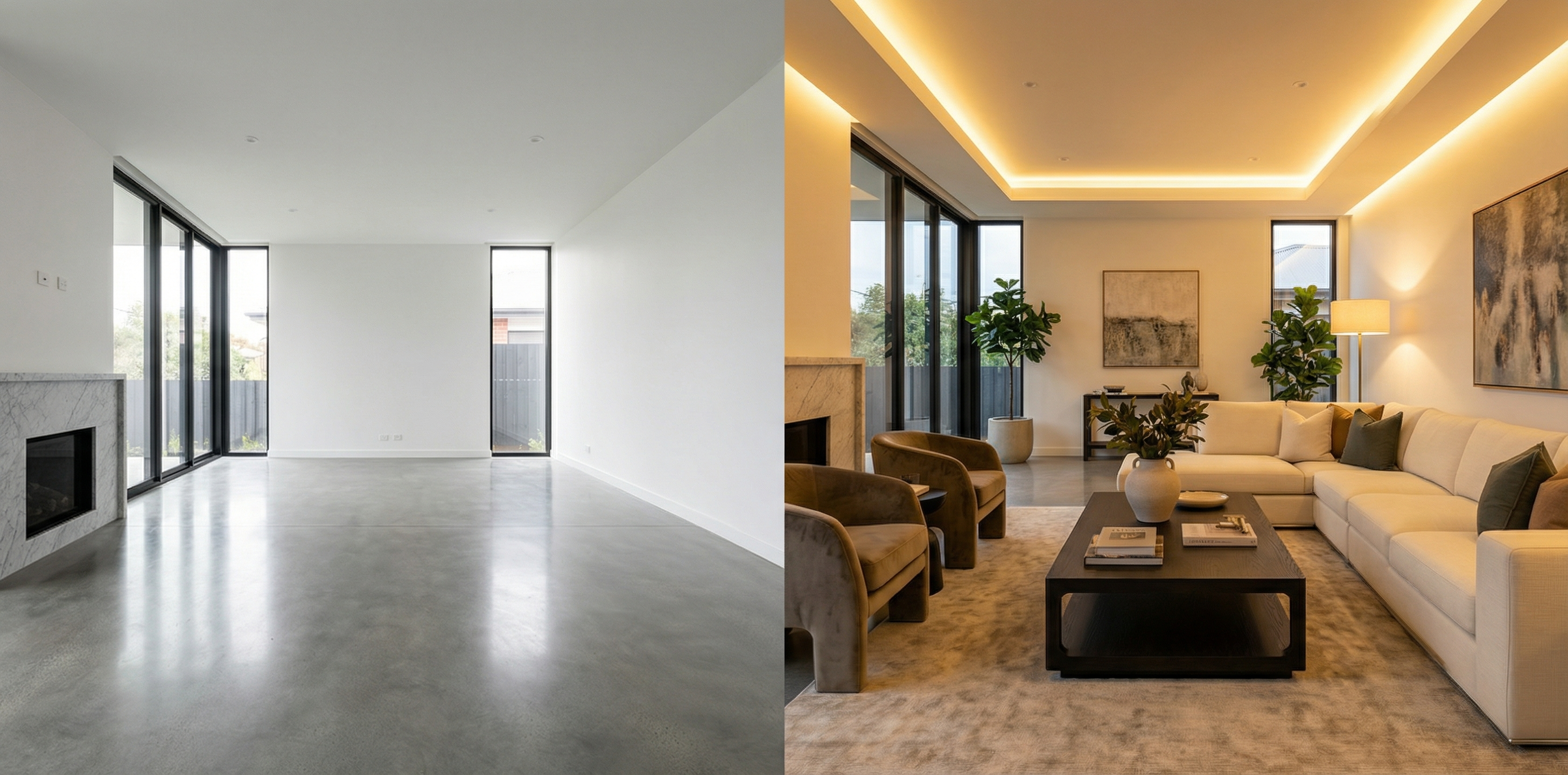
Empty rooms don’t sell houses. They sell doubt.
When a buyer scrolls past a vacant listing, they’re not imagining the life they could build there — they’re seeing a property nobody wanted to invest in. They’re calculating carrying costs, wondering what’s wrong, and clicking to the next listing before they’ve even processed the square footage.
The agents who consistently win listings, generate competitive offers, and close faster aren’t working harder than everyone else. They’ve built a workflow. Specifically, an AI-powered staging workflow that transforms a vacant, impossible-to-visualize property into a compelling, emotionally resonant listing — in hours, not days, for a fraction of traditional staging costs.
This is that workflow. Step by step.
Why the Old Staging Model Is Broken
Traditional physical staging costs between $1,500 and $4,000 for a vacant three-bedroom home, and that’s before you factor in monthly rental fees, scheduling delays, and the logistical nightmare of coordinating movers, stagers, and photographers around a listing timeline.
Even with that investment, you get exactly one design style. One interpretation of the space. One aesthetic that may or may not resonate with your actual target buyer demographic in that market.
The data on staging’s value is clear: according to the National Association of Realtors’ 2025 Profile of Home Staging, staged homes sell faster and command higher offers. Seventeen percent of buyer agents reported that staging increased offer value by 1–5% compared to similar unstaged homes. In a $600,000 market, that’s up to $30,000 in additional value — enough to justify virtually any staging investment many times over.
The problem isn’t staging’s effectiveness. It’s that the old delivery model doesn’t scale, doesn’t flex, and doesn’t serve the realities of a digital-first buying environment where 97% of buyers start their search online and form strong opinions before they ever schedule a showing.
AI staging tools solve both problems simultaneously. You get the proven psychological benefit of a beautifully presented space, delivered digitally, at a fraction of the cost, with the ability to generate multiple style variations in minutes.
The Core Workflow: Five Stages From Photos to Offers
Stage 1: Photography With AI Staging in Mind
This is the step most agents skip, and it creates unnecessary friction later. The best AI staging results don’t come from any photo — they come from photos shot with virtual staging in mind.
Shoot empty rooms with context. Capture the full room with enough wall space and floor area visible to let AI tools place furniture naturally. Low-angle shots that show floor-to-ceiling space work best.
Light the room properly. AI staging tools work with existing light conditions. Dark, underlit rooms produce darker staged results. Open blinds, shoot during golden hour, or use supplemental lighting for rooms with limited natural light.
Document room dimensions. AI staging platforms like RealEstage.ai use room proportions to place furniture to scale. A quick notation of room dimensions helps you verify that the AI-generated staging looks proportionally accurate before you send it to clients.
Capture multiple angles. For key rooms — living room, primary bedroom, kitchen — shoot from at least two angles. You’ll want staging variations from each perspective.
Stage 2: Selecting the Right Style for the Market
The biggest mistake agents make with AI staging is treating it as a one-size-fits-all tool. The furniture style that converts in a downtown loft market is completely different from what resonates in a suburban family neighborhood or a luxury coastal enclave.
Match the style to the buyer profile, not your personal taste.
- Young professionals and first-time buyers: Clean, modern minimalist with neutral palettes. Think white, warm gray, and wood tones. Uncluttered but inviting.
- Move-up buyers with families: Transitional style — comfortable, livable, with clear purpose in each room. Show a home office where the guest room is. Show a functional mudroom. Show storage.
- Luxury buyers: Contemporary or traditional depending on the property’s architectural character. Every detail signals quality — textured throws, layered rugs, architectural lighting.
- Investment buyers: Skip the high-end finishes. Show functional staging that communicates clean, neutral, and easy-to-rent.
Tools like RealEstage.ai offer multiple design styles — modern, traditional, Scandinavian, industrial, coastal, and more — so you can generate multiple versions and select whichever best matches your target demographic. Some agents generate two or three style variations and A/B test which gets more engagement on listing platforms.
Stage 3: Generate, Review, and Refine
This is the mechanical core of the workflow, and it’s where AI tools have made the most dramatic improvements in 2026.
Upload your empty room photos. Quality AI staging platforms process images in 30–90 seconds. The output is a photorealistic staged version of the space — furniture placed to scale, lighting matched to the source photo, no uncanny valley artifacts.
Review for accuracy. Even the best AI systems occasionally place furniture in awkward positions or create spatial anomalies. Look for:
- Furniture that doesn’t respect doorways or windows
- Shadows that don’t match the room’s light source
- Scale issues (a coffee table that’s too large for the seating area)
- Flooring transitions that don’t make sense
Most platforms allow regeneration with adjusted parameters, or simple editing to correct placement.
Generate the full suite of rooms. A complete listing typically needs staged versions of the living room, primary bedroom, kitchen (if vacant and empty), dining area, and any bonus spaces like a home office or loft. With RealEstage.ai’s AI staging platform, agents can stage a full vacant home in under 30 minutes — a task that would have required days of scheduling and thousands of dollars with traditional staging.
Stage 4: Listing Copy That Works With Visual Staging
Staged photos without aligned listing copy leave value on the table. The words in your listing need to do what the images started — guide the buyer’s imagination and connect the visual to the lifestyle.
Write to the staged experience. If you’ve staged the living room in a warm, modern style with built-in shelving and a reading nook, your copy should reference the “light-filled living area perfect for both entertaining and quiet evenings in.” The copy amplifies what the image suggests.
Lead with the transformation. Buyers who see well-staged photos and then read copy that matches the experience become significantly more invested. Their brain has already begun the process of imagining themselves in the space — your copy closes that loop.
Include disclosure language. AI-staged photos must be clearly identified as virtually staged in your listing. Most platforms generate images with this noted, and many MLSs now require explicit disclosure. This is a legal and ethical requirement, not optional. A compliant disclosure might read: “Photos may include virtual staging for illustrative purposes.”
Stage 5: Multi-Channel Distribution
A well-staged listing that only lives on the MLS is leaving reach on the table. The full workflow extracts maximum value from your staging investment by distributing it across every channel where buyers browse.
MLS listing: Lead with staged photos. If your MLS allows, alternate between staged and unstaged versions for transparency.
Social media: AI-staged photos perform dramatically better than empty room shots on Instagram, Facebook, and LinkedIn. Consider posting before/after comparisons — they generate high engagement and often go viral within local market communities.
Email marketing: If you maintain a buyer list, staged listing announcements generate higher open and click rates than standard listing photos.
Property websites: Single-property websites that combine staged photos, virtual tours, and neighborhood data have become a standard tool for agents using RealEstage.ai for listing marketing. The ability to present a listing as a complete package — visually and informationally — increases the quality of inquiries.
Listing presentation decks: When pitching a seller, bring your AI staging workflow into the pitch itself. Show how their vacant home will look after your staging process. This closes seller presentations that competitors lose because they can’t show, only tell.
The Numbers That Matter: What the Workflow Delivers
The value of a systematic AI staging workflow compounds across every listing.
Time savings: A traditional staging project takes 5–14 days from scheduling to photos. An AI staging workflow takes 1–3 hours. For agents managing 10+ listings per year, this adds up to weeks of recovered time.
Cost reduction: Physical staging averages $2,000–$4,000 for a vacant home. AI staging typically costs $30–$150 per listing depending on the platform and number of rooms. For a typical agent managing 15 listings per year, that’s a potential cost reduction of $25,000–$55,000 annually.
Listing performance: NAR data consistently shows that staged homes generate more showing requests and offers. The 2025 Profile of Home Staging notes that 81% of buyers’ agents said staging made it easier for buyers to visualize the property as their future home.
Agent positioning: Agents who offer a documented, professional AI staging workflow win seller listings against agents who don’t. Sellers want to know their home will be presented competitively. Showing up with a concrete technology-backed workflow is a differentiator that closes listing appointments.
Common Mistakes to Avoid
Over-staging. AI staging is powerful, but a living room with twelve pieces of furniture, three rugs, and wall-to-wall art reads as chaotic, not cozy. Restraint converts better than maximalism.
Ignoring room-specific buyer priorities. The kitchen and primary bedroom drive an outsized percentage of buyer decisions. If you’re going to allocate budget for more detailed staging, start there.
Using one style across all rooms. A modern minimalist living room paired with a traditional Victorian-styled bedroom creates cognitive dissonance. Keep style consistent throughout the home.
Forgetting the exterior. AI tools can enhance exterior shots too — adding lawn care, removing distractions, improving curb appeal visuals. An investment in exterior presentation pays dividends at the click-through level, before a buyer even sees the interior.
Skipping the disclosure. This is non-negotiable. Failing to disclose virtual staging creates legal and ethical exposure. Every reputable AI staging platform makes it easy to generate disclosure-compliant images.
Building the Workflow Into Your Business
The agents who get the most value from AI staging aren’t treating it as a one-off tool. They’ve systematized it.
They have a go-to platform — many high-volume agents have standardized on RealEstage.ai as their primary virtual staging tool because of its speed, style range, and output quality. They have a style guide that maps buyer demographics to design presets. They have a photographer who knows to shoot for AI staging. They have a checklist that runs from photo shoot to listing publication in a single day.
That systemization is what separates an agent closing 30+ transactions per year from one grinding through 10. Not talent. Not market conditions. Workflow.
What the Market Looks Like Without This
Take a moment to consider what buyers see when they’re scrolling active inventory in your market.
Most listings feature photos of empty rooms with builder-white walls, bare floors, and the echo of a space nobody has invested in. Some have dated furniture left behind by a seller who didn’t stage. A handful have been professionally staged at significant expense.
Then there’s the listing that opens to a warm, inviting, beautifully furnished living room — photographed beautifully, presented cohesively, with copy that tells a story. That listing gets more saves, more showings, and more offers. Not always — nothing in real estate is always — but consistently. Reliably. At scale.
The AI staging workflow described in this guide is available to you today. The technology exists. The platforms are accessible. The cost is a fraction of what it used to be.
Start with one vacant listing. Run the workflow. Compare your showing request rate to your previous vacant listings. The data will tell you what to do next.
Related Articles
- AI Virtual Staging for Luxury Listings: How High-End Agents Are Elevating Premium Properties
- AI Virtual Staging Is Now Non-Negotiable for Real Estate Marketing
- How to Choose the Right AI Staging Tool for Your Real Estate Business
- Virtual Staging Room by Room: Which Spaces Drive the Most Buyer Interest (2026 Guide)
- AI Staging and Buyer Psychology: Why Presented Homes Generate Faster Offers
- Property Presentation and Conversion: The Agent’s AI-First Marketing Guide
- The Real Estate Agent’s AI Marketing Stack for Maximum Listing Visibility
- Virtual Staging ROI: What the Data Actually Says About Staged vs. Unstaged Listings
- The Complete AI Real Estate Marketing Toolkit: Build a Listing System That Converts