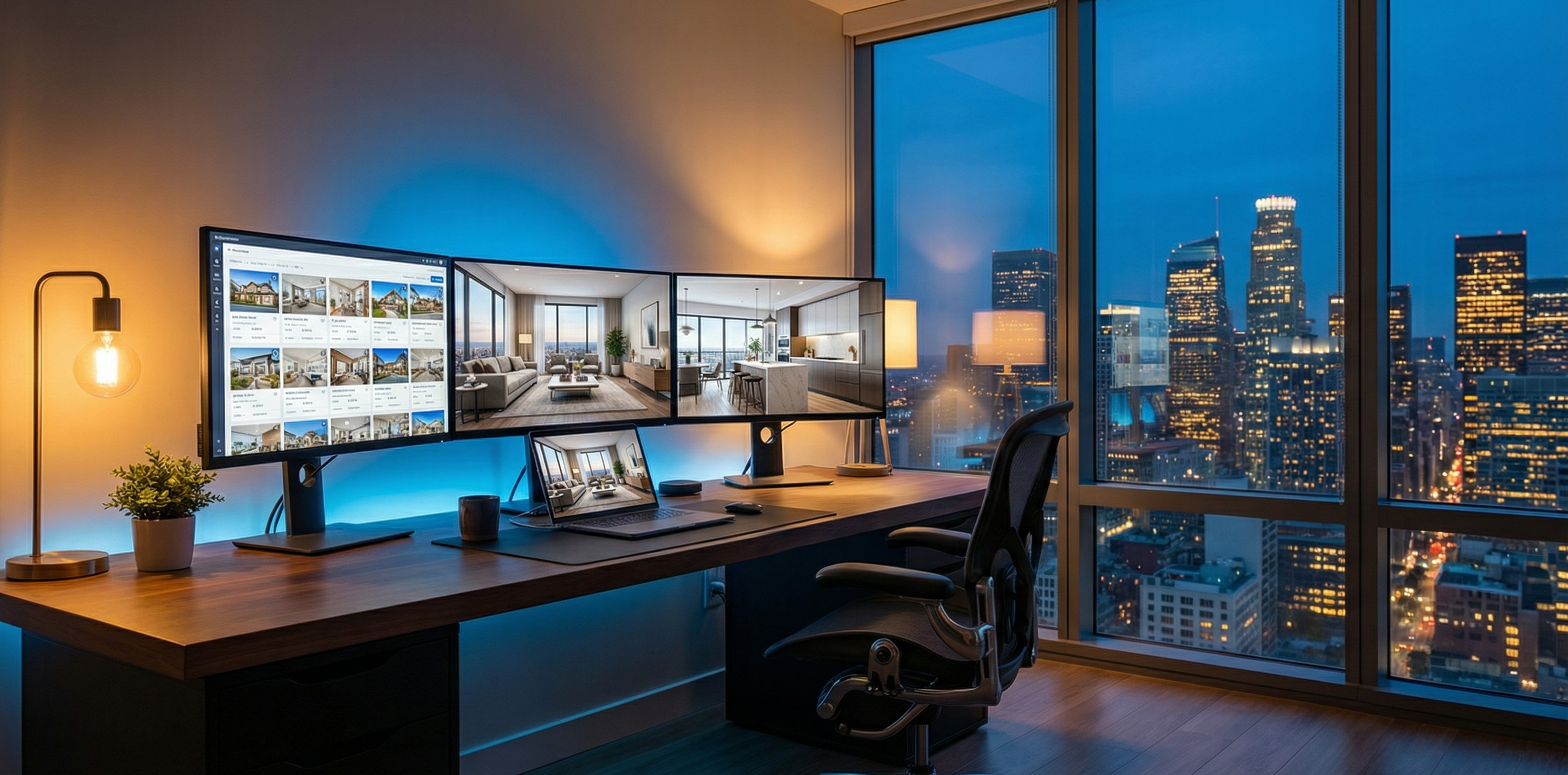
There’s a consistent pattern among top-producing real estate agents in 2026: they don’t treat each listing as a one-off marketing project. They run a system. A repeatable, optimized, AI-powered workflow that takes every new listing from signed agreement to maximum buyer engagement with minimal friction — and without reinventing the wheel each time.
The agents who struggle are often talented marketers who work hard on each listing but operate reactively. They scramble for photographers, manually write descriptions, cobble together social posts, and stage only when the budget allows. The result is inconsistent output, inconsistent results, and an enormous amount of time spent on marketing execution rather than the relationship-building and strategic work that actually grows a business.
In this guide, we’ll walk through the complete AI real estate marketing toolkit that top producers are building right now — layer by layer — and show you how to systematize your listing marketing so that every property you represent benefits from your best possible presentation, automatically.
Why System Beats Hustle in Real Estate Marketing
Before we get into the tools, it’s worth understanding the philosophy behind a marketing system — because the tools are only as powerful as the process they’re embedded in.
A marketing system solves three problems that hustle alone cannot:
Consistency. A system ensures that every listing — not just your high-profile ones — gets professional-grade marketing. When you operate from a repeatable playbook, the quality of your marketing doesn’t depend on how busy you are or how energized you feel on launch day.
Speed. AI tools have compressed the timeline for every stage of listing marketing. What once took a week can now be done in hours. A system that integrates these tools appropriately means you can launch listings faster, respond to market windows, and deliver a seller experience that visibly outpaces competitors.
Leverage. A system lets your time go further. When marketing tasks are systematized, you spend your hours on client relationships, prospecting, negotiations — the activities that actually require your judgment and presence — rather than on execution tasks that AI handles better and faster.
Research consistently confirms that listings with professional visual marketing outperform bare-bones listings by wide margins: properties with professional photography attract 50% more buyers, research suggests virtual staging can meaningfully boost click-through rates from search, and listings with video content receive up to 403% more inquiries. The data isn’t surprising. But building the system to capture that performance consistently — that’s where most agents fall short.
Layer 1: Property Presentation Foundation
Every marketing system starts with the same input: the property itself. Before any tool, AI or otherwise, can do its job, you need a presentation foundation.
Professional Photography (Non-Negotiable)
Professional photography is the substrate on which everything else builds. AI staging tools, virtual tours, and social creative all depend on high-quality source images. Budget photography produces mediocre AI outputs — garbage in, garbage out.
In 2026, professional real estate photography is widely available and cost-effective. There’s no defensible reason to list with smartphone photos. At entry-level price points, a professional shoot typically runs $150–$300. At mid-range and above, $300–$600. Against any commission, that’s a fraction of a percent of your marketing investment, and it affects every downstream asset you create.
The key specs to require from your photographer: wide-angle shots of every primary room, correct white balance, bracket exposure for HDR processing, and clean staging of any physically present furniture before the shoot.
Virtual Staging: The AI Layer That Transforms Empty Rooms
This is where AI tools have most dramatically changed the economics of listing preparation. Virtual staging with AI allows you to furnish any empty room digitally — adding photorealistic furniture, art, rugs, lighting fixtures, and decor — at a fraction of the cost of physical staging and in a fraction of the time.
The business case is clear. Physical staging for an entry-level to mid-range property runs $1,500–$4,000 per month. AI virtual staging for the same property — every room, professionally staged, with the ability to iterate style directions — typically costs under $100 on a modern platform. The quality delta between the two has narrowed dramatically; buyers interacting with premium AI staging cannot reliably distinguish it from physical staging in online photography.
For agents, this shift means staging is no longer an either/or budget decision. With AI staging tools like RealEstage.ai, you can stage every vacant listing as standard practice — not just the listings where the client has budget. That standardization elevates your average presentation quality across your entire portfolio.
A compliance note: Most MLS boards and the NAR Code of Ethics require that virtually staged images be disclosed as such — typically through a “virtually staged” watermark or label, and a notation in the listing remarks. Check your local MLS rules before publishing AI-staged images. Proper disclosure is straightforward and protects both you and your sellers.
Layer 2: Listing Optimization for Search and Discovery
Professional visuals get buyers to your listing. Listing optimization keeps them there — and converts browsers into showing requests.
MLS Description Optimization
AI writing tools have made it significantly faster to produce compelling MLS descriptions that balance keyword density for search, emotional resonance for buyers, and completeness for informed decision-making. The best descriptions open with a compelling feature hook, work through the property’s hierarchy of value, and close with a lifestyle statement.
The trap to avoid: AI descriptions that sound generic. The tool helps you write faster — but your knowledge of the property’s specific strengths, the neighborhood’s appeal, and the target buyer profile has to inform what you feed into the tool. Input quality drives output quality here, just as it does with AI staging.
Photo Sequencing Strategy
The order in which photos appear in an MLS listing matters more than most agents appreciate. Research on buyer attention in online property search shows that buyers form decisive first impressions within the first three to five images. A listing that opens with a curb shot and three bedroom photos has squandered its strongest conversion moment.
The optimal sequence typically opens with the hero shot (the room or feature that most strongly communicates the property’s value proposition), moves to the core living spaces that sell the lifestyle, and then fills out with utility spaces (bedrooms, bathrooms) before exterior and community amenities. AI-staged versions of your key rooms should always occupy the prime positions in this sequence.
Search-Optimized Remarks
Many MLSs allow both “public remarks” (buyer-facing) and “agent remarks” (agent-facing, with showing instructions and terms). Many agents treat agent remarks as a logistics dump. Top producers treat them as a soft-sell opportunity with the buyer’s agent — because the buyer’s agent is your first conversion target before they schedule a showing.
Layer 3: Multi-Channel Marketing Distribution
A listing that exists only in the MLS is a listing with one distribution channel. Top producers build multi-channel distribution into their system from day one.
Social Media Content Workflow
AI-assisted content creation has made it practical to produce a full week of social content from a single listing photoshoot. The workflow: generate staged images → write post copy → reformat for each platform → schedule.
The key insight here is that property presentation assets created for MLS — AI-staged rooms and virtual staging outputs, clean exterior shots — serve double duty as social content with minimal incremental work. A room-by-room breakdown of a staged property translates directly into a carousel post on Instagram or LinkedIn. A before-and-after of vacant versus staged is one of the highest-performing content formats in real estate social media.
Email Marketing Integration
Most agents’ email lists are dramatically underutilized for listing launches. A systematized approach treats every new listing as a newsletter feature: a dedicated property email, a market update section that contextualizes the listing, and a clear CTA for showing requests.
AI tools compress the production time for email content from hours to minutes. The writing, the image formatting, the subject line testing — all of these are tasks where AI assistance produces results that are as good as hand-crafted versions, in a fraction of the time.
Paid Digital Distribution
Targeted social advertising — Facebook and Instagram property ads, YouTube pre-roll on home search content, Google local search — has become increasingly accessible for individual agents through AI-optimized ad platforms. These tools help you define buyer audiences (home purchase intent, income demographics, geography), generate creative variants, and optimize toward showing requests automatically.
The agents building this into their standard listing budget are generating 30–40% more showing requests per listing, according to platform data from leading real estate ad tools.
Layer 4: Buyer Engagement and Conversion Optimization
Traffic and attention are necessary but not sufficient. The fourth layer of a high-performing listing system focuses on converting interested buyers into qualified showing appointments.
Virtual Tour Integration
AI virtual tours — beyond static photography — have become standard expectation in most markets for mid-range and above. Buyers scroll Zillow and Realtor.com on mobile, often at night, and the listings that stop their scroll are the ones with rich visual experiences. A virtual tour that integrates AI-staged room photography provides the most compelling representation of a property’s potential.
The technology here has become genuinely accessible. Several platforms now allow you to create a basic virtual tour from still photography — no special equipment required. The output isn’t as immersive as a Matterport scan, but for listings under $600K where Matterport isn’t economically justified, AI-assisted virtual tours deliver meaningfully better engagement than photo-only listings.
Instant Response Systems
One of the highest-impact agent productivity improvements in 2026 is AI-assisted inquiry response. Studies consistently show that leads that receive a response within five minutes are dramatically more likely to convert than leads that wait an hour or more. Most individual agents cannot monitor and respond to inquiries in real-time — but AI-assisted response systems can.
These systems capture buyer inquiries from your listing platforms, draft personalized responses based on the property details and the buyer’s specific question, and deliver them within seconds. The agent reviews and approves before sending (or sets parameters for automatic send on standard inquiries). The result: near-instant response times without requiring you to be glued to your phone during client appointments.
Showing Feedback Loop
AI CRM tools now automate the collection and summarization of showing feedback, flagging recurring themes (e.g., “multiple agents mentioned the kitchen feels small”) that should inform pricing or marketing adjustments. This feedback loop — which used to require manual follow-up calls that often went unanswered — now runs in the background automatically, giving you real-time market intelligence on how buyers are responding to your listing.
Layer 5: Seller Communication and Reporting
The final layer of a top-producer marketing system addresses something agents often overlook: systematic seller communication.
Sellers who feel informed and confident in their agent’s marketing effort are less likely to price reduce prematurely, less likely to call you in a panic after week two, and more likely to refer you after closing. That communication — weekly marketing reports, showing activity summaries, feedback digests — is exactly the kind of high-value, relationship-building work that AI tools can support without replacing your judgment.
AI-generated marketing activity reports pull data from your distribution channels (MLS views, social reach, showing requests, open house attendance) and compile them into a clean, branded PDF or email summary. Sending a professional marketing report to your sellers every week — automatically — costs you minutes but delivers outsized confidence.
Sellers who receive this level of reporting perceive their agent as more professional, more proactive, and more accountable. That perception is worth more than any single listing tactic, because it directly drives referrals.
Building Your AI Marketing Stack: Where to Start
If you’re looking to build or upgrade your listing system, the practical question is: where do you start?
The answer, based on ROI and implementation ease, is almost always the same: start with visual marketing.
Step 1: Standardize professional photography across all listings. This is your foundation — everything else builds on it.
Step 2: Add AI virtual staging to your workflow for every vacant listing. This single change has the highest buyer-engagement impact per dollar of any investment in your marketing system.
Step 3: Systematize your MLS presentation. Write a template description structure, define your photo sequencing strategy, and use AI writing tools to fill it efficiently.
Step 4: Build your social distribution workflow. Define which platforms you’re active on, create templates for listing content, and set up scheduling tools so distribution is semi-automated.
Step 5: Add inquiry response automation and showing feedback collection. These are high-impact additions that require some CRM integration but pay dividends immediately in response times and market intelligence.
Step 6: Implement seller reporting. Once your data is flowing from distribution channels, a weekly report can be largely automated.
Each step builds on the previous one. Agents who try to implement all six simultaneously typically fail to implement any of them well. Stack them sequentially, let each layer stabilize before adding the next, and within three to four months you’ll be operating a fundamentally different listing machine than you were when you started.
The Compounding Advantage
Here’s the important thing to understand about an AI-powered listing system: it compounds.
Every listing you run through the system produces better data (what messaging works, what staging styles convert, what distribution channels drive showings) that refines your next listing. Your templates improve. Your staging instincts sharpen. Your seller communication gets more precise. The system becomes more efficient with every iteration.
Agents who start building this system today — even imperfectly — have a significant advantage over agents who wait. The learning curve is real, but it’s a one-time investment that pays dividends across every future listing.
The technology layer of this system — particularly the AI staging and property presentation tools at its foundation — is mature enough today that you’re not adopting experimental technology. You’re adopting proven tools that top-producing agents are already running.
The question isn’t whether to build this system. It’s how quickly you can get it running. And that starts with the first step.
Related Articles
- The Virtual Staging Conversion Funnel: How AI Turns Listing Photos Into Closed Deals
- The Buyer’s First 8 Seconds: How AI Is Winning the Listing Attention War in 2026
- The AI Staging Business Case: What the Data Says About ROI in 2026
- AI Virtual Staging for Luxury Listings: How High-End Agents Are Elevating Premium Properties
- How to Choose the Right AI Staging Tool for Your Real Estate Business
- The Complete AI Listing Workflow: From Empty Rooms to Accepted Offers