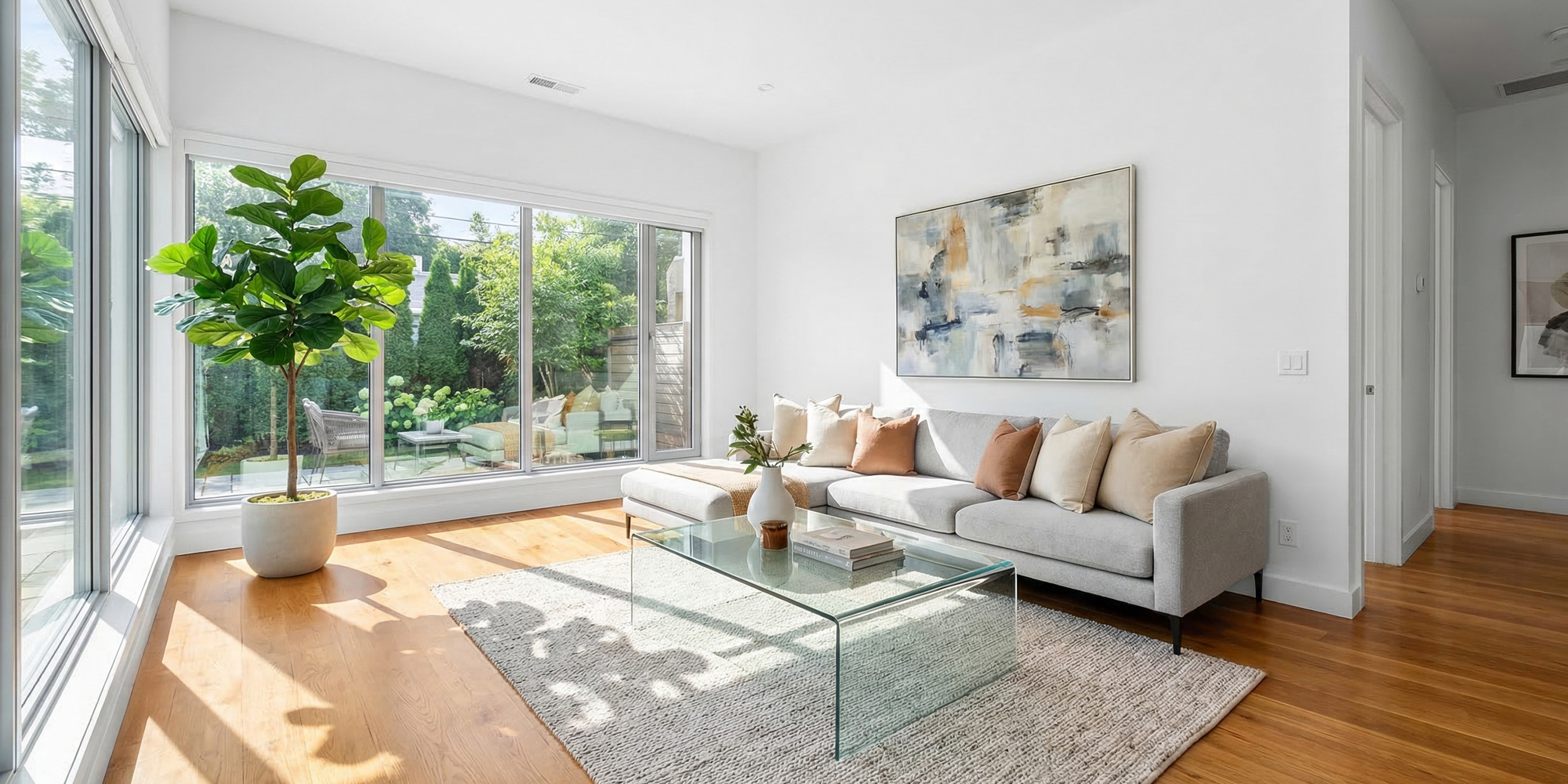
Empty rooms don’t sell houses — stories do. When buyers scroll through listing photos of bare white walls and scuffed hardwood floors, they don’t picture their lives unfolding there. They move on. That’s the vacant listing problem, and it costs agents time, price reductions, and deals that should have closed. In 2026, top-performing agents aren’t leaving this to chance: they’re using AI virtual staging to transform empty spaces into aspirational homes before the listing ever goes live. The results are measurable, the process is fast, and the competitive advantage is real.
Why Vacant Homes Are the Hardest Listings to Sell
A vacant property has two strikes against it before a single buyer walks through the door.
The first is visual failure. Empty rooms look smaller in photos. Without furniture to establish scale, a spacious 15-by-18-foot living room photographs like a broom closet. Buyers comparing your listing to a competitor’s professionally styled home have no choice but to perceive the difference — and they do.
The second is imagination failure. According to NAR’s 2025 Profile of Home Staging, 83% of buyers’ agents reported that staging a home made it easier for prospective buyers to visualize the property as their future home. That visualization step is what converts lookers into motivated buyers. Empty rooms short-circuit it entirely.
The data on buyer behavior backs this up: over 41% of top real estate agents believe vacant homes benefit most from home staging, more than any other property type. Yet traditional physical staging for a vacant home — renting furniture, coordinating movers, managing logistics — costs an average of $2,000 or more according to HomeAdvisor’s national pricing data, and that assumes you’re staging just the key rooms. Full-house staging on a larger vacant property can easily reach $5,000–$10,000 for a single listing cycle.
This is the gap that AI virtual staging was built to close.
The AI Virtual Staging Advantage for Vacant Properties
AI virtual staging does something physical staging cannot: it scales to every listing, every room, every price point, at a cost that makes wholesale adoption practical.
The economics have shifted dramatically. Where physical staging might consume 1–2% of a listing’s value in upfront costs, AI virtual staging tools typically run $15–$50 per image, with subscription models bringing the per-image cost down further at volume. For a five-room vacant property requiring eight to ten listing photos, the total investment with an AI tool like RealEstage.ai can be under $200 — compared to thousands for physical furniture rental.
But cost is only part of the story. The performance data matters more:
- Faster sales: Industry analysis from Coldwell Banker data suggests virtually staged homes spend significantly fewer days on market versus unstaged properties — some analyses showing up to a 20% reduction in time-to-sale.
- Higher online engagement: Virtually staged listings generate approximately 40% more online views than non-staged photos — critical in a market where the first impression happens on a screen, not at the front door.
- Better offers: Staged homes — physical or virtual — consistently correlate with stronger opening offers, since buyers who can visualize themselves in the space arrive at showings with emotional commitment already established.
For vacant listings specifically, the lift from virtual staging is proportionally larger because the baseline — empty rooms — is so visually disadvantaged to begin with.
How AI Virtual Staging Works: A Room-by-Room Walkthrough
The mechanics of AI virtual staging have matured significantly. Current platforms use generative AI models trained on millions of interior design images to place contextually appropriate furniture, lighting, and décor into room photos with photorealistic results.
Here’s the practical workflow for a vacant listing:
Step 1: Photograph the Empty Rooms First
This seems counterintuitive, but it’s the correct sequence. Have your photographer shoot the vacant property as-is, with professional lighting and proper angles. You want clean, well-exposed images of each room. AI staging works from these as the base layer — the architecture, flooring, windows, and wall angles must be clearly captured.
Key rooms to prioritize: living room, primary bedroom, dining room, and kitchen. According to the NAR 2025 staging data, these four rooms are staged most frequently because they drive the highest buyer emotional response. The living room alone was staged in 91% of cases, with the primary bedroom at 83% and dining room at 69%.
Step 2: Select Your Style Profile
AI staging platforms offer style libraries — Modern Farmhouse, Scandinavian Minimal, Mid-Century Modern, Coastal, Traditional, and others. Your selection should be calibrated to the buyer demographic most likely to tour this property. A downtown condo targets a different aesthetic than a four-bedroom suburban colonial.
AI virtual staging platforms like RealEstage.ai allow you to preview multiple style options before committing, which is useful for client-facing listing presentations where the seller wants input on how their home will be marketed.
Step 3: Generate and Review Staged Images
Upload your empty room photos, select your style, and run the staging generation. Processing time on current AI platforms ranges from seconds to a few minutes per image. Review the output critically:
- Does the furniture placement respect the room’s natural flow?
- Are proportions accurate — does a sectional sofa look correctly sized for the space?
- Are wall colors and flooring tones consistent with the actual property?
- Is the overall result believably photorealistic, or does it have artifacts that would signal manipulation to a discerning buyer?
High-quality AI staging should pass a casual buyer’s inspection. If something looks “off,” regenerate or adjust the prompt parameters before finalizing.
Step 4: Apply Disclosure Best Practices
Virtual staging requires disclosure in most markets, and transparency is non-negotiable. Standard practice is to label virtually staged images clearly in the MLS photo caption (e.g., “Photo virtually staged for illustrative purposes”) and to keep at least one unedited photo of each staged room in the listing gallery. Some MLSs now enforce this with automatic flagging — understand your local rules before publishing.
This disclosure step protects your license and your clients. It also protects buyer trust, which is a long-term brand asset no agent should compromise for a shortcut.
Room Prioritization: Where Virtual Staging Delivers the Highest ROI
Not every room has equal conversion weight. If you’re working within a tight per-listing budget, prioritize in this order:
1. Living Room: The anchor of the listing narrative. Buyers form their first interior impression here, and it anchors their mental model of the entire home. A well-staged living room elevates their perception of every room that follows.
2. Primary Bedroom: The room buyers care most about for themselves personally. Empty bedrooms feel transactional; staged bedrooms feel like a sanctuary. The difference in buyer engagement is significant.
3. Dining Room: Particularly powerful for family-oriented buyers. A properly staged dining area activates aspirational thinking about hosting, holidays, and daily life in the home.
4. Kitchen Styling (where applicable): AI staging can add décor elements, lighting improvements, and table arrangements to kitchen eating areas even when the cabinetry itself isn’t being altered.
5. Primary Bathroom: If the bathroom is already well-finished, light AI staging touches — towels, accent pieces, vanity styling — can add polish without overcomplicating the scene.
For agents using a platform like RealEstage.ai’s AI-powered staging workflow, staging a full vacant property across these five room types typically takes less than an hour from photo upload to final export — a timeline that would be measured in days with physical staging logistics.
Integrating AI Virtual Staging Into Your Pre-Listing System
The agents extracting the most value from AI virtual staging aren’t treating it as a one-off tool — they’re building it into a systematic pre-listing workflow.
Here’s what a high-performance pre-listing system looks like with AI staging embedded:
Day of Photography: Photographer shoots vacant property. Images are delivered same-day or next morning.
Staging Day (Day 1–2): Upload all empty room photos to your AI staging platform. Generate primary style option. Export finalized staged images.
Listing Prep (Day 2–3): Load staged images into MLS with proper disclosure language. Stage images lead the gallery. At least one raw photo per room included at the end. Staged images used in all digital marketing materials — social, email campaigns, listing website.
Agent Advantage: You go to market with a visually complete listing, typically within 48–72 hours of photography. Competitors with vacant listings either delay (waiting for physical staging) or go live with bare-room photos that perform poorly.
This systematic approach is why many high-volume agents now view their virtual staging tools for real estate listings as a core infrastructure investment rather than an optional line item. It’s not about whether you can afford to stage vacant listings — it’s about whether you can afford not to.
Choosing the Right AI Virtual Staging Platform in 2026
The market now includes a range of tools at different price points and capability levels. When evaluating platforms, prioritize these criteria:
Photorealism quality: The output must hold up to buyer scrutiny. Test with your actual listing photos before committing to a platform for client work.
Style range: Your buyer demographics vary by listing. You need access to multiple credible design aesthetics, not just one default template.
Turnaround speed: For active listing workflows, speed matters. Platforms that return results in under 10 minutes per room keep your pre-listing timeline intact.
Disclosure-ready output: Some platforms include watermark or labeling features that make compliance easier. This is a practical operational advantage.
Batch processing: For multi-room vacant properties, the ability to queue and process multiple images simultaneously cuts preparation time significantly.
Price structure: Understand whether the platform prices per image, per project, or per subscription. At scale, subscription models with generous credits typically offer better unit economics.
The Seller Conversation: Making the Case for AI Staging
When presenting to a prospective seller with a vacant property, address staging directly and early. Sellers who’ve received poor feedback from buyers on a prior vacant listing are often receptive. Those listing a vacant investment property or recently relocated home may not have considered it at all.
The framing that works: “Every buyer who sees your listing online forms a first impression before they ever contact us. Empty rooms make that impression neutral at best, negative at worst. Virtual staging costs a fraction of physical staging and gives your home every advantage in those critical first moments.”
Bring actual before/after comparisons from prior listings — the visual contrast is more persuasive than any statistic. If you’re using an AI-powered staging platform consistently across your listings, that’s a concrete differentiator to include in your listing presentation as a value-add service you provide at no additional cost to the seller.
What to Expect at the Other End
Agents who’ve built AI virtual staging into their vacant listing workflow consistently report the same outcomes: more online inquiries, higher showing-to-offer conversion, and faster time-to-contract. The mechanics are simple: better photos drive more clicks, more clicks drive more showings, better-prepared buyers make stronger offers.
The spring 2026 market is highly visual and highly competitive. Buyers have absorbed years of HGTV, design influencer content, and polished listing photography. Their baseline expectation for what a listing should look like has never been higher. Meeting that expectation on a vacant property — where every competing non-staged listing falls short by default — is a straightforward competitive advantage.
The empty room is the problem. AI virtual staging is the solution. The agents who’ve made the workflow systematic aren’t just selling vacant homes faster — they’re winning more vacant listing appointments in the first place, because sellers can see the difference before they sign.
Related Articles
- Virtual Staging vs. Traditional Staging: Cost, ROI, and What the Data Shows
- AI Virtual Staging for Your Listing Presentation: How to Win More Sellers
- Virtual Staging Disclosure and Compliance: The Complete Agent Guide
- Spring 2026 Listing Season: How AI Virtual Staging Helps Agents Scale
- AI Virtual Staging for Investment Properties: The 2026 Investor’s Guide
- The Property Presentation Scorecard: AI Staging Listing Checklist