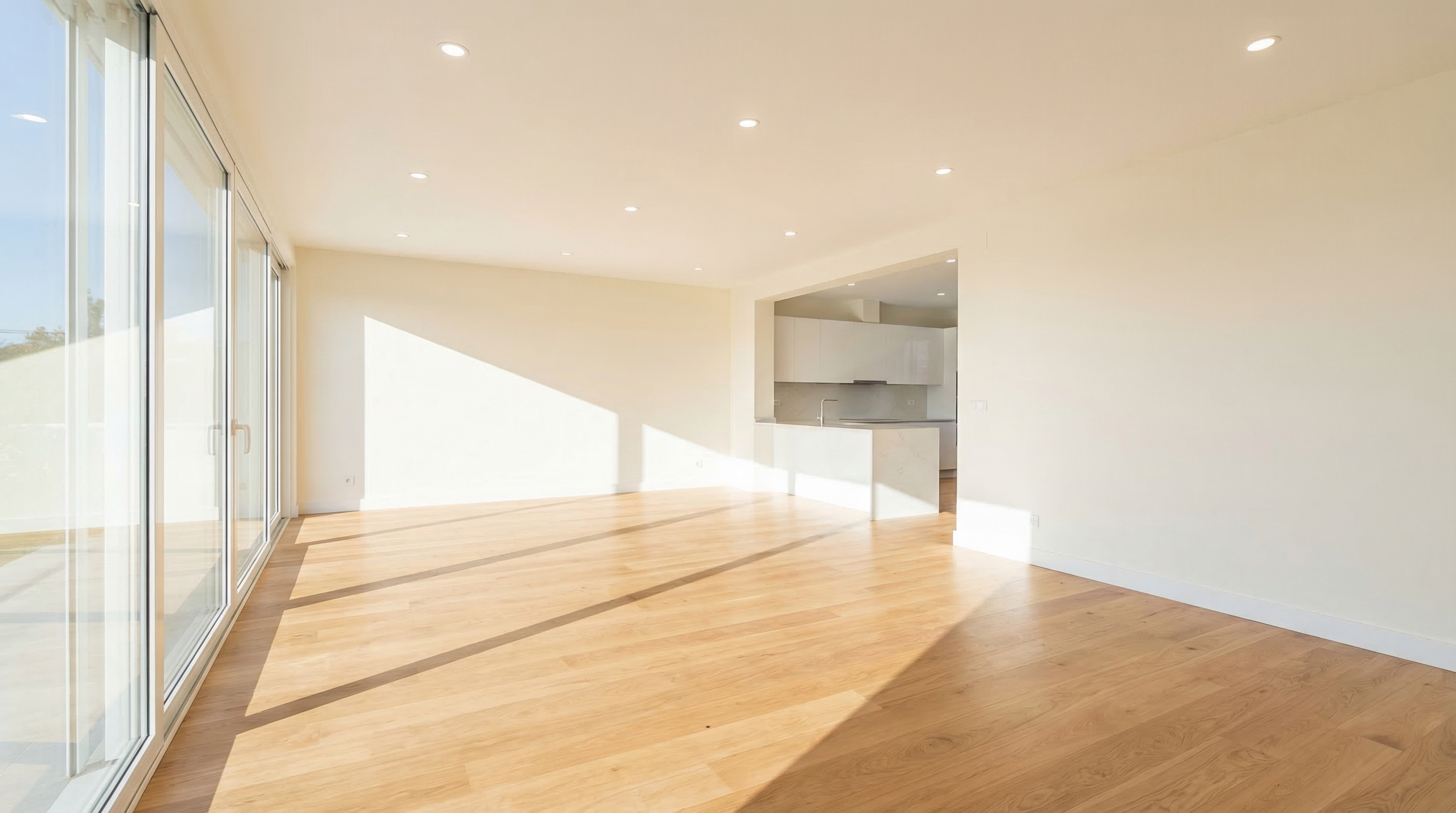
Every vacant investment property is a ticking clock. Mortgage payments, property taxes, insurance, and utilities accumulate whether the unit is generating income or not. For a fix-and-flip investor or a landlord marketing multiple vacant units, the holding cost isn’t an abstraction — it’s a direct line item eroding your return. The faster a property sells or leases, the more of that margin you keep. AI virtual staging has emerged as the most cost-effective tool in the investor’s arsenal to compress that timeline, and the data supporting it has never been stronger.
The Investment Property Marketing Problem
Investment properties present a specific and underappreciated marketing challenge. Unlike an occupied primary residence — where sellers’ furnishings, art, and personal warmth can be strategically leveraged — investment properties are typically vacant, stripped, or freshly renovated with bare walls and empty rooms. They photograph as cold, dimensionless boxes that give online buyers nothing to anchor their imagination to.
This matters because the listing photo is now the property. According to the National Association of Realtors’ 2025 Profile of Home Buyers and Sellers, 88% of buyers purchased their home through an agent or broker, but the search process overwhelmingly begins online. Buyers are making split-second decisions about which properties deserve a showing — and empty rooms consistently underperform in that digital beauty contest.
For investors working high-volume flips or managing multiple rental units, the problem compounds. Traditional staging requires renting furniture, coordinating delivery schedules, and paying stagers for each unit. When you’re running five properties simultaneously, the logistics become unworkable and the cost becomes prohibitive.
Why Traditional Staging Fails the Investor Math
Traditional home staging is designed around the primary residence seller: one property, a motivated homeowner willing to invest $2,000–$10,000 to maximize a single transaction. For investors, that model breaks down in three specific ways.
Cost per unit. A full traditional staging package for a 1,500 sq ft investment property typically runs $1,500–$4,000, depending on the market and the number of rooms. For a portfolio investor running three to five active listings simultaneously, that’s $5,000–$20,000 in staging costs alone — before photography, MLS fees, or carrying costs.
Speed. Traditional staging requires physical furniture to be selected, transported, and installed. In hot markets, a two-week staging lead time can cost you your buyer. Investors competing in high-turnover environments simply cannot afford a slow listing launch.
Scalability. The whole model requires physical presence. You cannot stage a property remotely, you cannot stage ten properties in the same week from a laptop, and you cannot iterate on staging choices after photographs are taken. Traditional staging is a one-shot, high-cost operation with no flexibility.
Florida Realtors reported in 2025 that virtual staging cuts costs by up to 97% compared to traditional staging. For investors, that isn’t just a marketing efficiency — it changes the ROI calculation of every deal.
AI Virtual Staging: The Investor’s Competitive Edge
The core value proposition for investment-focused use is different from consumer real estate. For primary residence sellers, AI staging is about emotional resonance and presentation quality. For investors, it’s about speed, cost structure, and scalability across a portfolio.
Platforms like RealEstage.ai are built precisely for this. Upload raw photos of a vacant unit — freshly renovated, mid-renovation, or bare — and receive professionally staged images within minutes. The turnaround from listing decision to MLS-ready photos collapses from days to hours, and the cost per image is a small fraction of what a physical staging crew would charge.
The downstream effects on investor returns are measurable. Research compiled by the Home Staging Institute shows that staged homes — including virtually staged properties — sell up to 73% faster than unstaged equivalents. In terms of investor economics, a 73% reduction in days-on-market isn’t a marketing vanity metric. It’s weeks of carrying costs you don’t pay.
On the offer-price side, NAR’s 2025 Profile of Home Staging found that 29% of agents reported staging led to a 1–10% increase in the dollar value offered, and 49% observed that staging reduced time on market. For a $350,000 flip, even a 3% price improvement from staging nets $10,500 — against a virtual staging cost of $150–$300 for the entire property.
Staging Strategies by Investment Property Type
Not every investment property presents the same marketing challenge. The staging approach needs to match the property type, target buyer, and market positioning.
Fix-and-Flip Residential
Flips are the highest-stakes use case for AI staging. The investor has capital tied up, carrying costs running, and a compressed exit timeline. The goal is a fast, competitive offer at or above list price.
For flips, prioritize staging the living room, primary bedroom, and kitchen — the three rooms NAR identifies as most important to buyers. A freshly renovated flip with modern finishes stages exceptionally well with AI tools because the blank canvas allows the AI to introduce contemporary furnishings without competing with dated décor.
Stage the property before scheduling the photographer, not after. Use the staged images as the primary listing photos, with original vacant-room shots included separately for compliance.
Multi-Family and Condo Units
Multi-family investors face a unique challenge: multiple nearly identical units that need to be differentiated in the market. AI staging platforms let you apply different style packages to each unit — Scandinavian minimalist in one, warm transitional in another — giving each listing its own visual identity without additional physical staging costs.
For condo sellers, the primary selling challenge is helping buyers visualize how furniture fits within the floor plan. AI staging solves this directly, and tools like RealEstage.ai’s virtual staging platform can apply furniture arrangements scaled precisely to the room’s square footage, making spatial relationships immediately clear.
Long-Term Rental Properties
Landlords marketing vacant rental units face a different version of the same problem. Prospective tenants apply the same visual filtering to rental listings that buyers apply to purchase listings. Empty apartments attract fewer inquiries, take longer to lease, and often rent for less than comparably staged units.
For rental properties, the staging approach should skew toward the target tenant demographic. A luxury urban apartment near financial districts should be staged with sophisticated, clean-lined furniture and neutral palettes. A family-oriented suburban rental benefits from warm, lived-in furnishings that signal function and comfort. AI staging platforms allow this style targeting at minimal incremental cost per unit.
Building a Cost Model for Your Portfolio
The ROI calculation for AI virtual staging in an investment context is straightforward. The key variables are holding cost per day, expected reduction in days-on-market, and the staging cost itself.
Consider a typical residential flip with the following profile:
- Purchase price: $280,000
- Renovation: $45,000
- List price: $385,000
- Carrying costs: $2,400/month (mortgage, taxes, insurance, utilities)
- Days-on-market without staging: 45 days
- Days-on-market with AI staging: estimated 28–32 days (based on industry data)
At $80/day in carrying costs, reducing the holding period by 14 days saves $1,120. The AI staging cost for five rooms — living room, primary bedroom, secondary bedroom, kitchen, and dining area — runs approximately $75–$150 depending on the platform. The net carrying-cost savings alone more than pay for the staging, before any consideration of the price improvement that staged properties typically command.
For investors managing five or more active listings, this math scales directly. The per-unit staging cost drops as you develop workflow efficiency, and the aggregate holding-cost savings compound across the portfolio.
Workflow: From Vacant Property to MLS-Ready in Under 24 Hours
The operational advantage of AI staging becomes clearest when you map the workflow against the traditional alternative.
Step 1 — Photography. Schedule a professional photographer immediately after renovation completion. Vacant-room photos are faster and cheaper to shoot than occupied ones — the photographer doesn’t need to work around furniture. A 1,500 sq ft property takes approximately 45–60 minutes to photograph.
Step 2 — AI staging. Upload the raw photos to an AI virtual staging platform like RealEstage.ai. Select the design style that matches your target buyer profile and the property’s finishes. For a modern flip with white oak floors and quartz countertops, a contemporary or transitional style will read most naturally. Processing typically takes 15–30 minutes per room.
Step 3 — Review and iterate. Review the staged outputs. If a furniture arrangement doesn’t complement the room’s proportions or the style reads off, you can regenerate. This iteration cycle costs nothing beyond the initial platform cost and takes minutes — not the days it takes to physically restage a room.
Step 4 — MLS upload. Lead the listing with your best staged images. Include the original vacant-room photos in the disclosure section or as supplemental images per your MLS rules and applicable state disclosure requirements.
Step 5 — Monitor and adjust. If your listing isn’t generating showing requests within the first five to seven days, evaluate your staging choices. A different style or a lead photo swap can be executed in under an hour without returning to the property.
Selecting the Right AI Staging Platform for Investment Volume
Not all AI staging tools are built for high-volume investor use. The key features to evaluate when selecting a platform for portfolio-scale work are: batch processing capability, style consistency across multiple rooms, turnaround time, and pricing structure.
Pricing models matter specifically for investors. Some platforms charge per image, others per project, others via subscription tiers. For investors processing three to five properties per month, a subscription tier with a generous monthly image allowance will almost always offer better unit economics than pay-per-image pricing. Platforms offering dedicated AI staging tools for real estate professionals with portfolio-oriented workflows are worth prioritizing over consumer-grade tools designed for occasional use.
Style library depth also matters at scale. If you’re staging multiple listings simultaneously for different market segments — a downtown condo, a suburban flip, a multi-family unit — you need a platform with enough distinct style packages to differentiate each property appropriately. Applying the same aesthetic to every unit undermines the purpose.
The Disclosure Layer
Investors should approach virtual staging disclosure with the same diligence as any other listing compliance issue. Several states, including California under Assembly Bill 723, which took effect January 1, 2026, now require that digitally altered listing images be labeled as such. MLS rules in most major markets have adopted similar requirements.
The practical workflow is simple: lead with your AI-staged photos for marketing impact, include the original vacant-room photos, and label the staged images clearly per your MLS requirements. Transparency builds buyer trust and eliminates any downstream dispute risk. It also protects your agent relationship — buyers who arrive at a showing expecting furnished rooms and find empty ones are not buyers who submit offers.
The Bottom Line for Investors
Holding costs are the enemy of investor returns. Every tool that compresses your days-on-market without consuming margin is worth serious evaluation. AI virtual staging sits at the intersection of cost efficiency, marketing performance, and operational scalability in a way that no physical alternative can match.
The data is consistent across sources: staged properties sell faster, attract more serious buyers, and command stronger offers. Virtual staging delivers those outcomes at a fraction of the cost of traditional methods — and at a speed that matches the pace of active investment operations. For investors still relying on empty-room photography or paying for physical staging on every unit, the math on switching is not complicated.
A platform like RealEstage.ai lets you stage a full five-room property in under two hours, for less than the cost of a single day’s holding expenses. Run that math across your portfolio, and the adoption decision becomes straightforward.
Related Articles
- The ROI of Virtual Staging: What the Data Actually Says
- Virtual Staging vs. Traditional Staging: Cost and ROI Guide for 2026
- Virtual Staging Cost and Pricing Guide for 2026
- AI Virtual Staging ROI: A Complete Guide for Real Estate Agents
- AI Staging Software 2026 Buyer’s Guide for Real Estate Agents
- Virtual Staging Room-by-Room: The Complete 2026 Guide