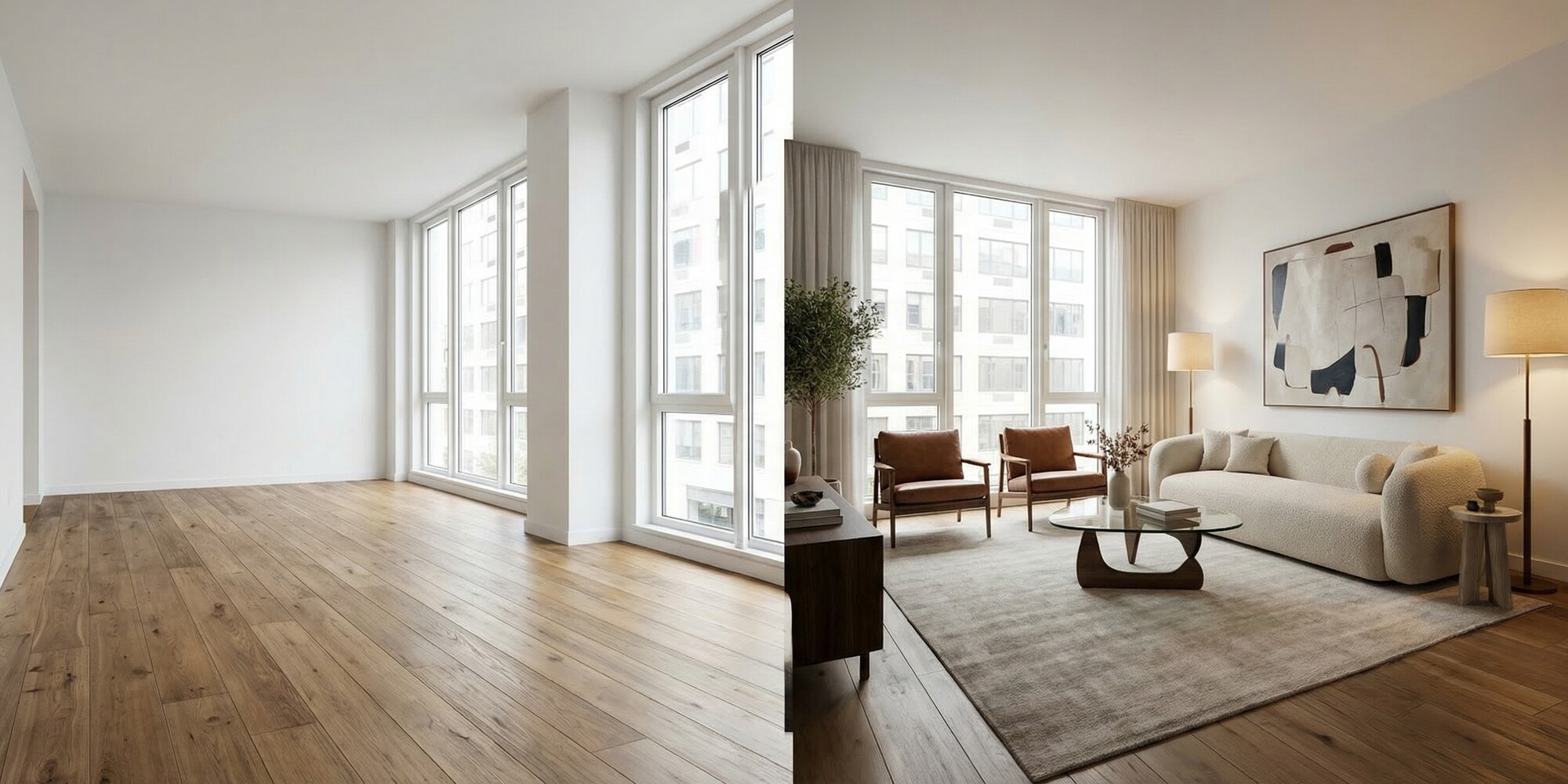
The modern homebuyer makes a decision before they ever open a front door. According to the National Association of Realtors® 2024 Profile of Home Buyers and Sellers, 96% of buyers used the internet at some point in their home search — and a growing share are narrowing their shortlist to three or fewer properties before scheduling a single showing. Your digital listing isn’t a preview of the home. For most buyers, it is the home, until proven otherwise.
That reality has created a two-part performance gap at the top of the funnel. Agents who’ve adopted 3D virtual tours are pulling ahead on engagement metrics. Agents who’ve integrated AI virtual staging are pulling ahead on emotional connection and offer velocity. But the agents closing at the highest rates in 2026 have discovered something the rest of the market is still figuring out: these two technologies are exponentially more powerful together than either is alone.
Why Virtual Tours Alone Aren’t Enough Anymore
The 3D virtual tour was a genuine breakthrough when it arrived in the mainstream. Platforms like Matterport, iGUIDE, and Zillow 3D Home gave buyers a way to walk through a property without physically being there — a capability that proved essential during the pandemic and became a competitive baseline afterward. According to Matterport’s published platform data, listings with 3D tours receive up to 300% more engagement than those without, and qualified leads from toured listings convert at significantly higher rates.
But there’s a ceiling on what virtual tours can achieve when the underlying space isn’t visually compelling. An empty room — even rendered in immersive 3D — is just an empty room. Buyers clicking through a vacant townhouse or a property with dated furnishings aren’t imagining their lives there. They’re noticing the scuff marks on the baseboard, the popcorn ceiling, the way the layout doesn’t quite make sense without furniture to anchor it. Engagement spikes on the tour. Emotional connection doesn’t.
This is the exact problem that AI virtual staging solves.
What AI Virtual Staging Adds to the Equation
AI virtual staging transforms vacant or poorly furnished spaces into photorealistic, beautifully appointed rooms — at a fraction of the cost and timeline of physical staging. Where traditional staging might run $1,500 to $5,000 or more for a single-family home, AI virtual staging platforms can stage every room in a property for under $100, with same-day or overnight turnaround.
The output isn’t a rough approximation. Modern AI staging generates physically accurate lighting, proportional furniture, and style-coherent design — the kind of images that show up in editorial layouts, not clip art collections. Buyers see a living room styled for how they actually want to live. They see the dining nook framed correctly with a table and chairs. They see the master bedroom as a retreat, not a bare box.
When those staged images are the visual layer that buyers interact with inside a 3D virtual tour, something shifts. The tour stops being a floor-plan validator. It becomes an emotional walkthrough of a home the buyer can picture themselves in.
The Mechanics: How to Stage Before You Tour
The sequencing matters here. To get the full benefit of pairing AI staging with a 3D virtual tour, agents should think about the workflow in this order:
Step 1: Photograph and scan simultaneously. Schedule your professional photographer and virtual tour scanning in the same session. This ensures consistent lighting, staging (if any physical staging is present), and angles between static images and the 3D scan data. Attempting to re-scan after staging changes introduces visual inconsistency that attentive buyers will notice.
Step 2: Stage AI photography assets first. Once photos are in hand, upload them to your AI virtual staging platform for processing. Select a design style appropriate for your target buyer — contemporary for urban condos, transitional for move-up family homes, warm minimal for first-time buyer price points. Turn this around in 24 hours or less; most platforms handle it overnight.
Step 3: Integrate staged images into the tour environment. This is where the workflow gets sophisticated. Some virtual tour platforms — particularly those with embedded image replacement features — allow staged photos to replace the raw scan thumbnails and photo overlays seen inside the tour. Check your tour provider’s capabilities. At minimum, staged images should be the featured photos in the MLS listing and all syndicated portals, so that the buyer’s first impression before entering the tour is already the staged version.
Step 4: Publish the tour link alongside staged MLS photos. Lead with your best staged images. The 3D tour link is the reward — the deeper engagement layer for buyers who are already interested. Treat the staged photos as the hook and the tour as the conversion tool.
The Numbers Behind the Strategy
Industry data consistently supports both halves of this approach. The Real Estate Staging Association (RESA) tracks staging outcomes across thousands of properties and consistently documents that staged homes sell faster and receive offers above list price at a significantly higher rate than comparable unstaged inventory. The National Association of Realtors® 2023 Profile of Home Staging found that 81% of buyers’ agents reported staging helped buyers visualize the property as their future home — the single most valuable conversion outcome in the digital funnel.
Layer in virtual tour performance data and the combined effect compounds. Properties that engage buyers longer at the top of the funnel — which virtual tours demonstrably do — convert at higher rates when the emotional connection is already established. Staging creates that connection. Virtual tours sustain and deepen it.
For agents handling volume — 10, 15, 20 listings or more per year — this combination also changes the economics of your marketing. Physical staging at scale is budget-prohibitive and logistically complex. AI staging tools like RealEstage.ai compress both the cost and the timeline, making it practical to stage every listing you take, not just the premium properties. That uniformity raises your brand standard across the board.
Addressing the “Empty Tour” Problem Directly
One of the most common objections agents hear from sellers about virtual tours is the cost and complexity. Sellers who’ve seen low-effort virtual tours — hastily assembled, poorly lit, walking through unfurnished rooms — are skeptical of the format. They associate it with a lower tier of marketing, not a premium one.
The most effective way to overcome that objection is to show them the combination in action before the listing appointment ends. With AI virtual staging, you can arrive at a pre-listing consultation with before-and-after examples of comparable properties — rooms that look exactly like theirs, transformed into showcase-ready spaces. When sellers see that visual proof alongside a 3D tour example, the conversation changes from “is this worth it?” to “when can we start?”
This is also where the AI staging preview becomes a listing-winning tool in competitive appointment situations. Showing a seller what their home will look like — digitally, professionally staged — while competing agents are still pitching comps and commission rates is a category of differentiation that’s difficult to argue against.
Choosing the Right Tools
Not all virtual tour platforms integrate equally well with AI staging workflows. Here’s how to think about the technology stack:
For virtual tours, the major platforms — Matterport, iGUIDE, and Zillow 3D Home — each offer different levels of photo overlay and integration flexibility. Matterport’s pro-tier plans support custom photo replacement within the tour environment, which is the cleanest implementation for pre-staged visuals. iGUIDE offers strong MLS embed compatibility. Zillow 3D Home is free and fast, but integration with custom staging is more limited.
For AI virtual staging, the differentiators are image quality, design style library, turnaround time, and per-room pricing. For most agents running 10+ listings per year, it’s worth establishing a go-to platform with predictable quality rather than shopping per-listing. RealEstage.ai offers the style depth and photorealistic output quality that holds up inside both static MLS galleries and the embedded photo layers of a virtual tour — which is a higher visual bar than staging for static images alone.
For MLS and portal syndication, ensure your staged images are marked appropriately per your MLS disclosure requirements for virtual staging. This is a non-negotiable compliance step; the National Association of Realtors® Code of Ethics and most MLS rules require disclosure when images have been digitally altered. Standard MLS remarks language (“Some photos have been virtually staged”) satisfies this requirement in nearly every market.
Making It Part of Every Listing
The agents who get the most leverage from this strategy aren’t the ones who deploy it selectively on premium listings. They’re the ones who’ve systematized it as the default. Every listing gets professional photography. Every listing gets AI staging for key rooms — living room, primary bedroom, kitchen/dining. Every listing gets a 3D virtual tour. The per-listing cost delta is minimal when AI staging is in the workflow; the competitive delta in the market is significant.
If you’re handling vacant properties, this combination is table stakes in most markets now. Buyers browsing your listing against a competing property that offers an immersive, staged virtual walkthrough will click away if your listing presents empty rooms in a flat photo gallery. The visual standard has moved, and the tools to meet it have never been more accessible.
The technology stack that used to require a dedicated marketing team and a five-figure listing budget now fits in a single-agent workflow, with same-day turnaround and pricing that makes every property worth the investment.
That’s not a trend. That’s a structural shift in how real estate gets sold online — and the agents who’ve embedded it into their standard practice are the ones writing the case studies everyone else will be reading next year.
Related Articles
- Buyer Psychology and Virtual Staging: How Staged Photos Drive Faster Sales in 2026
- Virtual Staging for Vacant Listings: The Complete Agent Guide for 2026
- The 24-Hour Listing Launch: AI Virtual Staging Prep That Gets Offers Fast
- AI Virtual Staging vs. Traditional Staging: Cost, ROI, and Results Guide 2026
- Spring 2026 Listing Season: How AI Virtual Staging Helps Agents Scale
- Real Estate Agent Productivity: The AI Listing System That Handles More Volume