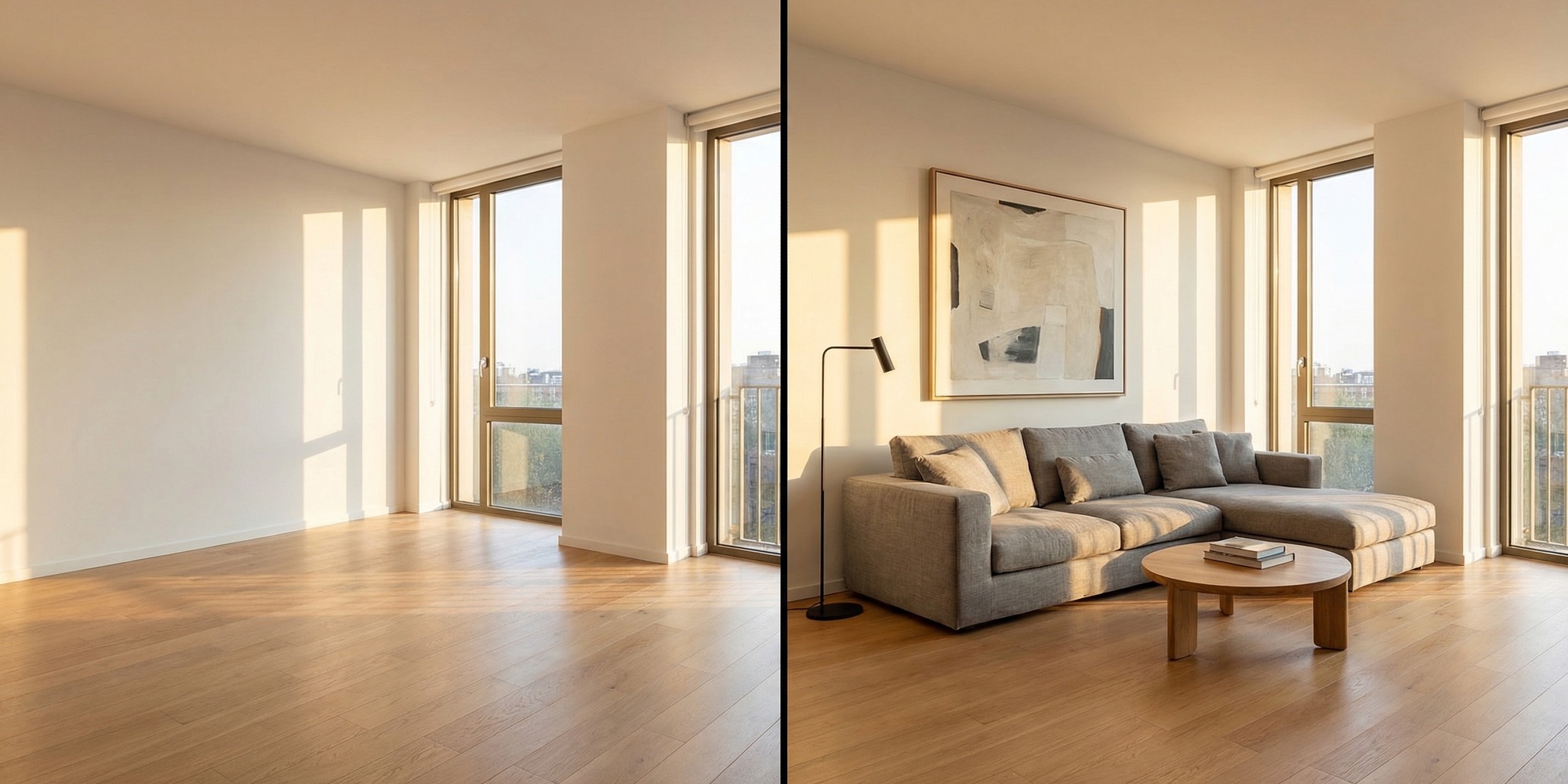
Every agent eventually confronts the same decision before a listing goes live: stage the property or skip it. The data in 2026 makes skipping it nearly indefensible — staged homes sell in an average of 23 days compared to 47 days for non-staged properties, a 51% reduction in time on market, according to a 2025 analysis of over 2,800 real estate transactions. The more nuanced question — the one that determines both your client’s net proceeds and your own operating margin — is which type of staging delivers the best return for a given listing.
Traditional home staging and AI-powered virtual staging are not interchangeable tools. They serve different situations, carry vastly different cost structures, and produce different results depending on property type, price point, and buyer demographics. This guide breaks down the real numbers behind both approaches so you can make the right recommendation every time.
The Business Case for Staging: What the 2025–2026 Data Shows
Before comparing methods, the foundational argument needs establishing. Staging skeptics — agents who believe great photography alone is sufficient — are increasingly at odds with buyer behavior data.
The National Association of Realtors’ 2025 Profile of Home Staging found that 29% of sellers’ agents reported staging led to a 1% to 10% increase in the dollar value offered. Nearly half — 49% — observed that staging reduced time on market. And 83% of buyers’ agents confirmed that staging made it easier for buyers to envision the property as their future home.
That last data point matters most for conversion. Buyers who can’t mentally occupy a space rarely make competitive offers. Staging — whether physical or virtual — bridges that cognitive gap.
The performance metrics from recent transaction data underscore the commercial argument:
- Days on market: 23 days (staged) vs. 47 days (non-staged)
- Sale-to-list price ratio: 98.7% (staged) vs. 94.2% (non-staged)
- Properties selling above list: 34% (staged) vs. 12% (non-staged)
- Weekly buyer showing requests: 8.3 (staged) vs. 3.1 (non-staged)
- Average staging ROI: 312%
With numbers like these, the question isn’t whether to stage. It’s how to stage efficiently and profitably.
Traditional Home Staging: True Costs and What You’re Buying
Traditional staging involves renting physical furniture, art, and décor and having professional stagers place it throughout the home. The service is comprehensive but expensive, and the cost structure scales sharply with property value.
What Traditional Staging Actually Costs in 2026
Based on industry pricing data across U.S. markets, here’s what agents and sellers can expect to pay:
| Property Value Range | Average Staging Cost | Additional Sale Price | Net ROI |
|---|---|---|---|
| $200k – $350k | $2,800 | $8,200 | 193% |
| $350k – $500k | $4,100 | $14,700 | 259% |
| $500k – $750k | $5,900 | $22,400 | 280% |
| $750k – $1M | $8,200 | $31,600 | 285% |
| $1M+ | $12,500 | $48,900 | 291% |
These figures represent initial placement costs plus typically 30 to 60 days of furniture rental. Extended listings compound the expense — most staging contracts run month-to-month after the initial period, adding $800 to $2,500 per month depending on property size and staging scope.
The Logistical Reality
Traditional staging introduces friction that virtual staging eliminates entirely. A stager must schedule a walkthrough, source appropriate furniture from their inventory, coordinate delivery and installation (typically requiring two to four business days), and maintain the property in showing condition throughout the listing period. Sellers must keep the staged furniture in place, often disrupting their day-to-day occupancy if they’re still living in the home.
The seller also bears the liability. Damaged rental furniture comes out of the staging deposit. Listings that sit longer than anticipated accumulate monthly rental fees that erode the net proceeds the staging was meant to protect.
For vacant properties at entry-level price points — where staging ROI is thinnest and sellers are most cost-sensitive — traditional staging frequently doesn’t pencil out. A $2,800 staging investment on a $280,000 sale represents 1% of gross proceeds before commissions, carrying costs, and closing costs.
AI Virtual Staging in 2026: The Case for the Digital Alternative
AI-powered virtual staging produces photorealistic furnished room images from empty or occupied room photography. The process has matured substantially since early-generation tools produced obviously synthetic results. In 2026, the gap in visual quality between professional virtual staging and physical staging, as it appears in MLS photography, has effectively closed for most property types.
What Virtual Staging Costs
Virtual staging operates on a per-image or per-room basis, with most platforms pricing between $15 and $75 per image depending on quality tier, turnaround time, and volume. A comprehensive staging package covering living room, primary bedroom, kitchen, and two secondary rooms typically runs $75 to $300 total — a fraction of the $2,800 entry point for traditional staging.
Platforms like RealEstage.ai process rooms in under 24 hours and allow agents to select from multiple design styles — modern, transitional, Scandinavian, coastal, and others — so the staging aesthetic can be matched to the buyer profile most likely to purchase in that neighborhood.
The cost-per-listing impact is transformative for agents managing high-volume listings. Traditional staging requires per-listing investment that doesn’t scale; virtual staging costs remain flat regardless of how many listings an agent carries.
Where Virtual Staging Outperforms Traditional
Speed to market. Virtual staging can be completed within 24 hours of receiving photography. There’s no scheduling lag, no installation window, no waiting for inventory availability. Agents can list faster, which matters in markets where days between photography and MLS activation affect listing momentum.
Flexibility. A physically staged home shows only one design aesthetic. Virtual staging allows multiple style variations from the same empty room photograph — showing buyers a modern interpretation and a transitional interpretation of the same space at no additional production cost.
Occupied home capability. Traditional staging of an occupied home requires clearing furniture, a process sellers resist. AI virtual staging can work with existing furnished rooms — decluttering, replacing dated furniture digitally, and presenting the space in its best configuration without requiring sellers to move a single piece.
Scalability. Agents building a consistent listing brand across multiple properties can apply virtual staging uniformly, ensuring visual consistency that physical staging — dependent on whatever inventory the stager has available — rarely achieves.
Head-to-Head: Where Each Method Wins
This is not a binary either/or decision. Understanding which situations favor each approach is what separates agents who use staging strategically from those who apply it reflexively.
Traditional Staging Wins When:
The property is high-value and in-person showings are critical. Buyers touring a $1.2 million home expect to walk through a property that feels lived-in and aspirational. Photographs alone, however well-staged virtually, don’t replicate the sensory experience of a beautifully staged physical space during an in-person showing.
The seller has budget and timeline. When a seller is motivated, well-capitalized, and willing to invest, traditional staging maximizes in-person presentation. The NAR data consistently shows buyers make decisions based on how a home feels in person, not just how it photographs.
The property is vacant at a premium price point. Empty rooms at $800k+ carry perceptual risk that even excellent virtual photography can’t fully mitigate for buyers who tour in person.
Virtual Staging Wins When:
The listing is entry-level or mid-market. Staging ROI is thinnest in the $200k–$350k range, and seller margins are tightest. Virtual staging delivers comparable online engagement at 5–10% of traditional staging cost.
The property needs to go live quickly. In competitive markets, days matter. Virtual staging eliminates the multi-day installation window and allows agents to move directly from photography session to MLS activation.
The property is occupied. AI virtual staging platforms can digitally transform cluttered, dated, or mismatched interiors without requiring sellers to vacate, declutter, or rent furniture.
The agent is managing volume. Agents with 10+ active listings cannot absorb traditional staging costs across their portfolio. Virtual staging maintains presentation standards at scalable cost.
The Hybrid Approach: How Top Producers Use Both
The most sophisticated agents don’t choose one method over the other — they use virtual staging as the baseline and layer in traditional staging selectively for listings where the investment calculus supports it.
A practical framework:
- All listings: AI virtual staging for MLS photos, syndication feeds, and digital marketing
- Mid-tier listings ($350k–$750k): Evaluate traditional staging for primary living areas only (living room, kitchen, primary bedroom), reducing staging cost by 40–60% versus full-home staging
- Premium listings ($750k+): Full traditional staging for in-person showing experience, supplemented by virtual staging for rooms that staging budget doesn’t cover
This framework ensures every listing goes to market with polished visual presentation regardless of budget, while reserving traditional staging investment for situations where it delivers maximum return.
Building a Virtual Staging Workflow That Actually Converts
The agents extracting the most value from virtual staging have systematized the process into a repeatable listing workflow. Here’s how it typically looks:
Step 1: Photography First
Commission a professional photographer before staging decisions are finalized. Empty room photography is clean, gives AI systems maximum flexibility, and avoids the constraints of working around existing furniture.
Step 2: Define Your Buyer Profile
Select staging style based on the likely buyer for that property and neighborhood. A coastal contemporary aesthetic works in beachside communities; transitional staging performs better in established suburban neighborhoods where buyers skew 40+. Platforms like RealEstage.ai offer multiple design style options so this matching can happen before a single image is processed.
Step 3: Stage Key Rooms Strategically
NAR data shows buyers’ agents rank room importance as follows: living room (37% most important), primary bedroom (34%), kitchen (23%). Not every room requires staging. Focus AI staging resources on the three rooms that drive buyer decisions, then supplement with clean, well-lit photography for secondary spaces.
Step 4: Deliver Before and After Versions
Providing both the empty room and the virtually staged version in your MLS listing builds trust with buyers who’ve developed healthy skepticism about AI-generated images. Disclosing that images are virtually staged — as many MLSs now require — and showing the actual empty room alongside the staged version demonstrates transparency while still delivering the emotional impact of a furnished presentation.
Step 5: Repurpose Staged Images Across Channels
Virtual staging images don’t expire when the listing sells. Agents can use staged room images in listing presentations, social media content, market reports, and buyer-facing materials indefinitely. Traditional staging photography is listing-specific and depreciates the moment the furniture is removed.
The ROI Calculation Your Sellers Need to See
Sellers often resist staging costs without context. The calculation that consistently moves reluctant sellers:
Traditional staging scenario ($450k home):
- Staging cost: $4,100
- Expected sale price uplift (per data): $14,700
- Net benefit after staging cost: $10,600
AI virtual staging scenario ($450k home):
- Staging cost: $150–$250 for full property coverage
- Online engagement improvement: equivalent click-through and showing request rates
- Net benefit: listing performs comparably online at 95%+ cost savings
For listings where in-person showing experience is critical, traditional staging justifies its cost at mid-to-upper price points. For everything else — the majority of residential listings — AI virtual staging through a platform like RealEstage.ai delivers the core value proposition of staging at a cost that makes economic sense at every price point.
What This Means for Your 2026 Listing Strategy
Staging is no longer optional. The data on buyer behavior, days on market, and sale-price performance has made staged listings the expectation, not the exception. But the staging method — traditional, virtual, or hybrid — should be a deliberate strategic decision driven by property type, price point, seller budget, and timeline.
The agents who win listing presentations in 2026 are the ones who can explain this framework to sellers with clarity and confidence. They’re not recommending staging as a default upsell — they’re delivering a data-backed recommendation that demonstrates professional competence and protects seller net proceeds.
Virtual staging has eliminated the cost objection that kept entry-to-mid-market listings from staging entirely. That’s the real story behind the 2026 numbers. The ceiling on staging adoption was always cost, not conviction. AI has removed that ceiling.
Related Articles
- The Hidden Cost of Vacant Home Listings — And How AI Virtual Staging Eliminates It
- The Real ROI of AI Virtual Staging: An Agent’s Data Guide for 2026
- AI Virtual Staging vs. Price Reduction: What the Data Says About Listing Strategy
- AI Virtual Staging for Occupied Homes: A Practical Listing Strategy for 2026
- AI Listing Optimization and Virtual Staging: The Agent ROI Framework for 2026
- The 10-Point Property Presentation Scorecard: How to Grade — and Fix — Any Listing Before It Goes Live