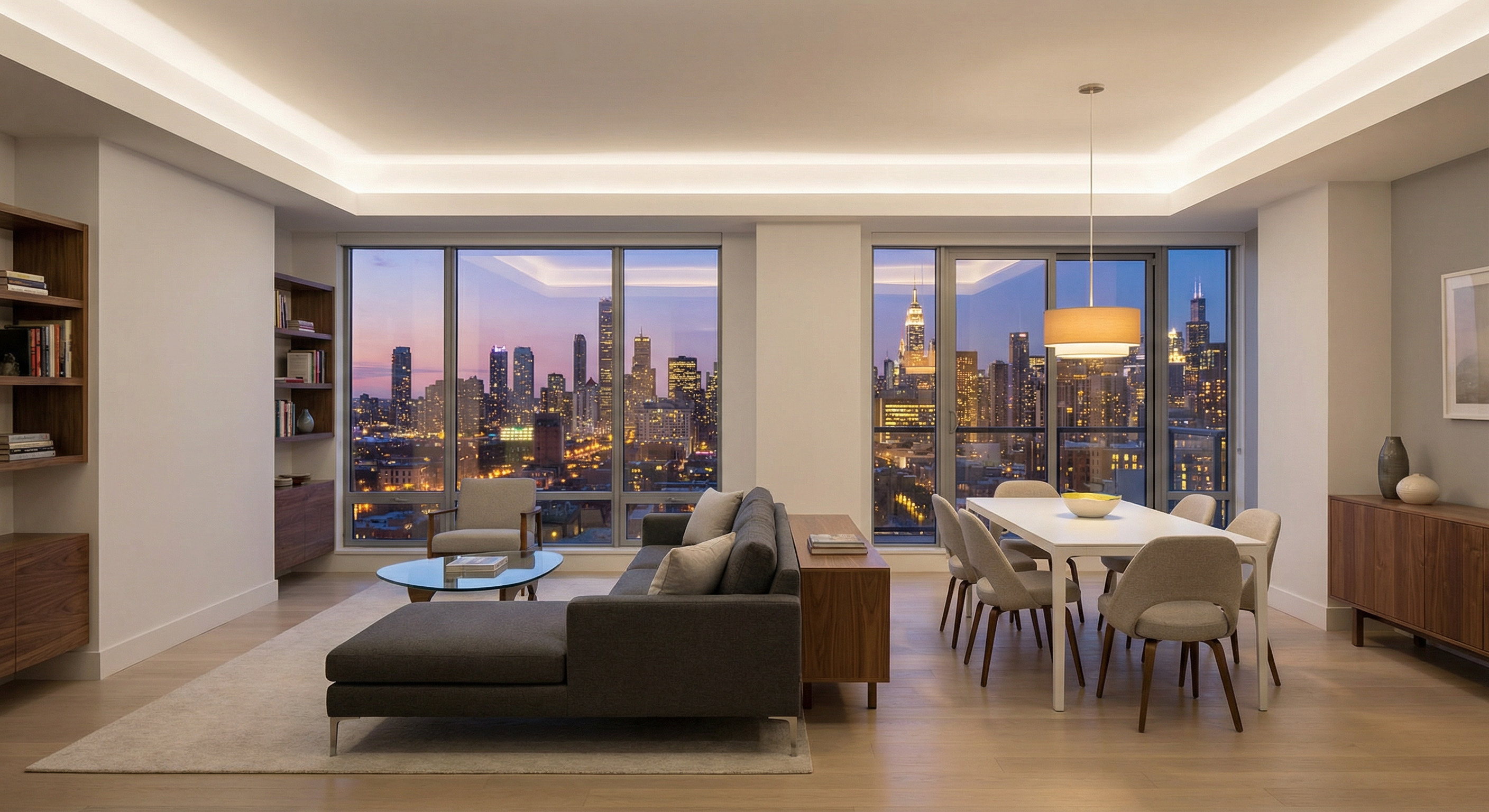
Condos are the property type that breaks traditional staging. The logistics alone — elevator access windows, HOA restrictions on crew hours, storage limitations, and the challenge of making 750 square feet look inviting to buyers who can only see photos — mean that physical staging is often impractical, expensive, or flat-out impossible. And yet, the stakes have never been higher: according to NAR research, 81% of buyers’ agents say staging makes it easier for buyers to visualize a property as their future home. For condo listings where empty rooms can feel claustrophobic and cold, that visualization gap is the difference between an offer and a pass.
AI virtual staging closes that gap completely. For a fraction of the cost of physical staging and with none of the logistical headaches, agents can now deliver fully furnished, photorealistic condo interiors that connect with urban buyers before they ever walk through the door. Here’s what every agent working condo and multi-unit listings needs to understand in 2026.
Why Condos Are the Hardest Property Type to Stage
Walk a traditional staging crew into a single-family home and the logistics are manageable: a driveway for the truck, flexible timing, and usually enough square footage to create multiple distinct rooms. Walk that same crew into a 12th-floor condo and every one of those assumptions falls apart.
HOAs frequently restrict move-in hours to a narrow window — often 9 AM to 5 PM on weekdays only — meaning staging crews are competing with elevator access alongside residents. Building management may require certificates of insurance before any vendors set foot in common areas. Storage on-site is typically nonexistent, so every piece of furniture must be trucked in and out each time a showing is scheduled. In high-rise buildings, elevator capacity limits mean a full staging crew can take an entire morning just moving furniture between floors.
The cost reflects those challenges. A professional staging package for a two-bedroom condo in a major metro market typically runs $1,500 to $4,000 for the initial setup, with monthly rental fees of $500 to $1,200 to keep the furniture in place through the listing period. For a condo priced at $350,000, that’s a meaningful percentage of the commission being absorbed before the listing even goes live.
Then there’s the square footage problem. Smaller rooms are less forgiving of staging missteps than large homes. An oversized sofa, the wrong rug size, or furniture that crowds the flow creates photos that make already-compact spaces feel even smaller. Traditional staging is an art that requires physical iteration — moving pieces, testing arrangements, adjusting until the composition works in camera. That process is expensive, time-consuming, and rarely achievable within the constraints of condo building access policies.
What AI Virtual Staging Does Differently
AI virtual staging approaches the problem from the opposite direction. Instead of bringing furniture into the space, it places photorealistic digital furnishings directly into photographs of the empty unit. The result looks identical to physical staging in the final image — and for online buyers, the final image is all that matters.
According to HomeLight’s survey of over 900 top real estate agents, staged homes sell faster and for more money than unstaged equivalents. That advantage no longer requires physical furniture. AI staging delivers the same visual presentation at a fraction of the cost, with zero logistical complexity.
For condo listings specifically, this creates several distinct advantages that physical staging simply cannot match:
- No HOA scheduling conflicts. AI staging requires only photographs, which the listing agent can take on their own schedule without coordinating crew access or elevator reservations.
- Unlimited style iterations. Not sure whether urban buyers in this building prefer minimalist Scandinavian or warm mid-century modern? AI staging can render both versions in the same session, letting agents and sellers compare options and choose the presentation most likely to resonate with the target demographic.
- Consistency across all rooms simultaneously. Physical staging budgets often force agents to choose which rooms to prioritize. AI staging allows every room in the unit — including the often-neglected second bedroom that sellers use as storage — to present at full quality.
- Zero monthly rental cost. Once the AI-staged photos are in the MLS, there is no ongoing furniture rental fee eating into the seller’s proceeds.
Platforms like RealEstage.ai have built their tools specifically around real estate photography workflows, allowing agents to upload condo photos and receive professionally staged images within hours rather than days.
Matching Condo Staging Styles to Urban Buyer Profiles
One of the most underutilized advantages of AI virtual staging for condo listings is the ability to tailor the visual style to the specific buyer demographic most likely to be interested in a particular unit. Urban and suburban condo buyers are not a monolith, and the staging choices that resonate with a 28-year-old first-time buyer are meaningfully different from what appeals to a 55-year-old downsizer.
Studio and one-bedroom units attract a disproportionate share of young professional buyers and investors. These buyers respond to clean, functional aesthetics — Scandinavian minimalism, neutral palettes with a single accent color, multi-purpose furniture that demonstrates how small spaces can feel intentional rather than cramped. AI staging can render Murphy bed configurations, fold-down dining tables, and built-in storage solutions that help buyers see the unit’s full potential even when these features aren’t physically present.
Two- and three-bedroom condos skew toward couples, families, and downsizers. These buyers want warmth, livability, and demonstration that two people can share the space comfortably without feeling crowded. Transitional and mid-century modern styles tend to perform well in this segment — warmer wood tones, layered textiles, and dedicated zones for dining, living, and work that make the floor plan legible at a glance.
Luxury high-rise units require a premium staging aesthetic that matches the price point — bespoke furniture arrangements, sophisticated color palettes, and careful attention to the way staged furnishings frame the unit’s signature features, whether that’s floor-to-ceiling views, a chef’s kitchen, or spa-quality bathrooms. The AI virtual staging capabilities available through RealEstage.ai include dedicated luxury style libraries designed for high-end unit presentations.
Agents who take the time to match staging style to buyer profile — rather than defaulting to the same generic contemporary look for every listing — consistently report stronger buyer engagement and shorter days on market.
The Condo Staging Workflow: Empty Unit to MLS-Ready in Hours
The practical workflow for AI virtual staging a condo listing is straightforward enough that agents can manage it entirely themselves, without relying on photographers or staging coordinators who may not understand real estate listing requirements.
Step 1: Photograph the empty unit. Shoot during the day to maximize natural light through windows — particularly important for high-rise units where the view is a selling point. Capture wide-angle shots of each room from the corner that makes the space look largest. For open-plan condos, capture the full living-dining-kitchen run in a single frame if possible. A standard smartphone on a tripod with HDR mode enabled will produce photos adequate for AI staging, though a dedicated real estate camera produces better results.
Step 2: Select your staging style. Upload the photos to your AI staging platform and select the furniture style that matches your target buyer profile. On RealEstage.ai, this process takes minutes — agents choose from style categories, specify the room type for each photo, and submit for processing.
Step 3: Review and request revisions. Review the staged images when they arrive. Professional AI staging platforms allow for revision requests — adjusting furniture scale, swapping out pieces that don’t work compositionally, or requesting a different style variant to compare options.
Step 4: Prepare compliant listing images. This is the step most agents overlook. Before using AI-staged images in MLS listings, agents must understand their local MLS’s disclosure requirements for virtually staged photography.
Step 5: Upload to MLS and marketing channels. AI-staged images are delivered as high-resolution JPEGs ready for direct MLS upload. Use them for the primary listing photos, social media marketing, email campaigns, and any print materials.
Total elapsed time from photographing an empty unit to receiving publication-ready staged images: typically four to eight hours with a professional AI staging service.
The ROI Case: What the Numbers Say for Condo Listings
The cost advantage of AI virtual staging over physical staging for condos is stark. A full AI staging package for a two-bedroom condo — including the living room, primary bedroom, second bedroom, and kitchen — typically costs $80 to $250 depending on the platform and number of rooms. Physical staging of the same unit averages $2,000 to $3,500 for setup plus ongoing monthly rental fees.
That cost differential compounds when you factor in the speed advantage. NAR’s research consistently shows that staged homes spend fewer days on market than unstaged equivalents, and time on market correlates directly with final sale price — the longer a listing sits, the more buyers assume something is wrong with it, and the more price reductions follow.
For condo agents who manage a consistent pipeline of listings, AI virtual staging also has a productivity multiplier that physical staging can’t match. An agent who lists five condos per month using physical staging is coordinating five separate vendor relationships, five scheduling windows, five sets of access logistics, and five monthly rental billing cycles. The same agent using AI virtual staging is uploading photos and reviewing digital deliverables — a process that takes a fraction of the time and eliminates vendor coordination entirely.
The agents seeing the clearest ROI from AI virtual staging treat it as a standard listing service they provide to every seller client, not an optional upgrade. When staging is presented as a default part of the listing package — something every seller receives as part of working with this agent — it positions the agent as more professional than competitors, increases listing quality across the board, and creates a measurable competitive advantage without adding meaningful cost to operations.
MLS Compliance and Disclosure Requirements
Any agent using AI-staged or digitally enhanced photography in MLS listings must understand the disclosure requirements in their local market. Most MLS systems now have explicit rules requiring that virtually staged images be labeled clearly — typically with a disclosure in the photo caption or a visible watermark on the image itself indicating that the photo has been virtually staged.
The NAR Code of Ethics supports this transparency approach, requiring that agents present properties honestly and without misleading buyers about the property’s current condition. A virtually staged photo that a buyer might reasonably mistake for a photo of how the property currently appears — complete with furniture — crosses an ethical line if it’s not disclosed.
Best practice is to provide both the virtually staged version and the empty room version in your MLS listing, allowing buyers to compare and clearly understand that the furniture is not included. This approach is transparent, meets MLS requirements in most markets, and actually creates a useful buyer experience by showing the space potential alongside the actual empty condition.
Labeling AI-staged images appropriately does not diminish their marketing effectiveness. Buyers understand and appreciate the transparency — and the staged image still does its job of helping them visualize the finished space.
Getting Started: Choosing the Right AI Staging Platform for Condo Listings
Not all AI virtual staging platforms are built equally, and condo listings have specific requirements that distinguish capable platforms from mediocre ones.
Scale accuracy is the most important technical requirement. AI staging that renders furniture at the wrong scale — a sofa that fills a living room wall-to-wall, or chairs that dwarf the dining table — makes small condo spaces look smaller, not larger. Look for platforms that demonstrate precise spatial awareness in their sample outputs.
Style library depth determines how well you can match staging aesthetics to specific buyer demographics. A platform with twenty generic “modern” furniture sets is less useful than one with carefully curated collections across Scandinavian, transitional, mid-century modern, luxury contemporary, and other styles that resonate with distinct condo buyer profiles.
Turnaround time matters operationally. Some platforms promise 24-hour delivery but routinely deliver in 48 to 72 hours. For an agent trying to get a listing live before the weekend, that difference is significant. Verify actual turnaround time through agent reviews, not marketing copy.
Revision policies matter as much as initial quality. AI staging occasionally produces results that miss the mark — a piece of furniture positioned awkwardly, or a color scheme that doesn’t work with the existing finishes. Platforms that include at least one round of revisions in their base price offer meaningfully better value than those that charge per revision.
RealEstage.ai was built specifically for real estate agents and addresses all of these requirements — delivering photorealistic, scale-accurate staging with a deep style library, fast turnaround, and a revision workflow that keeps agents in control of the final output. For agents who list condos and urban properties regularly, it represents the most efficient path from empty unit to compelling listing presentation.
Condo listings are a growth segment in virtually every urban market, and the agents who build a systematic, repeatable approach to presenting them will consistently outperform competitors who are still trying to work around HOA restrictions and elevator scheduling windows. AI virtual staging doesn’t just solve the logistics problem — it produces a better marketing result than physical staging in most cases, at a fraction of the cost, delivered in hours. The agents who treat this as table stakes rather than optional technology are the ones building the condo listing pipelines that define market share in 2026.
Related Articles
- How AI Virtual Staging Reduces Days on Market: The 2026 Agent’s Playbook
- Vacant Listings and AI Virtual Staging: The Real Cost of Leaving Properties Empty and Unstyled
- AI Virtual Staging for Listing Appointments: How to Win Seller Trust in 2026
- AI Virtual Staging for Luxury Real Estate: How High-End Agents Command Premium Prices in 2026
- Real Estate Visual Marketing: Photography, AI Staging, and the 2026 Listing Standard
- AI Listing Descriptions for Real Estate: The Copywriting Playbook for 2026