The first buyer to view your listing online won’t remember the price. They’ll remember how the living room made them feel. That emotional response — triggered within seconds of landing on your listing photos — is shaped almost entirely by the staging aesthetic you choose. And in 2026, choosing wrong has measurable consequences.
Why Design Style Is the Hidden Lever in Listing Performance
The 2025 NAR Profile of Home Staging found that 83% of buyers’ agents say staging makes it easier for buyers to visualize the property as their future home. But that stat carries an important caveat: it assumes the staging style actually resonates with the target buyer. A contemporary minimalist aesthetic lands differently in a suburban family market than it does in an urban condo corridor — and getting that mismatch wrong can quietly kill a listing’s momentum before showings begin.
The good news: AI virtual staging has eliminated the cost barrier to style experimentation. Agents can now test multiple aesthetics on the same listing in a single afternoon, compare results, and publish the version most likely to connect with the target buyer pool — all without moving a piece of furniture.
The 5 Design Aesthetics Dominating Listings in 2026
Understanding which styles are outperforming — and which markets they’re outperforming in — is now a core competency for listing agents.
1. Warm Minimalism
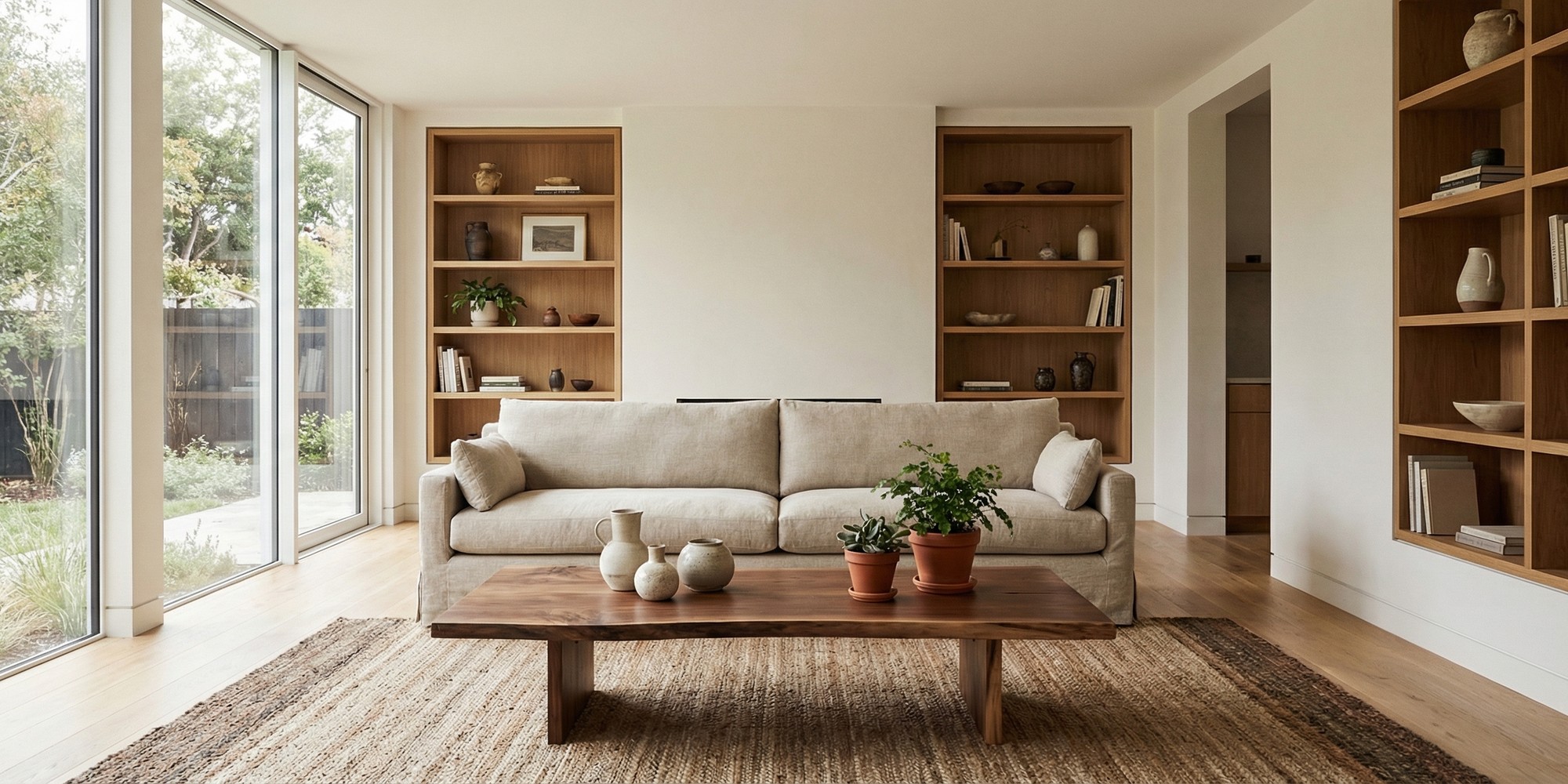
The successor to cold, sterile minimalism, warm minimalism retains clean lines and uncluttered spaces but introduces natural textures, earthy palettes, and organic shapes. Think linen sofas, walnut side tables, and terracotta accent pieces against warm white walls.
Where it performs best: Urban condos, new construction, and properties targeting millennial and Gen Z buyers who follow design trends. This aesthetic photographs exceptionally well in natural light, making listing photos pop in scroll-heavy social feeds.
2. Modern Transitional
Transitional staging blends contemporary furniture profiles with traditional design elements — neutral color palettes, classic upholstery patterns, and a sense of permanence. It’s the safest staging choice in broad buyer markets because it offends no one and appeals to nearly everyone.
Where it performs best: Single-family suburban homes in the mid-range price bracket. According to NAR’s 2026 home stager trend analysis, transitional aesthetics remain the most consistently requested staging style in active buyer markets — precisely because they read as “home” rather than “showroom.”
3. Refined Farmhouse
Shiplap and galvanized metal have given way to a more elevated expression of farmhouse style. In 2026, refined farmhouse aesthetics feature architectural millwork, antique-adjacent lighting, and heritage finishes that read as enduring rather than trendy. Think reclaimed-wood tones, linen textiles, and artisan ceramics — not barn doors and mason jar light fixtures.
Where it performs best: Properties in suburban and exurban markets, particularly those targeting buyers relocating from urban areas. Design trend data for 2026 confirms this aesthetic correlates strongly with buyers who value authenticity and long-term livability over trend currency.
4. Soft Contemporary
A reaction against both sterile modernism and overly decorated interiors, soft contemporary staging prioritizes texture, matte finishes, and a muted, deeply intentional color palette. Buyers in 2026 crave softness and depth — a direct rejection of the high-gloss, high-contrast staging look that dominated the late 2010s.
Where it performs best: Higher-end suburban and semi-luxury listings where buyers are sophistication-oriented but not trend-obsessed. This aesthetic is particularly effective in primary bedrooms and bathrooms, the second-most-important staging priority according to NAR research.
5. Nature-Forward / Biophilic
The fastest-growing staging aesthetic in the 2025–2026 cycle, biophilic staging incorporates abundant plant life, natural light emphasis, organic material palettes, and an overall sense of indoor-outdoor connection. This style isn’t just aesthetically resonant — it speaks directly to buyer wellness priorities that have become a major listing driver since 2021.
Where it performs best: Open-plan homes with strong light, properties with garden access or outdoor living spaces, and listings targeting hybrid-working professionals who spend significant time at home.
Matching Style to Listing: A Practical Framework
The most common mistake agents make when selecting a staging style is defaulting to personal preference rather than buyer persona mapping. Here’s a repeatable decision framework that takes the guesswork out of the process.
Step 1: Define your target buyer profile. Who actually buys in this zip code, at this price point, with this property type? Age range, household composition, and lifestyle priorities directly predict aesthetic resonance. A first-time buyer in their early 30s and a retiring couple downsizing from a larger home respond to entirely different visual cues.
Step 2: Audit the neighborhood’s existing listing aesthetic. Browse active and recently sold listings within a half-mile radius. If transitional staging dominates the comps, you have two options: match the baseline to avoid standing out negatively, or deliberately differentiate with a more distinctive style. Differentiation works when your property’s architecture supports it.
Step 3: Let the architecture guide the choice. A craftsman bungalow doesn’t want ultra-contemporary furniture; a glass-and-steel condo doesn’t want farmhouse styling. The staging should feel like a natural extension of the space, not a contradiction of it.
Step 4: Test before you commit. With traditional physical staging, you had one shot. With an AI virtual staging platform like RealEstage.ai, you can generate multiple styled versions of the same room and compare them before any buyer sees the listing. Agents who run style comparisons consistently find that their subjective “best guess” and the version that actually performs best diverge more often than they converge.
The Rooms That Matter Most — And the Right Style for Each
Staging impact is not evenly distributed across a property. The NAR 2025 Profile of Home Staging identifies the living room as the most impactful room for buyer decision-making (37%), followed by the primary bedroom (34%) and the kitchen (23%).
Living Room: This is where your style choice carries the highest leverage. Warm minimalism and soft contemporary both photograph exceptionally well, particularly when paired with strong natural light and a neutral base palette. This is the room where buyers decide whether to schedule a showing.
Primary Bedroom: Buyers are making an emotional case for themselves as the inhabitant of this space. Softer, more personal aesthetics — refined farmhouse, soft contemporary, biophilic — consistently outperform cold modernism here. The goal is aspirational livability, not architectural statement.
Kitchen: The kitchen is where buyers calculate practicality. Keep staging minimal — a few well-chosen accessories, excellent lighting, and clean surfaces. Let the finishes do the work; the staging job here is simply to get out of the way.
How AI Staging Has Changed the Style Equation
Three years ago, the style selection question was mostly theoretical. Traditional staging vendors required three-to-five business days of lead time, a furniture catalog choice made without visual context, and a commitment you couldn’t easily reverse if the style missed. Most agents defaulted to whatever the staging company’s standard package looked like.
AI-powered virtual staging has fundamentally reordered this workflow. Dedicated AI staging platforms allow agents to generate photorealistic staged images from empty or existing room photos in minutes — applying any style from a curated library, adjusting individual furniture pieces, and regenerating until the result is right. The cost per room is a fraction of traditional staging; the timeline compresses from days to hours.
More importantly, AI staging makes the style experimentation described above economically viable at every price point. Testing three different aesthetics on a single listing is no longer a luxury reserved for high-commission properties — it’s a standard workflow step accessible to any agent working any market.
This is exactly why the conversation in 2026 has shifted from “should I stage?” to “which style should I stage in, and how quickly can I get it right?”
Building Style Selection Into Your Listing System
For agents managing consistent listing volume, ad-hoc style selection creates unnecessary variability. The agents closing at the highest rate in their markets are building systematic style-selection protocols into their listing intake process.
A workable version of that protocol:
- Listing intake: Document the target buyer profile as part of the CMA and listing consultation. Capture demographics, lifestyle, and comparable buyer behavior alongside the financial analysis.
- Style brief: Select a primary aesthetic and one alternative based on the buyer profile framework and neighborhood audit. Document the reasoning — you’ll refine it with experience.
- Staged asset review: Generate both options, compare, and commit to the version with the strongest visual impact and style-to-space alignment.
- Consistency across rooms: Once you select a style, apply it coherently across all staged rooms. Inconsistency creates a jarring listing experience that subconsciously signals disorganization to buyers — the opposite of what you’re after.
RealEstage.ai’s workflow tools support this natively — agents can stage entire properties under a unified design brief, ensuring visual coherence across every room without requiring a design background to execute it professionally.
The 2026 Buyer Expects More
The buyers entering the market in 2026 are visually sophisticated. They’ve spent years on design-forward platforms — Pinterest, Instagram, Architectural Digest digital — and they notice when a listing’s staging feels generic, dated, or mismatched to the space. They may not articulate it explicitly, but it shapes how seriously they engage with a listing and whether they schedule a showing at all.
Agents who treat staging style as an afterthought are leaving engagement on the table. Agents who approach it as a deliberate, buyer-persona-mapped decision are consistently winning more showings, shorter days-on-market, and stronger offers.
The tools to do this professionally — and quickly — are available at a cost that makes the ROI straightforward. The only variable is whether you’re using them with intention. If you’re not already building style-matched virtual staging into every listing workflow, the gap between your results and the market leaders in your area will keep widening.
Related Articles
- How to Choose the Right AI Staging Tool for Your Real Estate Business
- AI Virtual Staging vs. Traditional Staging: The 2026 Cost-Benefit Analysis
- How Buyer First Impressions Are Shaped by AI Listing Presentation
- AI Virtual Staging Buyer Behavior and Listing Outcomes: What the Data Shows
- The Virtual Staging Conversion Funnel: How to Close More Deals with Better Listing Photos
- The AI Staging ROI Business Case for 2026