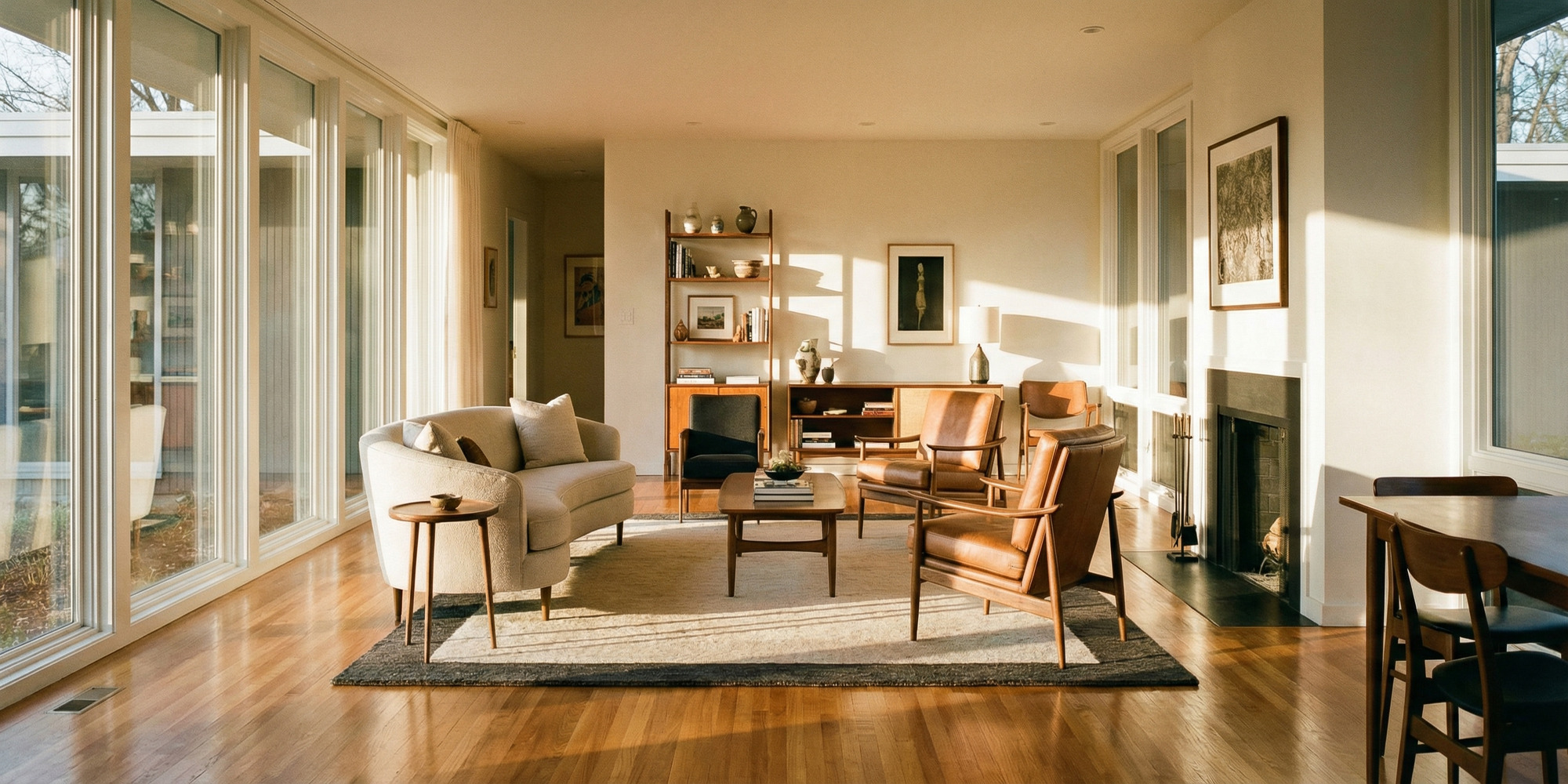
Every agent has been there. You walk into a vacant listing — clean, updated, good bones — and you know it should sell fast. But the photos come back looking like a storage unit cleared out by movers, and the online views trickle in while competing staged listings pull traffic and offers. The property sits. Days on market climb. Price reductions enter the conversation.
Vacant listings are among the most challenging properties in any agent’s portfolio — and they’re also among the most expensive to solve for. Traditional staging, which involves physically furnishing an empty home with rented furniture and decor, carries a price tag that regularly shocks sellers: $1,500 to $4,000 for the first month, with monthly carrying costs of $150 to $1,200 until the home sells. For a property that takes 45 to 90 days to close, that bill compounds fast.
In 2026, AI virtual staging is fundamentally reshaping this calculation. It delivers professional, photorealistic furnished interiors — without a single piece of furniture crossing the threshold — at costs that are often 90% lower than physical staging. For agents who want to protect seller margins while competing at the top of the market, understanding this technology is no longer optional.
Why Vacant Homes Underperform — and Why It’s Not Your Fault
The challenge with vacant listings isn’t about price or location. It’s about buyer psychology.
According to HomeLight’s survey of more than 900 top real estate agents, 92% of agents report that staging is beneficial to the selling process, and over 50% say staging increases a home’s value by 1% to 10%. Yet roughly 34% of agents also report staged homes sell one to two weeks faster than non-staged ones — which, in a competitive market, is the difference between a clean contract and a price reduction conversation.
The reason is straightforward. Empty rooms are cognitively challenging for buyers. When a room has no furniture, no scale reference, and no warmth, buyers default to seeing problems — the ceiling looks lower than it is, the room feels smaller than the floorplan shows, awkward corners become deal-breakers in a viewer’s mind rather than design opportunities. The absence of furniture creates absence of imagination. This is precisely the gap that AI-powered virtual staging tools are engineered to close.
Online, the problem is even more acute. The National Association of Realtors reports that 98% of buyers now use the internet to search for homes, with the vast majority forming first impressions based entirely on listing photos before ever scheduling a showing. An empty room in a listing gallery doesn’t just undersell the property — it gets scrolled past.
The Real Cost of Traditional Staging for Vacant Properties
When it comes to staging costs, vacant properties are categorically more expensive than occupied ones. A stager working in a furnished home can often rearrange and style existing pieces. In an empty home, they’re starting from scratch — transporting furniture, installing decor, managing inventory, and billing by the room and by the month.
Breaking down the typical cost structure for vacant home staging in 2026:
- Initial consultation: $150–$600
- Per-room staging (furniture rental + styling): $300–$700 per room, per month
- Full-home staging (3-bed, 2-bath): $1,500–$4,000 for the first month
- Luxury or larger properties: $5,000–$10,000+ for a single month
- Carrying costs: $150–$1,200 per additional month until sold
A home that takes 60 days to sell with traditional staging easily incurs $3,000–$6,000 in staging expenses alone — before factoring in professional photography, listing fees, and marketing costs. For sellers already stretched thin on closing costs and commissions, this is a significant friction point.
Agents who advocate for staging often absorb part of this cost themselves to make the listing competitive. That’s a real hit to productivity and profitability at scale — especially for agents managing multiple vacant listings simultaneously.
What AI Virtual Staging Actually Delivers
AI virtual staging uses machine learning and generative AI to digitally furnish photos of empty rooms with photorealistic furniture, lighting, and decor. The output — a set of high-resolution, fully furnished listing images — is used in MLS listings, marketing campaigns, and online portals in place of (or alongside) the empty-room photography.
The quality of AI virtual staging in 2026 has advanced considerably from the early-generation software of previous years. Current platforms can accurately read room geometry, respect natural light sources, and apply consistent interior design principles across multiple rooms in a single property. The result is a coherent, cohesive presentation that reads as a professionally staged home — not a rendering.
Key advantages for agents managing vacant listings:
- Turnaround time: Most AI-staged images — including those generated via RealEstage.ai’s real estate staging platform — are delivered within 24–48 hours of submitting empty-room photos
- Cost: Typically $15–$40 per image, compared to hundreds of dollars per room per month for physical staging
- Flexibility: Multiple style options (modern, traditional, Scandinavian, transitional) can be generated for the same room to test market appeal
- No logistics: No furniture trucks, no installation crews, no monthly carry costs
- Immediate availability: Listings can go live with fully staged visuals the same week photos are taken
For agents listing vacant investment properties, estate sales, new construction, or any home where the seller has already moved out, AI virtual staging eliminates the entire cost-and-logistics burden of physical staging while delivering equivalent — and often superior — results in online marketing.
The ROI Case: Running the Numbers
Consider a typical vacant listing scenario in a mid-range market:
Traditional staging path:
- Full staging setup: $2,800 (3 bedrooms + living room)
- Monthly carry (60 days): $1,400
- Total staging cost: $4,200
- Expected value boost: ~$13,000–$15,000 (per HomeLight’s Top Agent Insights, Q3 2025)
- Net staging ROI: Positive, but expensive upfront
AI virtual staging path:
- 8 rooms × $25/image: $200
- Professional photography (still needed): $350–$500
- Total visual marketing cost: $550–$700
- Expected value impact: Comparable to physical staging for online-first buyer pools
- Net staging ROI: Strongly positive with near-zero risk
The math isn’t subtle. AI virtual staging doesn’t just save money — it changes the risk profile of investing in listing presentation. An agent recommending a $200 AI staging package to a seller is a much easier conversation than asking for a $4,000 commitment before the first showing.
This is why AI virtual staging platforms like RealEstage.ai are increasingly becoming standard workflow tools for agents handling vacant listings — not luxury add-ons, but baseline professional practice.
How to Integrate AI Virtual Staging Into Your Vacant Listing Workflow
Getting the most from AI virtual staging requires understanding where it fits in the broader listing preparation process. Here’s the workflow top agents are using in 2026:
Step 1: Empty the room completely before photos
This sounds obvious, but it matters. AI staging produces its best results when working with an entirely clean, empty room. Any leftover furniture, personal items, or clutter in the base photo will either need to be digitally removed (adding cost and complexity) or will produce a staged image that looks cluttered or inconsistent.
Step 2: Shoot with professional real estate photography
AI virtual staging is not a substitute for professional photography — it’s a complement to it. The base images need correct exposure, appropriate wide-angle framing, and consistent white balance. Don’t try to save money on photography and expect the AI staging to compensate for poor source photos.
Step 3: Submit to the AI platform with style direction
Most platforms — including AI-powered property presentation tools like RealEstage.ai — allow you to specify a design style per room. This is where you apply your local market knowledge. Luxury condos typically perform better with contemporary or minimalist staging; suburban family homes generally respond better to transitional or traditional styles. When in doubt, request multiple options and test.
Step 4: Review for quality and disclosure compliance
AI staging output should always be reviewed before being used in listings. Check that furniture scale is correct, light sources are consistent, and architectural features haven’t been obscured or distorted. Also confirm that your MLS and local market standards for virtual staging disclosure are met — most markets require that virtually staged images be labeled as such in the listing.
Step 5: Integrate staged images strategically in marketing
Don’t replace all listing photos with staged versions. The strongest practice is to use AI-staged images as the primary gallery visuals for online marketing while including at least some empty-room photos (clearly labeled) to set accurate expectations for buyers visiting in person. This approach maximizes online appeal while maintaining buyer trust.
Disclosure, Ethics, and Buyer Trust
The accelerating adoption of AI virtual staging has prompted important conversations about disclosure and buyer expectations. In most markets, virtually staged images must be labeled in MLS listings. The standard varies by board — some require a watermark or caption on each image, others require a single disclosure statement in the listing description.
Beyond compliance, there’s a practical reason for transparency: buyers who arrive at a showing expecting a furnished home and find an empty one will feel misled. Reputable platforms like RealEstage.ai provide disclosure-ready labeled image versions that comply with most MLS standards out of the box. That erodes trust in the listing agent and can poison the negotiation before it starts. Done right — with labeled images, honest descriptions, and accurate empty-room companion photos — AI virtual staging enhances the presentation without deceiving anyone.
The best AI virtual staging platforms are built with this in mind. They make it easy to generate labeled versions of staged images and encourage agents to use both staged and unstaged photos in the listing gallery.
Choosing the Right AI Virtual Staging Platform
Not all AI virtual staging platforms are created equal. As the category has matured, significant differences have emerged in image quality, turnaround time, design library depth, and ease of use. Agents evaluating platforms in 2026 should test for:
- Photorealism: Does the staged image look like a professional interior photograph, or like a 3D render?
- Style range: Does the platform offer enough design styles to match the property’s target buyer demographic?
- Consistency: Can it maintain consistent styling across 8–12 rooms in a single property?
- Turnaround: Does it deliver within 24 hours, or will it delay your listing launch?
- Disclosure support: Does it offer labeled image versions that meet MLS compliance requirements?
RealEstage.ai has built its platform specifically for real estate professionals managing vacant listings and property presentations at scale. The platform’s AI is trained on real estate photography — not generic interior design imagery — which produces outputs that read correctly in the context of MLS listings and online marketing. For agents who need consistent, high-quality virtual staging across multiple listings without logistical overhead, it’s worth evaluating as a primary tool in your property presentation workflow.
The Bottom Line for Agents in 2026
Vacant listings will always be part of the real estate landscape. Estate sales, investment properties, relocation listings, new construction, and move-before-you-sell situations all produce empty homes that need to tell a compelling story to buyers scrolling through online galleries.
Physical staging remains a powerful tool, and for certain listings — particularly high-value homes where every dollar of presentation investment returns multiples — it may still be the right choice. But for the majority of vacant listings, where staging cost is a real friction point and the online buyer journey is the primary battlefield, AI virtual staging offers a better ROI, faster turnaround, and lower risk for both agent and seller.
The agents who will win the most vacant listing business in 2026 are the ones who can walk into a listing appointment, show the seller exactly what their empty rooms will look like furnished — using AI-generated samples on a tablet — and explain precisely how much money they’ll save compared to physical staging. That’s a compelling pitch, backed by real economics.
The technology to do that exists today. The question is whether you’re using it.
Related Articles
- AI Virtual Staging in 2026: The $24-Per-Photo Tool That’s Replacing $2,000 Traditional Staging
- How AI Virtual Staging Reduces Days on Market: The 2026 Agent’s Playbook
- AI Virtual Staging for As-Is and Fixer-Upper Listings: How to Show Buyers the Potential in 2026
- The Real Estate Agent’s Visual Marketing Stack: Pairing Professional Photography with AI Virtual Staging in 2026
- AI Real Estate Marketing Automation: How Agents Are Running 24/7 Listing Campaigns in 2026
- AI Virtual Staging for Second Homes and Vacation Rentals: The Complete Listing Playbook for 2026