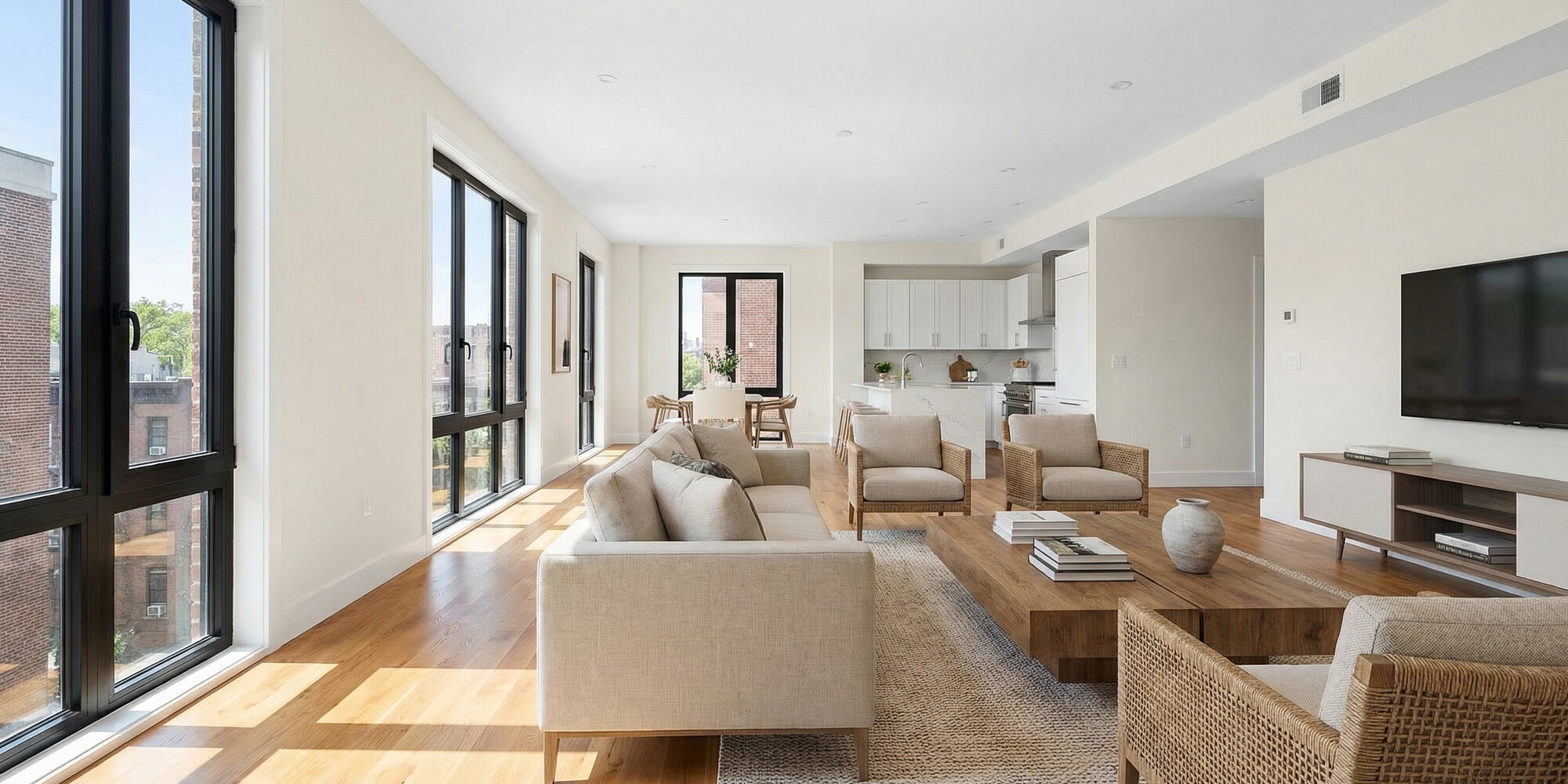
House flipping margins hit a 17-year low in 2025 — and they haven’t recovered. The average gross profit on a flipped home sits at roughly $66,000, squeezed from both ends by rising renovation costs and a buyer pool that has more inventory to choose from than at any point in the past decade. In this environment, every line item on the marketing side gets scrutinized. Traditional physical staging — which can run $1,500 to $4,000 per property per month — is no longer the default assumption. The investors and agents outperforming their markets in 2026 have replaced it with something faster, cheaper, and demonstrably more effective: AI virtual staging.
This isn’t a cost-cutting compromise. It’s a strategic upgrade. Here’s what the shift looks like in practice — and why agents who work with investors need to make it core to their listing process.
Why Investment Properties Are the Ideal Use Case for AI Staging
Investment properties — freshly flipped homes, vacant rentals, distressed acquisitions — share a profile that makes them particularly well-suited to AI virtual staging. They’re usually empty, recently renovated, and under time pressure. Every day the property sits unsold is money leaving the deal.
Traditional staging solves the empty-room problem by renting furniture and hiring a staging company to install it. That process takes days to schedule, costs real money, and adds logistical complexity to a timeline investors are already managing carefully. AI virtual staging solves the same problem in hours, for a fraction of the cost, without anyone needing to set foot in the property.
The math is straightforward. An investor running three to five flips simultaneously can’t afford to stage each one at physical staging rates. AI staging removes that constraint entirely — enabling consistent, professional presentation at every price point without ballooning the marketing budget.
The Cost Compression Advantage
Let’s be specific. A conventional home staging engagement for a vacant 1,800 sq. ft. property typically involves a staging consultation, furniture rental for 60-90 days, and installation/removal fees. All-in, that often lands between $2,000 and $5,000 depending on market and scope. For a higher-end flip in a competitive market, full-home staging can exceed $8,000.
AI virtual staging costs a fraction of that. Professional-grade platforms typically charge per room or per image — commonly $20 to $60 per rendered photo. A complete set of staging photos for a four-bedroom flip property (kitchen, living room, master bedroom, two additional bedrooms, dining area) runs $120 to $360. That’s a 90%+ cost reduction versus the physical alternative.
The implications compound at scale. An agent representing an investor with a portfolio of ten active listings is looking at $20,000 to $50,000 in traditional staging costs per cycle. With AI staging, that becomes $1,200 to $3,600. The savings don’t just protect the investor’s margin — they make it possible to stage every property in the portfolio without financial trade-offs.
RealEstage.ai operates exactly in this space: a purpose-built AI staging platform designed for the throughput demands of active real estate professionals, not just occasional one-off staging projects.
Speed as a Competitive Lever
The average house flip takes approximately 166 days from purchase to resale. That timeline includes acquisition, renovation, marketing, and closing. The marketing window — from listing launch to accepted offer — is where AI staging has the most direct impact.
According to NAR’s 2025 Profile of Home Staging, 49% of agents reported that staging reduced a property’s time on market. For a flip, every week the property sits is additional carrying cost: mortgage interest, insurance, property taxes, and utilities. A single week of reduced holding time on a $400,000 flip can represent $500 to $1,500 in direct savings depending on financing structure.
Traditional staging requires scheduling. AI virtual staging requires none. Upload the photos, select the style, receive professionally staged images within hours. The listing can go live the day renovation wraps — not a week later, waiting for the staging company’s availability.
That compression of the pre-listing timeline is one of the clearest operational advantages available to agents and investors working in 2026’s market.
What Buyers Actually Respond To
The staging question isn’t just operational — it’s psychological. Buyers making offers on investment properties are making the same emotional and financial calculations as any other buyer. Empty rooms test their spatial imagination. Poorly presented listings make them wonder what else wasn’t taken care of. Well-staged listings communicate competence, value, and move-in readiness.
Virtual tour listings generate 40% more clicks than non-virtual listings, and professionally staged photos are the foundation of any listing’s visual first impression. According to the same NAR 2025 staging data, 29% of sellers’ agents reported that staged homes received offers 1 to 10% above the asking price compared to similar unstaged properties.
On a $400,000 flip, that 1% premium represents $4,000 above asking. The AI staging investment that enabled it cost less than $300. The ROI calculus isn’t complicated.
AI virtual staging platforms like RealEstage.ai generate photorealistic room transformations that buyers respond to the same way they respond to physical staging — because the visual result is designed to be indistinguishable from a fully furnished space.
The Rental Property Application
AI staging isn’t limited to flips. Property managers and landlords marketing rental vacancies face the same empty-room problem with even tighter economics: traditional staging is economically irrational for a unit that generates $2,200/month in rent. But a vacant unit with bare walls and hollow rooms still needs to compete against professionally marketed alternatives.
AI staging solves this at rental-appropriate economics. A $60 investment in three staged photos can meaningfully improve listing engagement, reduce days vacant, and attract higher-quality tenants. For a landlord managing multiple units, the ability to quickly stage each one before it hits the market represents a genuine operational advantage.
Investors building rental portfolios are increasingly directing their agents toward AI staging tools built for high-volume property workflows — tools that can be applied across every unit in a portfolio without per-unit cost becoming a barrier.
How Agents Can Position This as a Service Differentiator
Real estate agents who specialize in investor clients — or who want to break into that segment — have a concrete value proposition to build around AI staging.
Most investor clients are running numbers. They understand cost structures and they evaluate agents on the efficiency of the transaction, not on relationship warmth. An agent who can demonstrate a standardized marketing system — one that gets every property staged, photographed, listed, and in front of qualified buyers within 24 to 48 hours of project completion — is solving a real problem for an investor client.
Here’s the positioning: frame AI staging as part of your listing-ready package. Every flip you take on goes live with a full suite of AI-staged photography, MLS-optimized description, and social media assets. You can deliver this faster and at lower cost than any competitor still defaulting to physical staging. That’s a meaningful differentiator in a segment where speed and precision directly translate to dollars.
When investors see you can consistently execute this workflow, you become a preferred partner — not just a transaction agent.
What to Look for in an AI Staging Platform for Investment Work
Not every AI staging tool is built for the throughput demands of investor-focused agents. Here’s what matters when evaluating platforms:
- Batch processing capability — the ability to stage multiple rooms or multiple properties in a single workflow without manual uploads per image
- Style consistency — the ability to apply the same design aesthetic across all rooms in a single property to create a cohesive presentation
- Turnaround speed — for investor timelines, same-day or next-day delivery is a hard requirement
- Quality at multiple price points — the rendering quality needs to hold up in both entry-level flip markets and premium renovation projects
- Flexible output formats — MLS-ready file sizes, social media dimensions, and print-quality exports from a single source image
RealEstage.ai’s AI staging engine is built around exactly these requirements — handling the scale and throughput needs of agents who list multiple properties simultaneously, not just occasional single-listing use cases.
Building the System Around Your Investment Clients
The agents who are winning investor business in 2026 aren’t winging it. They have a defined process: renovation wraps, photographer arrives, images are uploaded to the AI staging platform the same day, listing goes live 24 hours later. That predictability is what investor clients pay for — and what separates high-volume investment-focused agents from generalists.
AI virtual staging is the core technology enabling that system. It removes the scheduling friction of physical staging, collapses the pre-listing timeline, and delivers presentation quality that competes with any physical staging setup — at a price point that preserves rather than erodes investor margins.
The national average ROI for house flipping is 31.5%, and it’s trending lower. Every efficiency gain in the marketing workflow is a direct contribution to the net return on a deal. For investors counting on compounding volume to build portfolio equity, that efficiency isn’t optional — it’s structural.
Agents who understand this, and who have built purpose-built AI staging workflows into their listing process, are the ones capturing investment client relationships that generate repeat business deal after deal. The tools are available. The only question is whether you’re using them.
Related Articles
- The Vacant Home Problem: How AI Staging Turns Your Hardest Listings Into Fast Sales
- AI Virtual Staging vs. Traditional Staging: The Complete 2026 Cost-Benefit Analysis
- The AI Staging Business Case: What the Data Says About ROI in 2026
- The Complete AI Real Estate Marketing Toolkit: Build a Listing System That Converts
- The First 72 Hours: Why Your Listing Launch Window Determines Everything
- Why Top-Performing Real Estate Agents Refuse to List Without AI Virtual Staging