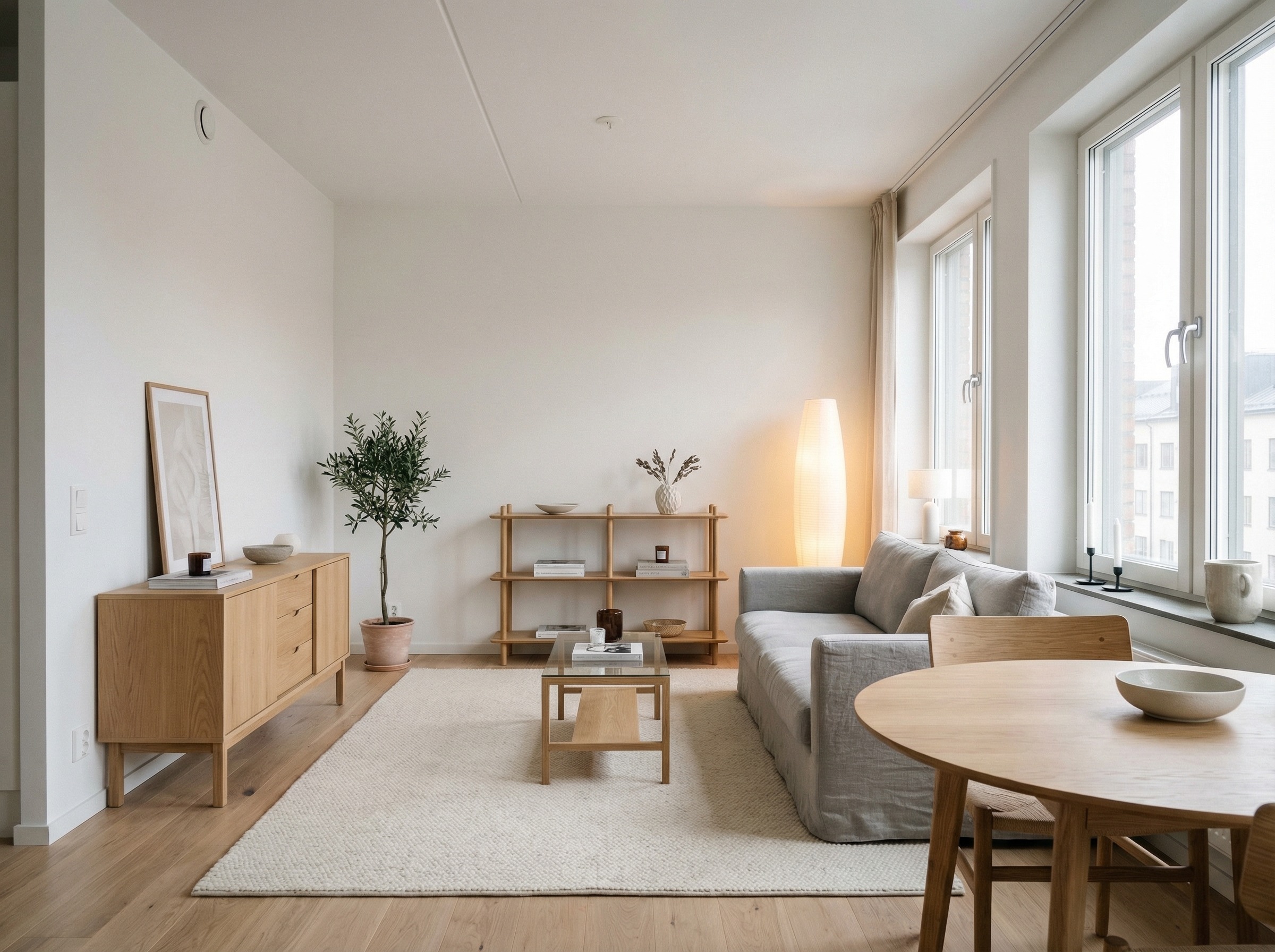
Condos and compact homes represent a substantial share of the housing inventory in most markets — and one of the toughest challenges for listing agents. Empty rooms look smaller than they are. Buyers scroll past bare concrete floors and white walls without a second glance. Traditional physical staging, when it’s even logistically possible, costs more than many sellers can justify on a $350,000 studio. AI virtual staging changes the math entirely — and agents who’ve figured this out are running circles around the competition.
This isn’t a theoretical advantage. The data is unambiguous. According to the National Association of Realtors’ 2025 Profile of Home Staging, 83% of buyers’ agents said staging made it easier for buyers to envision a property as their future home. That psychological bridge — helping a buyer mentally move in — is even more critical in small spaces, where the margin for imagination is razor-thin without visual context.
The Small Space Problem Traditional Staging Can’t Solve
Physical staging was designed for the median American home, not the 650-square-foot urban condo or the 900-square-foot starter ranch. The economics break down fast:
- Furniture rental and delivery costs don’t scale down with square footage — you’re often paying $2,000–$4,000 for a full staging regardless of unit size
- Access logistics are complicated in multi-unit buildings with elevator restrictions and move-in windows
- Coordination time eats into an agent’s margin on lower-priced properties where commission is already thin
- Duration limits mean staged furniture gets pulled mid-listing if the property sits longer than expected
The result: most condos and small homes hit the market empty, or worse, occupied and cluttered with a current tenant’s belongings that photograph terribly. Either scenario kills online conversion.
Buyers browsing Zillow or Realtor.com make a scroll-or-click decision in under three seconds. An empty condo with a ceiling fan as the only visual reference is not going to make the cut.
Why Small Spaces Need Visual Help More Than Large Ones
There’s a counterintuitive truth that experienced agents understand: smaller rooms require more design context, not less. A sprawling great room reads as “spacious” even when empty. A 12x14 living area in a condo looks like a broom closet without furniture to establish scale.
When you introduce a appropriately scaled sofa, a floor lamp, a coffee table, and a media console, something clicks for buyers. The room suddenly reads as “intimate and efficient” instead of “cramped.” The right furniture selection — proportional to the space, visually light in style — transforms perception.
This is where RealEstage.ai delivers an outsized advantage for small-space listings. The platform’s AI understands spatial constraints and automatically selects furniture scaled to the room dimensions captured in the photo. Rather than placing a hulking sectional that fills a living room wall-to-wall (a common mistake in manual virtual staging), the AI optimizes for visual breathing room — making compact spaces feel livable and aspirational.
The ROI Case for Small-Space Virtual Staging
The economics are straightforward. According to the NAR’s 2025 data, 29% of agents reported that staging led to offers 1% to 10% higher than unstaged comparables, and 49% of sellers’ agents observed measurable reductions in days on market.
On a $350,000 condo, a 3% price improvement translates to $10,500. AI virtual staging for that same listing costs roughly $30–$75 for a full set of rooms. The return multiple is not subtle.
Traditional staging ROI often gets eroded by the upfront cost — even if it works, you’re netting a fraction of the improvement after staging fees. AI virtual staging eliminates that erosion. The gross improvement flows almost entirely to your client’s bottom line (and reinforces your value as an agent who maximizes seller returns).
This framing is also a powerful tool in listing consultations. Agents who present the AI staging ROI case — with actual numbers from their market — consistently report stronger listing win rates. If you’re not already building this into your seller pitch, you’re leaving conversion points on the table.
Which Rooms to Prioritize in Compact Properties
Not every room in a small property needs virtual staging. Budget and buyer psychology should guide your prioritization.
Living Room — Non-Negotiable
This is the room that appears in the hero photo of almost every listing. It’s the first interior buyers see, and it sets the tone for the entire property. In condos and small homes, the living room often doubles as the dining area — making it even more important to demonstrate how the space can function.
Stage it every time, no exceptions.
Primary Bedroom — High Priority
Buyers care deeply about where they’ll sleep. An empty bedroom with a ceiling fan reads as a motel. A primary bedroom with a platform bed, side tables, and a simple dresser reads as a retreat. For small bedrooms especially, the right staging communicates that the space works without feeling squeeze.
Kitchen and Dining Area — Context Dependent
Open-plan condos where the kitchen and dining area are visible together benefit significantly from staging the dining zone. A small table with two chairs and a pendant lamp overhead does more for perceived space than almost any other single element.
If the kitchen itself is small but new, let the finishes do the work. Add counter accessories (a coffee maker, a plant, a bowl of fruit) in post-processing if your AI platform supports it — this costs nothing and adds life.
Secondary Bedrooms and Bathrooms
Stage secondary bedrooms only if you have budget remaining. Bathrooms rarely need staging and most AI platforms don’t offer bathroom-specific options anyway.
Style Strategy for Small Spaces: What AI Tools Should Do
The furniture style you select for small-space virtual staging matters significantly. The wrong aesthetic — heavy, dark, maximalist — will make a compact room feel claustrophobic even with technically correct staging.
The styles that convert best in compact properties:
- Scandinavian/Nordic — Light wood tones, clean lines, low-profile furniture. Creates visual airiness without sacrificing warmth.
- Modern Minimalist — White and grey palettes, simple forms, minimal ornamentation. Makes rooms look larger by reducing visual noise.
- Contemporary Transitional — Neutral palette with subtle texture. Appeals to the broadest buyer demographic without being polarizing.
Avoid heavy traditional styles (dark wood, ornate details), maximalist bohemian, and anything that photographs as “busy.” In small spaces, every visual element competes for attention, and staging should reduce that competition, not add to it.
RealEstage.ai gives agents direct control over style selection by room type — so you can specify Scandinavian for the living room while opting for a slightly warmer contemporary palette in the bedroom. That level of control, available without a designer or lengthy back-and-forth, is what separates modern AI staging platforms from the first-generation tools that applied a single style to everything.
The Open-Concept Challenge and How AI Handles It
Open-concept condos present a unique staging challenge: you need furniture that clearly defines zones — living, dining, workspace — without physically partitioning the space. In traditional staging, interior designers use area rugs, strategic furniture arrangement, and lighting to accomplish this. In AI virtual staging, the same logic applies but the execution is faster.
When staging an open-concept unit, your goal is to demonstrate how the buyer would actually live there. Show a sofa and media console oriented toward where the TV would hang. Show a dining table positioned to maximize natural light from the windows. If the unit has a defined work-from-home nook, a compact desk and chair turns that alcove into a selling point rather than dead space.
Agents who communicate these zone definitions clearly in their staging prompts — or who use platforms that allow specific room-zone designations — get noticeably better results. AI virtual staging platforms like RealEstage.ai are built around this kind of contextual room understanding, producing outputs that reflect how people actually inhabit spaces rather than catalog-shoot aesthetics.
Photographing Small Spaces to Maximize AI Staging Quality
The quality of your input photos directly determines the quality of AI staging output. Small spaces demand intentional photography technique.
Use wide-angle lenses (but not too wide): A 16mm or 18mm equivalent gives you enough coverage to capture the full room without the fisheye distortion that makes rooms look artificially large and buyers feel deceived. Anything wider than 14mm is counterproductive.
Shoot from corners: Position your camera in corners to maximize visible floor space. More visible floor = perceived larger room.
Shoot multiple exposures and bracket: Natural light is harder to control in condos with limited window access. Bracketed exposures give your AI platform cleaner base images to work with.
Declutter ruthlessly before shooting: Even if the unit is occupied, clear every surface. AI staging replaces furniture but cannot remove existing possessions in most platforms.
Level your shots: Crooked horizontals are exaggerated in small rooms where parallel lines (window frames, baseboards, ceiling lines) dominate the visual field.
Following these practices reduces revision rounds and produces AI staging outputs that require minimal human touch-up — which keeps your per-listing cost down and your turnaround time fast.
Integrating AI Staging Into Your Condo Listing Workflow
The agents getting the best results from AI virtual staging aren’t treating it as an afterthought — they’re building it into their standard listing workflow from day one.
A practical framework:
- Listing appointment: Set seller expectations that photos will be taken within 48 hours and digital staging will be applied before going live. Position this as your competitive advantage.
- Photography session: Book a professional photographer who understands real estate composition. Briefing them on the wide-angle, corner-shot approach described above pays dividends.
- Same-day upload: Upload photos to your AI staging platform immediately after receiving the RAW files. Most platforms return staged versions within minutes.
- Review and approve: Check AI outputs for furniture scale, style consistency, and any artifacts. Most need minimal adjustment.
- MLS upload: Staged photos go live with the listing.
The entire AI staging component of this workflow — from photo upload to approved staged images — takes under an hour for a typical condo. That efficiency is only possible with platforms purpose-built for real estate, where the AI has been trained on thousands of actual listing photos rather than generic interior design datasets.
Tools like RealEstage.ai are designed specifically for this workflow: upload a listing photo, select your room type and style, and receive photorealistic staged outputs in minutes — ready to upload directly to MLS, Zillow, and your marketing channels.
Pitching AI Staging to Sellers of Small Properties
The objection you’ll hear most often from sellers of condos and small homes: “It’s a small space — buyers will be able to tell what they’re getting.”
This reflects a common misconception. Buyers aren’t trying to determine square footage from listing photos — they’re trying to feel something. They want to see themselves in the space. Empty photos don’t give them that. Professionally staged photos do.
Your counter-pitch:
Frame it as competitive positioning. In any active condo market, your listing is competing against dozens of similar units. The ones with staged, professionally presented photos receive more clicks, more showings, and more offers. The data supports this — you’re not guessing.
Show the cost. When a seller understands that AI staging costs $50–$100 for a full unit and is already included in your marketing package, the conversation ends there. You’re not asking them to approve a $3,000 budget line. You’re showing them a service that’s effectively free relative to what they’ll gain.
Show examples. Before-and-after images from similar properties in your market close the deal. If you don’t have your own, most AI staging platforms maintain before-and-after galleries. Use them.
The Competitive Reality in 2026
The adoption curve for AI virtual staging has reached the point where vacant, unstaged listings are now a competitive liability — especially in the condo segment. Buyers’ agents report it constantly: their clients skip past empty listings in favor of staged ones, even when the empty listing is objectively a better property.
The bar has moved. Staging was once a premium service for high-value listings. Today, in the condo and small-home market, it’s table stakes. The only question is whether you’re using expensive, logistically cumbersome traditional staging or efficient, scalable AI-powered virtual staging that fits the economics of your listing.
The math, the data, and the buyer behavior all point in the same direction. The agents not adapting aren’t failing because the market changed. They’re failing because they chose not to change with it.
Related Articles
- Virtual Staging Room by Room: Which Spaces Drive the Most Buyer Interest (2026 Guide)
- AI Virtual Staging vs. Traditional Staging: The Complete 2026 Cost-Benefit Analysis
- The AI Staging Business Case: What the Data Says About ROI in 2026
- How to Choose the Right AI Staging Tool for Your Real Estate Business
- The Buyer’s First Impression: How AI Is Winning the Listing Attention War in 2026
- The Vacant Home Problem: How AI Staging Turns Your Hardest Listings Into Fast Sales