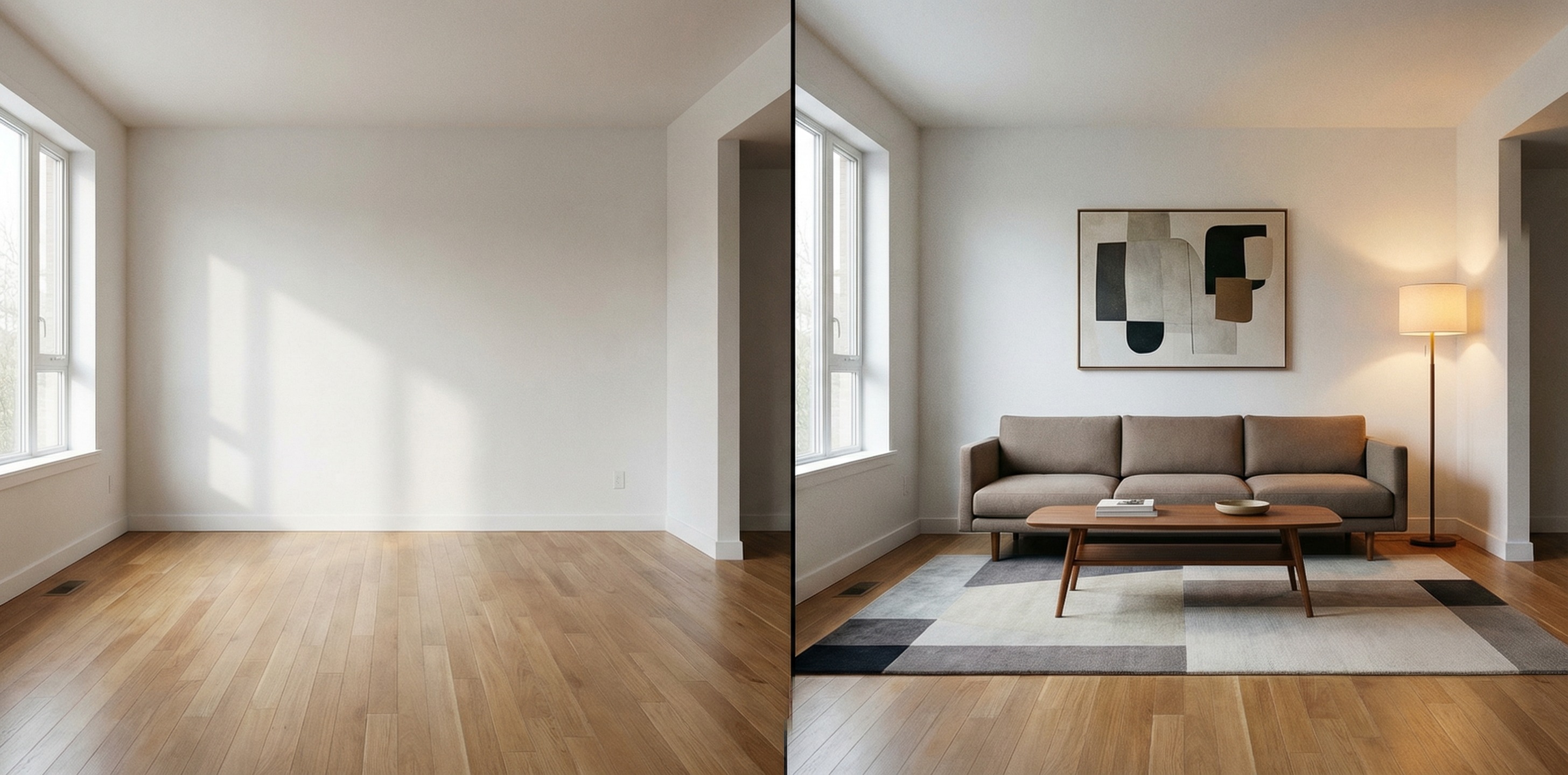
The staging decision used to be simple: hire a professional stager, fill the rooms, shoot the photos, and list. Today, real estate agents face a more complex calculation — one that pits the familiar cost and quality of traditional physical staging against the speed, economics, and scale of AI virtual staging. Both approaches deliver results. But they don’t deliver the same results, at the same cost, for the same listings.
This analysis breaks down exactly what each approach costs, where each performs best, and how to build a staging strategy that maximizes your return on every listing in 2026.
The Real Cost of Traditional Staging
Traditional physical staging has never been cheap, but its price has climbed steadily alongside labor costs and furniture rental rates. According to NAR’s 2025 Profile of Home Staging, the median cost of using a professional staging service was $1,500 — and that’s the median, not the ceiling.
For larger properties, luxury listings, or multi-room staged packages, the numbers climb quickly:
- Initial consultation: $150–$300
- Furniture rental per room per month: $400–$800
- Full-home staging (3–4 rooms): $2,000–$5,000 upfront
- Extended rental if listing sits: $400–$1,000/month in carrying costs
- Re-staging after feedback: Additional labor fees
When a listing sits longer than expected — a real risk in a slower market — those monthly rental fees compound. An agent who stages a vacant four-bedroom and doesn’t receive an offer in 30 days may find themselves negotiating with a stager over renewal terms.
Beyond direct cost, there’s the logistics overhead: scheduling consultations, coordinating furniture delivery, managing staging contracts, and ensuring the property is accessible for setup and breakdown. For agents managing multiple listings simultaneously, this operational load is significant.
77% of agents don’t stage all their listings, according to data analyzed by AI Home Design — not because staging doesn’t work, but because the economics don’t justify the investment on every property. That gap is exactly where AI virtual staging has taken hold.
What AI Virtual Staging Costs in 2026
The AI virtual staging market has matured considerably. What began as a niche tool producing inconsistent results now delivers photorealistic renders competitive with high-end physical staging — at a fraction of the cost.
Current market pricing for AI virtual staging:
- Per-image pricing: $3–$20 per staged photo
- Subscription models: $14–$99/month for unlimited or high-volume use
- Agency/team tiers: $150–$500/month for multi-user access and bulk processing
For a typical three-bedroom listing requiring six staged photos, the cost difference is stark:
| Approach | Cost Per Listing | Turnaround |
|---|---|---|
| Traditional staging | $1,500–$5,000 | 3–7 days |
| AI virtual staging | $18–$120 | 2–24 hours |
Platforms like RealEstage.ai have pushed the quality ceiling further with tools designed specifically for production real estate workflows — where consistency, turnaround time, and professional-grade output all matter simultaneously.
Quality: Is There Still a Perception Gap?
This is the question agents ask most. The honest answer: there was a quality gap in 2023. In 2026, it’s largely closed.
Early AI staging tools produced images with uncanny furniture placement, lighting inconsistencies, and visible artifacts that trained eyes — buyers’ agents, photographers — could spot immediately. That era is over. Current-generation AI staging models produce photorealistic renders with accurate room proportions, natural lighting integration, and style coherence that holds up to close inspection.
What hasn’t changed is the limitation of working from existing photography. AI virtual staging improves the visual appeal of good photos. It cannot compensate for poor lighting, unflattering angles, or outdated camera equipment. The quality of the source photography still matters — AI staging elevates good photos to great; it can’t rescue fundamentally flawed ones.
According to research published by AgentUp, 58% of buyer agents report that virtual staging influences how most clients perceive a property — a number that reflects how normalized digitally staged photos have become in the buying process.
Where traditional staging still holds an edge: high-end and luxury properties where in-person showings carry significant weight, and where a buyer walking through a beautifully staged home delivers an emotional experience that photos alone cannot replicate. For a $4M residence where buyers are flying in from out of state and expect a premium physical environment, the investment in traditional staging may still be justified.
Speed: The Competitive Advantage That Compounds
In real estate, timing is everything. The first 72 hours after a listing goes live are the highest-traffic window your listing will ever see. Buyers saved searches notify immediately. Agents ping clients. Social posts go viral or get buried.
Traditional staging requires scheduling consultations, coordinating furniture logistics, and waiting on delivery — a process that realistically adds 3–7 days to your listing timeline. For agents working with motivated sellers or in competitive markets, that delay is a meaningful disadvantage.
AI virtual staging compresses that timeline to hours. Upload your photos, select a style, and receive professional-quality staged renders before the end of the business day. RealEstage.ai and comparable platforms allow agents to turn around a complete set of staged listing photos in under 24 hours — meaning your MLS listing goes live at full visual impact, not with placeholder empty-room photos.
The compounding effect: agents who consistently launch listings with complete, professional staging from day one develop a reputation for preparation. Sellers notice. That reputation feeds the listing pipeline.
Scalability: Where AI Wins by a Wide Margin
Traditional staging doesn’t scale. Every listing requires a separate stager consultation, a separate furniture order, and a separate logistics chain. An agent who goes from managing 5 listings a year to 20 doesn’t get four times the benefit of traditional staging — they get four times the complexity.
AI virtual staging is the inverse. Once an agent has a workflow established — a go-to platform, a preferred design aesthetic, a consistent photo brief for their photographer — adding new listings costs almost nothing incrementally. A team of agents sharing an AI staging subscription on a platform like RealEstage.ai pays a flat monthly rate regardless of volume.
For high-producing agents and teams, this economics shift is transformational. Consider:
- A 20-listing/year agent using traditional staging at $2,000/listing spends $40,000 annually on staging alone
- The same agent on an AI staging platform might spend $500–$1,200 annually for the same coverage
The difference is not marginal. It’s the kind of line item that changes how agents think about which listings deserve staging resources — from “only the expensive ones” to “every single one.”
Disclosure and Compliance: What Changed in 2026
This is an area where agents need current knowledge. In 2026, MLS disclosure requirements for digitally altered listing photos have tightened across most major markets. Several states now require explicit labeling when AI-generated or digitally modified images are used in MLS submissions.
The baseline industry standard, consistent with NAR’s guidance on virtual staging compliance, requires:
- Clear disclosure that photos have been digitally staged or enhanced
- Access to unaltered photos upon request or alongside staged images
- No removal or alteration of existing structural elements — virtual staging can add furnishings but cannot remove walls, change window placement, or eliminate disclosed defects
Traditional physical staging exists entirely in the real world and carries no disclosure requirements — what’s in the home at time of photography is what buyers see. AI staging requires active compliance management.
This isn’t a reason to avoid AI staging. It’s a reason to choose a platform that builds compliance into its workflow. Purpose-built AI virtual staging tools designed for professional real estate use — including AI staging platforms built around MLS compliance — include disclosure watermarks, before/after image pairs, and documentation that satisfies most MLS requirements.
The Decision Framework: Which Approach Wins, When
Based on cost, speed, quality, and scalability, here is a practical framework for choosing between approaches:
Use AI virtual staging when:
- The listing is vacant or sparsely furnished
- Your budget per listing is under $500
- You need photos ready in 24 hours or less
- You’re managing more than 5 active listings simultaneously
- The listing is priced below the top 10% of your market
- You need to refresh or relist a property that has been sitting
Consider traditional staging when:
- The listing is luxury or ultra-premium (typically $2M+) with significant in-person showing traffic
- The seller is hosting open houses and wants the physical environment to support buyer emotion
- The property has structural or design challenges that benefit from a professional stager’s eye and furniture selection
- You have a staging budget that the seller is willing to fund
Use both strategically when:
- High-value listings benefit from full physical staging for showings, with AI staging used to produce the hero MLS photos and social content before furniture arrives
- A listing is being relaunched after a price reduction and needs a rapid visual refresh to signal change to buyers who’ve already scrolled past
Building the Hybrid Approach Into Your Business
The most productive agents in 2026 aren’t choosing one approach over the other — they’re building a tiered staging system that applies the right tool to each listing based on its market position, timeline, and seller expectations.
For the majority of their listings — the everyday inventory that doesn’t justify a $3,000 staging bill — AI virtual staging tools deliver professional visual marketing at a cost that makes staging accessible on every property. For the marquee listings where physical presence matters, traditional staging remains part of the arsenal.
Getting that system built doesn’t require a major overhaul. It requires one decision: identify the platform you’ll use for AI staging, build it into your standard listing preparation checklist, and stop leaving visual marketing to chance on listings that can’t support a traditional staging budget.
The math is simple. The listings that don’t get staged get fewer clicks, generate less showing traffic, and close slower. In 2026, there’s no longer a cost argument for skipping visual staging on any listing. The only remaining question is which tool you use.
Related Articles
- Virtual Staging ROI: Real Performance Data from 1,847 Listings in 2026
- Virtual Staging Cost in 2026: Pricing, Packages, and ROI (Agent Guide)
- Virtual Staging Disclosure 2026: AI Compliance Rules Real Estate Agents Must Know
- The AI Staging Business Case: What the Data Says About ROI in 2026
- How to Choose the Right AI Staging Tool for Your Real Estate Business
- AI Virtual Staging in 2026: The Complete Guide for Real Estate Agents