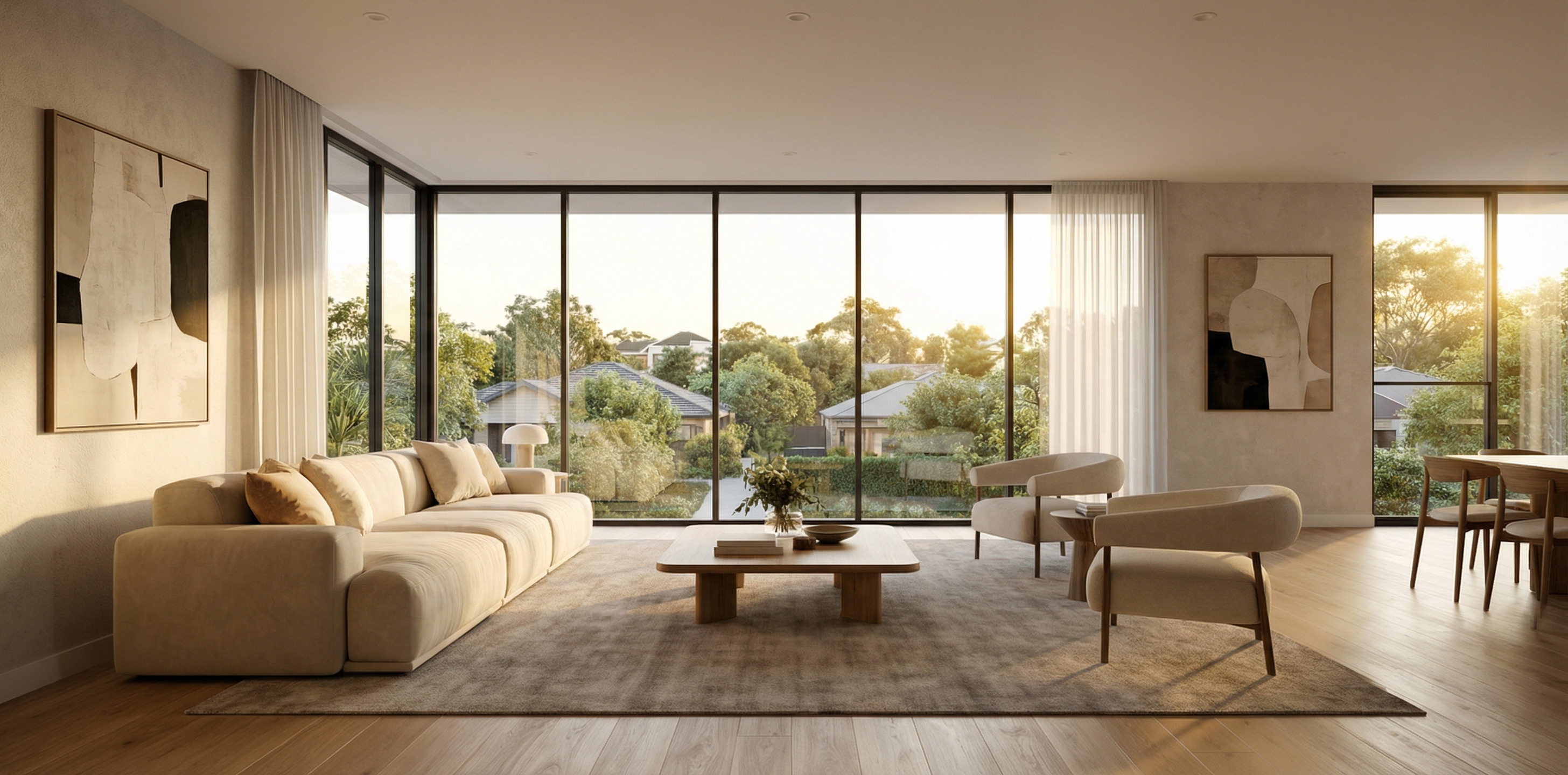
Every listing on Zillow, Realtor.com, and Redfin is competing in the same brutal attention economy. Buyers are browsing dozens of properties in a single session, their thumbs moving fast, their decisions made in less time than it takes to read a sentence. Your listing’s hero photo — not its price, not its square footage, not even its location — is the deciding factor in whether a buyer stops or scrolls. If the photo doesn’t stop them, nothing else matters, because they never see anything else.
This is the online listing attention problem. And it’s costing agents showings, offers, and closed deals every single day.
The Digital-First Home Search Is Now Total
The shift to online-first home searching isn’t new, but its dominance has become absolute. According to the National Association of Realtors’ 2025 Profile of Home Buyers and Sellers, 97% of home buyers used the internet at some point during their search — and for the overwhelming majority, that search begins online long before they ever contact an agent.
The implications are significant. By the time a buyer calls to schedule a showing, they’ve already made a preliminary judgment about your listing based entirely on what they saw on a screen. The in-person visit confirms or overturns a first impression that was formed days or weeks earlier, in a two-second scroll, on a phone screen in the back of an Uber.
What this means for agents is straightforward: the listing photo is now the first showing. It’s not a preview. It’s not supplemental marketing material. It is the moment where most of a listing’s buyer pipeline is either won or lost. Agents who treat it as anything less are starting every listing at a disadvantage.
The Attention Economy of Online Real Estate
To understand the scale of the problem, consider what a buyer actually experiences when they search for homes online. A typical Zillow session involves filtering by price, beds, and location — then landing on a grid of thumbnails. Each thumbnail is a judgment call: stop or scroll.
Research on digital attention spans — particularly in high-choice environments like real estate portals — consistently shows that users make engagement decisions in under three seconds. In a grid view of 20 listings, a buyer’s eyes move fast. Properties with visually compelling hero photos draw attention immediately. Properties with dark, cluttered, or empty rooms don’t register at all.
This isn’t a subjective preference. Redfin’s research on listing photos found that listings with professional-quality photography received 118% more online views than comparable listings with standard photos. That gap — 118% more eyes on your listing — translates directly into more showing requests, more offers, and ultimately a faster sale at a better price.
The challenge: most agents understand that photo quality matters, but far fewer have connected “photo quality” to the specific, solvable problem of staging. An empty room photographed with a high-end camera is still an empty room. A cluttered room shot on the latest iPhone is still cluttered. The camera isn’t the variable. The presentation of the space is.
What Buyers Are Actually Looking For
Buyers browsing online listings aren’t evaluating square footage and floor plans in the first pass — they’re looking for a feeling. They want to see themselves living in the space. They’re asking, consciously or not: does this place feel like home?
Empty rooms fail that test immediately. A bare living room with white walls and builder-grade carpet doesn’t evoke anything. It asks buyers to do mental work — to imagine furniture, rugs, lighting, and personality — at a moment when they’re already making fast, emotional decisions. Most buyers don’t do that work. They scroll.
Cluttered or dated rooms fail differently. They evoke the wrong feeling. Buyers see the current occupant’s life, not their own. The olive-green couch, the stacked boxes in the corner, the wallpaper from 1994 — all of it gets registered, however briefly, as a negative signal. The brain says: “not for me,” and the thumb moves.
Professionally staged rooms — physical or virtual — solve both problems. They show a space that’s inviting and aspirational without being intimidating. They let buyers imagine their life in the home without having to do the imaginative heavy lifting themselves. The emotional response is immediate: “I want to see this in person.”
This is the entire value proposition of staging, and it’s why AI virtual staging platforms have become essential tools for agents who take online presentation seriously.
The Virtual Staging Advantage: What the Data Shows
Physical staging has always solved the attention problem — but at a cost that makes it impractical for most listings. A full physical stage runs anywhere from $1,500 to $5,000 or more depending on home size, duration, and market. For a median-priced home, that’s a significant investment with no guaranteed return.
AI virtual staging changes the math entirely. For a fraction of the cost — typically $20 to $75 per room — RealEstage.ai can transform empty or cluttered rooms into polished, furnished spaces that look indistinguishable from physical staging in online photos. The turnaround is measured in hours, not days. And the output is production-ready: high-resolution images formatted for MLS upload, Zillow, Realtor.com, and social media.
The performance impact is well-documented. Industry data consistently shows that virtually staged listings sell significantly faster than their non-staged counterparts. Research cited by multiple staging professionals and industry publications indicates virtually staged homes average roughly 24 days on market — compared to 90 days for unstaged properties. That’s a dramatic acceleration driven entirely by a stronger first impression in the online search phase.
For agents, the ROI math is simple. The fee for virtual staging is recovered many times over in faster closes, stronger offers, and — critically — sellers who see results and refer their agent to family and friends. The listing that sits for 90 days is marketing damage. The listing that moves in three weeks is a referral engine.
The Scroll Problem, Solved: How AI Staging Creates Stopping Power
The specific mechanism by which AI staging fixes the attention problem is worth unpacking, because it’s not just about making rooms look pretty.
AI staging creates visual hierarchy. Furnished rooms have a clear center of attention — the sofa anchoring the living room, the dining table centered under the light fixture, the bed styled against the primary wall. The eye knows where to go. Empty rooms have no hierarchy: they’re flat, visually ambiguous, and forgettable.
AI staging creates scale. One of the most common complaints from buyers who tour homes after seeing online photos is that rooms felt smaller than expected. Empty rooms exacerbate this problem because the eye has no reference points for scale. Furniture anchors the space and communicates its actual dimensions far more effectively than an empty floor can.
AI staging creates emotional context. The specific furniture and design choices in a virtual stage aren’t accidental. Leading AI-powered staging platforms use style options calibrated for buyer appeal — modern, transitional, Scandinavian, coastal — each designed to trigger the “I can see myself here” response that drives buyers from browse to action.
AI staging creates consistency across the listing. One well-staged room surrounded by empty or cluttered rooms doesn’t work. The stopping power of the hero photo has to carry through to the interior shots that follow — or buyers will feel misled and disengage. A complete AI staging workflow, applied room-by-room, creates a coherent visual narrative that sustains attention through the full photo set.
From Scroll Stop to Showing Request: The Full Funnel
Stopping the scroll is the first conversion. What happens next determines whether that attention translates into a showing.
When a buyer stops on a listing, they typically do the following in rapid sequence: look at the remaining photos, check the price and key details, read the description, and — if still interested — either save the listing or contact an agent for a showing. The time from scroll-stop to showing request can be minutes. The window is short, and every element of the listing either supports or undermines the momentum created by that first photo.
This is why the AI staging workflow at RealEstage.ai covers more than just the hero shot. The kitchen, the master bedroom, the main living areas — all of them need to hold the standard set by the first photo. An agent who stages only the living room and leaves the kitchen looking dated or the master bedroom empty has stopped the scroll only to lose the buyer two photos later.
Top-producing agents who’ve fully integrated AI virtual staging into their listing process report a measurable lift across the entire buyer funnel: more saves, more showing requests, and faster contract timelines. The investment of 24 to 48 hours to stage a full listing before going live pays dividends from the first day on market — when the algorithm-driven traffic is highest and buyer interest is most concentrated.
Building AI Staging Into Your Standard Listing Workflow
The practical question for agents isn’t whether AI staging improves online performance — the data is clear on that. The question is how to integrate it efficiently so it doesn’t add friction to your listing process.
A workable framework:
- Shoot first, stage after. Standard listing photography happens on schedule. AI staging is applied to the photos before MLS upload, not as a replacement for photography.
- Prioritize the rooms buyers weight most. If you’re working under time pressure, stage the living room, master bedroom, and kitchen first. These are the rooms that dominate buyer attention and drive showing decisions.
- Match the staging style to the property’s buyer profile. A downtown condo marketed to young professionals calls for a different aesthetic than a suburban family home. AI staging platforms offer style options — use them intentionally.
- Build in a buffer before go-live. The worst outcome is rushing staging and uploading before it’s done. Build 24–48 hours into your listing launch timeline for staging review and MLS prep.
- Stage every room that will be photographed. Partial staging creates visual inconsistency that buyers notice, even if they can’t articulate why the listing feels off.
Agents who run this workflow consistently report that AI staging has become one of the highest-leverage tasks in their pre-market checklist — high impact, relatively low cost, and fast to execute compared to physical staging logistics.
The Competitive Case for Moving Now
The agents who adopted AI virtual staging early are the ones who’ve built a measurable listing performance advantage over the last 18 months. In a market where inventory remains constrained and listing competition for seller clients is intense, the ability to demonstrate superior online performance — more views, more saves, faster offers — is a powerful differentiator in the seller consultation.
The tools are mature, the costs are accessible, and the performance lift is documented. The question is no longer whether AI staging works. It’s whether an agent’s listings will compete at the level buyers now expect — or whether they’ll continue losing the scroll before the conversation even begins.
Buyers have already decided what a quality listing looks like. They’ve been conditioned by the best-presented properties on the market. Every listing that shows up below that standard isn’t just missing a sale — it’s actively reinforcing a buyer’s decision to move on.
The agents who stop the scroll win the showing. The agents who win the showing win the deal.
Related Articles
- The Virtual Staging Conversion Funnel: How AI Turns Listing Photos Into Closed Deals
- Buyer First Impressions: How AI Listing Presentation Changes Everything
- The Seller Consultation Advantage: How AI Staging Helps Agents Win Listings
- How to Choose an AI Staging Tool for Real Estate in 2026
- AI Virtual Staging: A Non-Negotiable in Real Estate Marketing
- Stale Listings Reset: How AI Virtual Staging Resets Buyer Perception