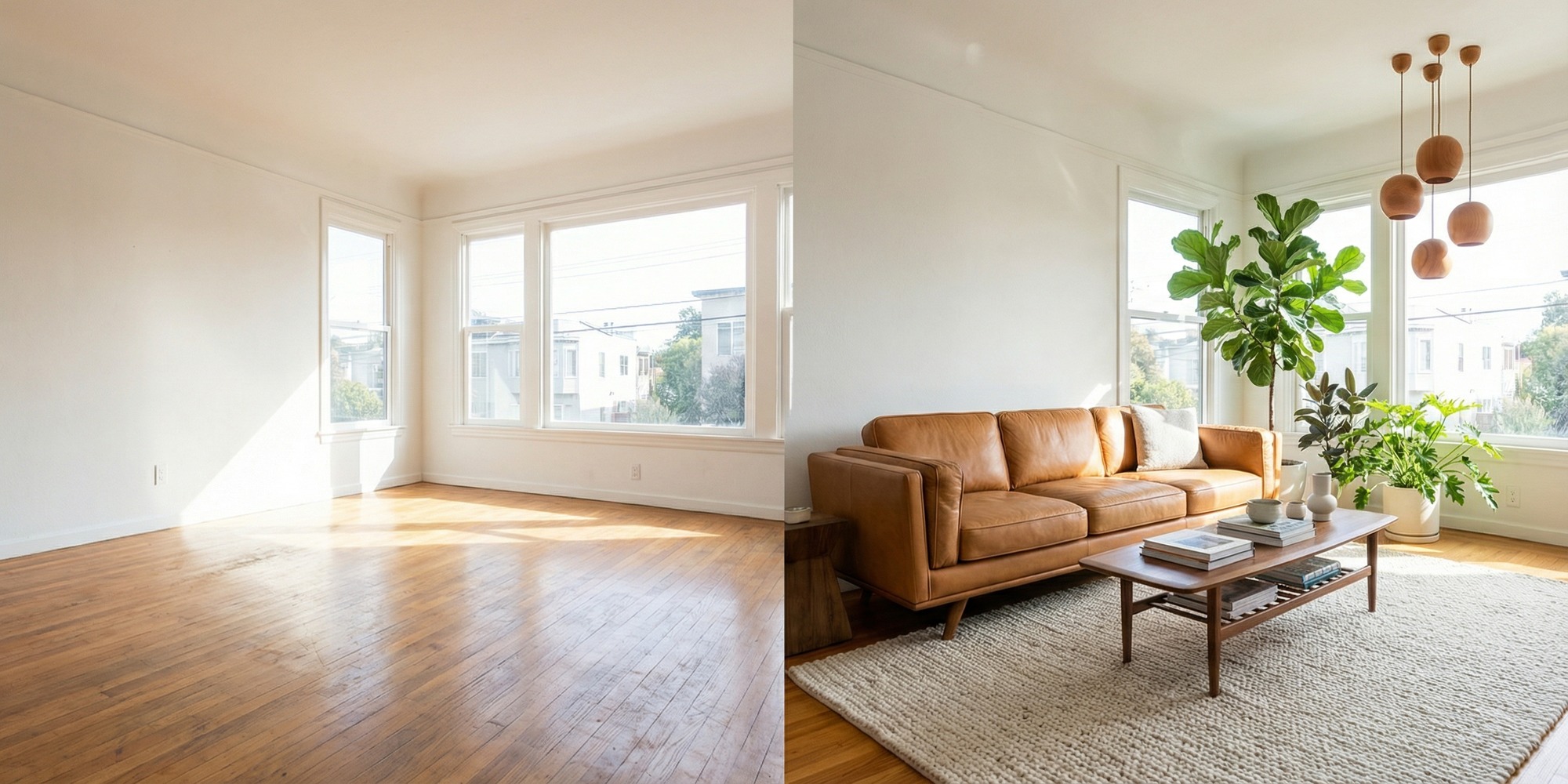
Every real estate agent has faced the same nightmare: a perfectly good fixer-upper sitting on the market while showings trickle in, buyers scroll past the listing photos, and the seller grows increasingly frustrated. The property has genuine value — good bones, a desirable location, an attractive price point — but online, it looks like a project nobody wants to take on. The problem isn’t the house. It’s the imagination gap.
Buyers who encounter an as-is or fixer-upper listing online face an almost impossible cognitive task: they must simultaneously see the property as it is today and envision what it could become after renovation. Most can’t do both at once. They scroll on. AI virtual staging bridges that gap — and for agents who know how to use it, it’s transforming one of the hardest listing categories into a competitive differentiator.
The Imagination Gap: Why Fixer-Upper Listings Underperform Online
The challenge isn’t unique to any market. Fixer-upper and as-is listings consistently generate fewer online inquiries per price bracket than comparable move-in-ready properties, and the reason is almost always the same: online listing photos set buyer expectations before the first showing ever happens.
According to the National Association of REALTORS® 2025 Profile of Home Staging, 83% of buyers’ agents report that staging a home made it easier for buyers to visualize the property as a future home. That figure rises to near-universal importance for vacant or distressed properties, where buyers have even less context to anchor their mental projection.
The implication for as-is listings is stark: if buyers cannot picture themselves — or a renovated version of the property — in the space, they disengage online before ever scheduling a showing. No showing means no offer. No offer means price reductions, extended days-on-market, and a frustrated seller relationship.
Traditional staging offers no practical solution here. You cannot stage over structural damage, deferred maintenance, or a property that genuinely needs work before occupancy. Even in livable-but-dated fixer-uppers, hiring a traditional staging company to move in furniture is expensive and often counterproductive — buyers still see the dated finishes, original fixtures, and worn flooring underneath.
AI virtual staging offers a fundamentally different approach: rather than physically masking a property’s condition, it digitally presents what the space could become.
How AI Virtual Staging Addresses As-Is Properties Differently
AI virtual staging tools don’t just add furniture to empty rooms. Modern platforms can digitally replace flooring, repaint walls, update fixtures, and swap out dated architectural elements — all within a photograph. For as-is and fixer-upper properties, this capability transforms the online presentation from “here’s what needs work” to “here’s what this could be.”
RealEstage.ai is designed precisely for this workflow. The platform allows agents to upload original property photos and apply targeted transformations — selecting from contemporary, transitional, and modern staging styles — to produce publication-ready images that show buyers the space’s potential. The turnaround is measured in minutes, not days, and the cost is a fraction of traditional staging.
For agents handling fixer-uppers regularly, this capability changes the listing math entirely. Instead of apologetically disclosing a property’s current state and hoping buyers can imagine better, you lead with what’s possible — and you include the property’s current condition photos alongside the staged versions for full transparency.
Practical Strategies by Fixer-Upper Category
Not all as-is listings are created equal. The staging strategy needs to match the property’s specific condition and the buyer persona most likely to purchase it.
Dated but Livable Properties
These are the most common fixer-upper type: properties built in the 1970s–1990s with original finishes that are functional but visually outdated. Popcorn ceilings, carpeted bedrooms, oak cabinets, brass fixtures. Nothing is broken — it just doesn’t photograph well.
For these listings, AI virtual staging is extraordinarily effective. The underlying structure is sound, the layouts are usable, and the transformation required is cosmetic. A skilled AI staging platform can replace carpet with hardwood flooring visually, update wall colors, swap in contemporary furniture, and modernize the overall aesthetic — all without touching the property.
The resulting photos tell a completely different story than the original. Buyers scrolling online see a home with a clear upgrade path, and the cognitive burden of imagination is lifted. Inquiries increase because the photos answer the question buyers were silently asking: “What would this look like if I updated it?”
Agents who handle dated-but-livable properties regularly report that using an AI-powered staging platform for this property type often produces their most dramatic photo transformations — and the most dramatic uptick in showing requests.
Vacant Properties with Deferred Maintenance
Vacant properties present a unique problem in every listing category, but that challenge intensifies when the property also shows deferred maintenance — scuffed walls, dated light fixtures, worn floors. Empty rooms with visible wear signals abandonment rather than opportunity.
For these listings, AI virtual staging serves a dual purpose: adding furniture to contextualize the space while simultaneously presenting a vision of what the property looks like when maintained and styled. The virtual staging tools at RealEstage.ai allow agents to address both dimensions in a single workflow, producing images that communicate livability even when the physical property currently falls short.
The practical rule is straightforward: always include both the original, unstaged photos and the AI-staged versions in the listing. Lead with the staged version in the primary photo position; provide the unstaged photos further in the gallery or in the disclosure section.
Properties with Cosmetic Damage Only
Water stains on ceilings, scuffed walls, damaged baseboards — these are technically fixer-upper issues, but they’re among the easiest and least expensive to address. They’re also highly penalizing in listing photos, where a water stain on a ceiling becomes the dominant visual in a room that might otherwise be attractive.
AI staging can be used here to create a representation of what the space looks like after simple cosmetic repair. Again, full disclosure is required — the actual condition must be communicated to buyers. But presenting the “repaired” version as part of your listing photos helps buyers understand that the issue is minor and the path to a presentable home is straightforward.
Major Renovation Candidates
At the far end of the spectrum are properties that require substantial renovation — outdated kitchens, original bathrooms from the 1950s, properties that have been partially renovated and abandoned. Here, AI virtual staging serves more as a conceptual tool than a presentation tool.
Rather than staging the existing space, agents can use AI-generated staged photos as part of a renovation vision package — showing buyers what the kitchen could look like with modern cabinetry, quartz countertops, and updated appliances. This isn’t a representation of the current state; it’s explicitly presented as a “renovation concept,” and disclosure language should make that unmistakably clear.
Used this way, AI staging becomes a selling tool in the listing presentation itself: you’re not just marketing the current property, you’re marketing the investment opportunity.
Disclosure Requirements: Compliance Is Non-Negotiable
AI-staged photos in any real estate listing require clear disclosure that the images have been digitally altered. For as-is and fixer-upper properties, this requirement takes on additional weight — buyers must understand that the staged version does not represent the current physical condition.
The National Association of REALTORS® Code of Ethics requires that REALTORS® not misrepresent properties or create false impressions through marketing materials. Virtually staged photos that do not accurately represent the current condition qualify as misrepresentation if they are presented without disclosure.
Best practice requires three layers of protection:
- Label every staged photo — include text in the image caption, MLS remarks, or directly on the photo stating “Virtually Staged” or “AI-Staged Rendering.”
- Include unstaged originals — always provide actual-condition photographs in the listing. Never use staged-only photos for a property in non-staged condition.
- Disclose in listing remarks — add explicit language to the public MLS remarks noting that some photos are AI-staged representations and that buyers should verify current condition through in-person inspection.
These three practices protect both the buyer and the agent, maintain ethical standards, and — critically — do not reduce the effectiveness of the staged photos. Buyers understand that virtual staging represents a vision, and they respond to it positively when the actual-condition photos are also present.
The Cost Math: AI Staging vs. Traditional Options for Fixer-Uppers
For a distressed or as-is property, traditional staging ranges from difficult to impossible. Moving furniture into a property with damaged floors, maintenance issues, or incomplete renovation means exposing the staging company’s inventory to damage and handling liability — most professional stagers will decline or quote significant premiums.
Even for livable but dated fixer-uppers, traditional staging quotes typically run $1,500 to $4,500 for a full home, with rental periods of four to six weeks. That cost falls on the agent, the seller, or both — and it still doesn’t address the fundamental issue that the dated finishes remain visible in every photo.
AI virtual staging through a platform like RealEstage.ai costs a fraction of that, with most full-home staging packages completing in under an hour and delivering results the same day. For agents working with sellers on tight budgets — which describes most as-is and fixer-upper seller situations — that cost difference is meaningful to the listing conversation.
The ROI case is straightforward: if AI staging converts even one additional showing into a purchase offer on a listing that would otherwise have sat for 60 days, the cost-benefit ratio is orders of magnitude in your favor.
Building the As-Is Listing Presentation: A Practical Workflow
Incorporating AI virtual staging into your as-is listing workflow doesn’t require a process overhaul. It adds a single step — and delivers substantially better listing photos in return.
Step 1: Professional photography first. Every as-is or fixer-upper listing still requires professional photography of the property as it currently exists. These photos serve dual purposes: the original-condition disclosure photos and the base images for AI staging.
Step 2: Select staging style and rooms. Identify the rooms that will benefit most from staging — living areas, primary bedroom, kitchen if cosmetic updates are being shown. Choose a staging style that matches the buyer demographic for that price point and location.
Step 3: Apply AI staging. Upload the professional photos to your AI staging platform and generate the staged versions. A complete-home staging workflow on RealEstage.ai typically completes within minutes.
Step 4: Review and select. Choose the staged versions that best represent the property’s potential. Edit or regenerate any rooms that need adjustment.
Step 5: Build the disclosure-compliant listing photo set. Lead with the best staged photo as your primary listing image. Organize the gallery to present staged versions first, followed by original-condition photos. Add “Virtually Staged” captions to all AI-generated images.
Step 6: Add disclosure language to your MLS remarks. A single sentence is sufficient: “Select photos are AI virtual staging representations. Original condition photos included in gallery. Buyers to verify property condition through independent inspection.”
This six-step workflow takes under two hours end-to-end for most properties and produces a listing package that out-presents the competition in every major buyer search platform.
The Bottom Line for Agents
Fixer-uppers and as-is listings have always been the hard cases in a real estate agent’s portfolio. They require more marketing effort, more buyer education, and more patience with sellers who often have unrealistic expectations about market interest. AI virtual staging doesn’t eliminate that complexity, but it removes the single biggest barrier to engagement: the inability of online buyers to see the property’s potential.
When buyers can see what a space could become — without requiring the imagination leap that most buyers can’t or won’t make during a 30-second online scroll — inquiry rates increase, showings happen, and negotiations begin. The property doesn’t change. The presentation does.
Agents who build AI virtual staging into their as-is listing workflow aren’t just improving their listing photos. They’re systematically closing a conversion gap that has cost agents and sellers time, money, and frustration for years. In a market where attention is the scarcest resource, showing buyers the potential isn’t optional — it’s the entire job.
If you haven’t yet built AI staging into your fixer-upper listing process, RealEstage.ai is the practical starting point — from upload to publication-ready photos in minutes, at a cost that makes sense for every price point.
Related Articles
- The Real Estate Agent’s Visual Marketing Stack: Pairing Professional Photography with AI Virtual Staging in 2026
- AI Exterior Virtual Staging: Transforming Curb Appeal and Listing First Impressions in 2026
- AI Virtual Staging for Second Homes and Vacation Rentals: The Complete Listing Playbook for 2026
- Vacant Listing AI Virtual Staging: The Complete Agent Guide for 2026
- AI Virtual Staging for Real Estate Listings in 2026: What Agents Need to Know
- Buyer Psychology and Virtual Staging: How Listing Photos Drive Faster Offers