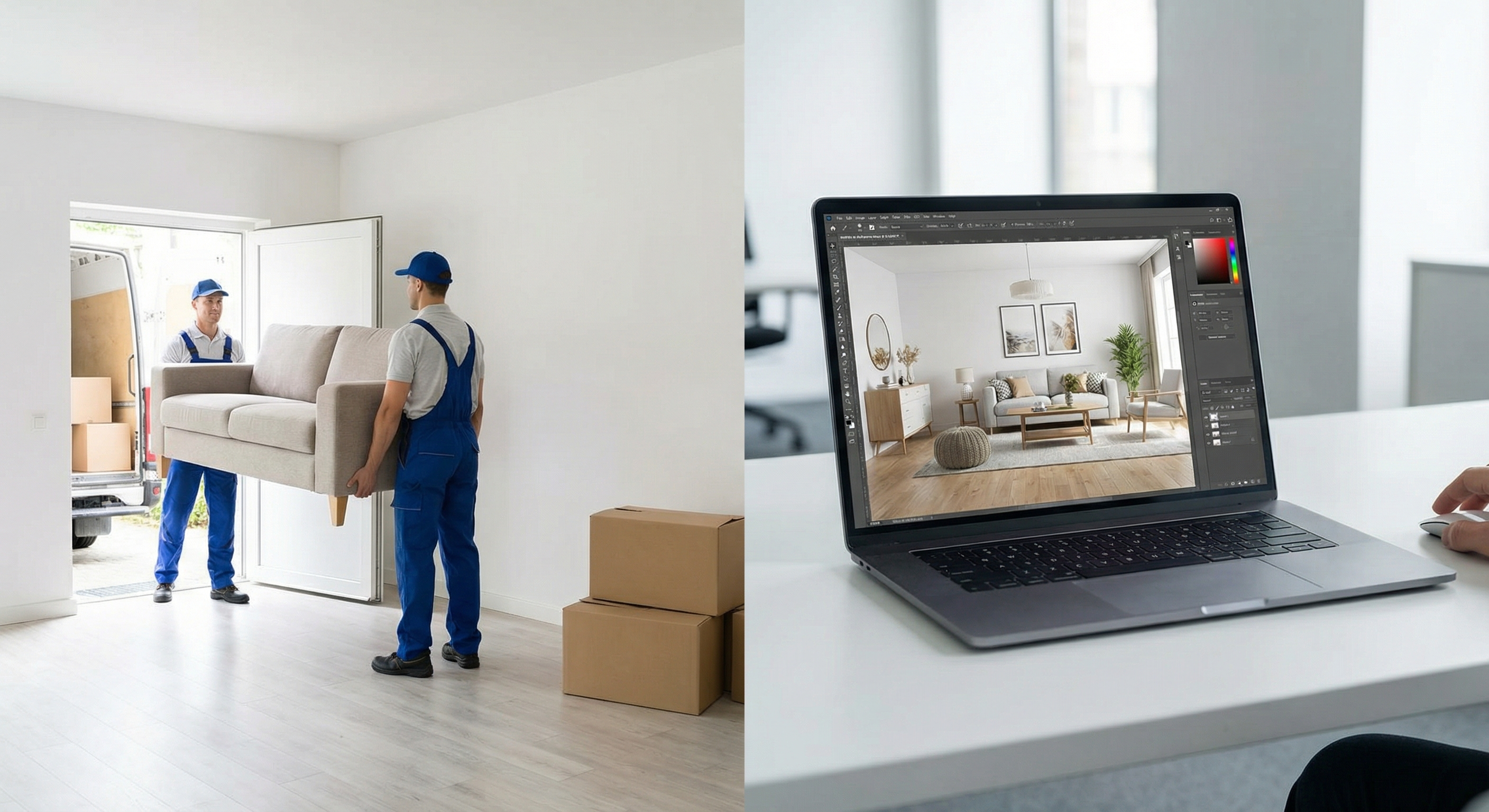
The debate between virtual staging and traditional staging is over. In 2026, the data is clear: virtual staging delivers better results at a fraction of the cost, with faster turnaround times and greater creative flexibility. AI-powered platforms like RealEstage.ai have transformed how agents market vacant properties, making professional staging accessible to every listing.
Here’s why virtual staging has become the default choice for top-performing agents.
Cost: Virtual Staging Wins by 95%
Traditional staging costs between $2,000 and $6,000 per property, depending on the size of the home and the quality of the furniture. That includes:
- Furniture rental fees
- Delivery and setup labor
- Ongoing monthly rental costs
- Removal and cleanup
Virtual staging, by contrast, costs between $50 and $150 per room using platforms like RealEstage.ai. For a typical three-bedroom home, that’s $150–$450 total versus $3,000+ for traditional staging.
The math is simple: Virtual staging costs 95% less than traditional staging while delivering comparable—or better—buyer engagement.
Speed: Hours Instead of Weeks
Traditional staging requires:
- Finding available furniture inventory
- Scheduling delivery (often 1-2 weeks out)
- Coordinating movers and stagers
- Waiting for setup day
- Photography after staging is complete
Total timeline: 2-4 weeks from decision to listed photos.
With AI virtual staging platforms like RealEstage, the process takes hours:
- Upload photos of empty rooms
- Select staging styles
- Generate staged images via AI
- Download and list immediately
Total timeline: Same day. Often within an hour.
In competitive markets where speed matters, virtual staging means your listing goes live weeks earlier—capturing buyer interest while competitors are still waiting for furniture delivery.
Flexibility: Unlimited Designs, Zero Physical Limits
Traditional staging locks you into one design style. If your stager brings mid-century modern furniture but buyers in your area prefer farmhouse chic, you’re stuck. Changing styles means scheduling new furniture delivery, additional costs, and more delays.
Virtual staging offers unlimited variations. Platforms like RealEstage.ai let you generate multiple staging styles for the same room:
- Modern minimalist for urban buyers
- Cozy traditional for family-oriented markets
- Luxury contemporary for high-end listings
- Industrial loft aesthetics for downtown condos
You can A/B test different styles, target multiple buyer demographics, and even update staging mid-listing if market feedback suggests a different approach would perform better.
Quality: AI Staging Rivals Professional Photography
Early virtual staging tools produced obvious, poorly-rendered images that hurt credibility. Modern AI platforms have closed the quality gap entirely.
RealEstage.ai uses advanced generative AI models trained on millions of professionally staged interiors. The result is photorealistic staging that seamlessly integrates furniture, lighting, shadows, and reflections into the original photo.
Buyers can’t tell the difference—and that’s the point. The goal isn’t to deceive; it’s to help buyers visualize the potential of the space. Virtual staging does this as effectively as physical staging, without the logistical overhead.
Scalability: Stage Every Listing, Not Just Luxury Homes
Traditional staging economics mean most agents only stage high-end listings where the ROI justifies the $3,000+ investment. Mid-market and entry-level homes are often listed with empty rooms—resulting in longer days on market and lower sale prices.
Virtual staging democratizes professional presentation. At $50-150 per room, every listing becomes economically viable to stage. Agents using platforms like RealEstage report staging 100% of their vacant listings, regardless of price point.
The result: Faster sales and higher close rates across the entire portfolio.
Environmental Impact: Zero Waste, Zero Carbon Footprint
Traditional staging generates significant environmental costs:
- Diesel trucks delivering furniture across town
- Wear and tear on rental furniture requiring eventual disposal
- Energy costs of warehousing inventory
- Packaging waste from repeated moves
Virtual staging produces zero physical waste and minimal energy consumption (a few cloud server cycles to generate images). For environmentally conscious sellers and buyers, this matters.
When Traditional Staging Still Makes Sense
Virtual staging isn’t the right choice for every scenario. Consider traditional staging when:
- Open houses are critical to your marketing plan and buyers expect to walk through furnished spaces
- Ultra-luxury properties ($5M+) where buyers expect in-person, high-touch experiences
- Architectural showcases where physical furniture serves as scale reference for unusual room layouts
For most residential listings under $2M, virtual staging delivers better results at lower cost.
How Agents Are Using Virtual Staging in 2026
Top-performing agents are adopting hybrid strategies:
- Virtual staging for MLS photos and online marketing (where 95% of buyers start their search)
- Empty open houses with tablets showing staged renderings in each room
- Traditional staging reserved only for luxury listings with extended marketing timelines
This approach maximizes buyer engagement online (where decisions are made) while minimizing costs.
Platforms like RealEstage.ai make implementation simple: Upload photos, select styles, generate staged images, and list within hours.
The Bottom Line
Virtual staging beats traditional staging on cost (95% cheaper), speed (same-day vs. weeks), flexibility (unlimited styles), and scalability (stage every listing). AI virtual staging tools like RealEstage have reached professional quality standards that rival physical staging in buyer engagement.
The question isn’t whether to use virtual staging—it’s whether you can afford not to in a competitive market where speed and presentation determine which listings win.
For agents still using traditional staging by default, 2026 is the year to make the switch.
Dive deeper into the data with The ROI of Virtual Staging and avoid common pitfalls with 5 Virtual Staging Mistakes That Cost You Sales.
Frequently Asked Questions
Is virtual staging better than traditional staging?
In most cases, yes. Virtual staging costs 95% less, delivers results in minutes instead of days, offers unlimited design flexibility, and performs within 5% of physical staging on key metrics like days on market and sale price premium.
How much cheaper is virtual staging than traditional staging?
Virtual staging costs $100-$250 for a full home compared to $3,000-$5,000 for traditional staging — a 95% cost reduction. This makes professional staging accessible for every listing, not just luxury properties.
Can buyers tell the difference between virtual and physical staging?
With modern AI platforms like RealEstage.ai, the difference is nearly imperceptible. AI staging accounts for room geometry, lighting, shadows, and perspective to create photorealistic results that buyers respond to just like physical staging.