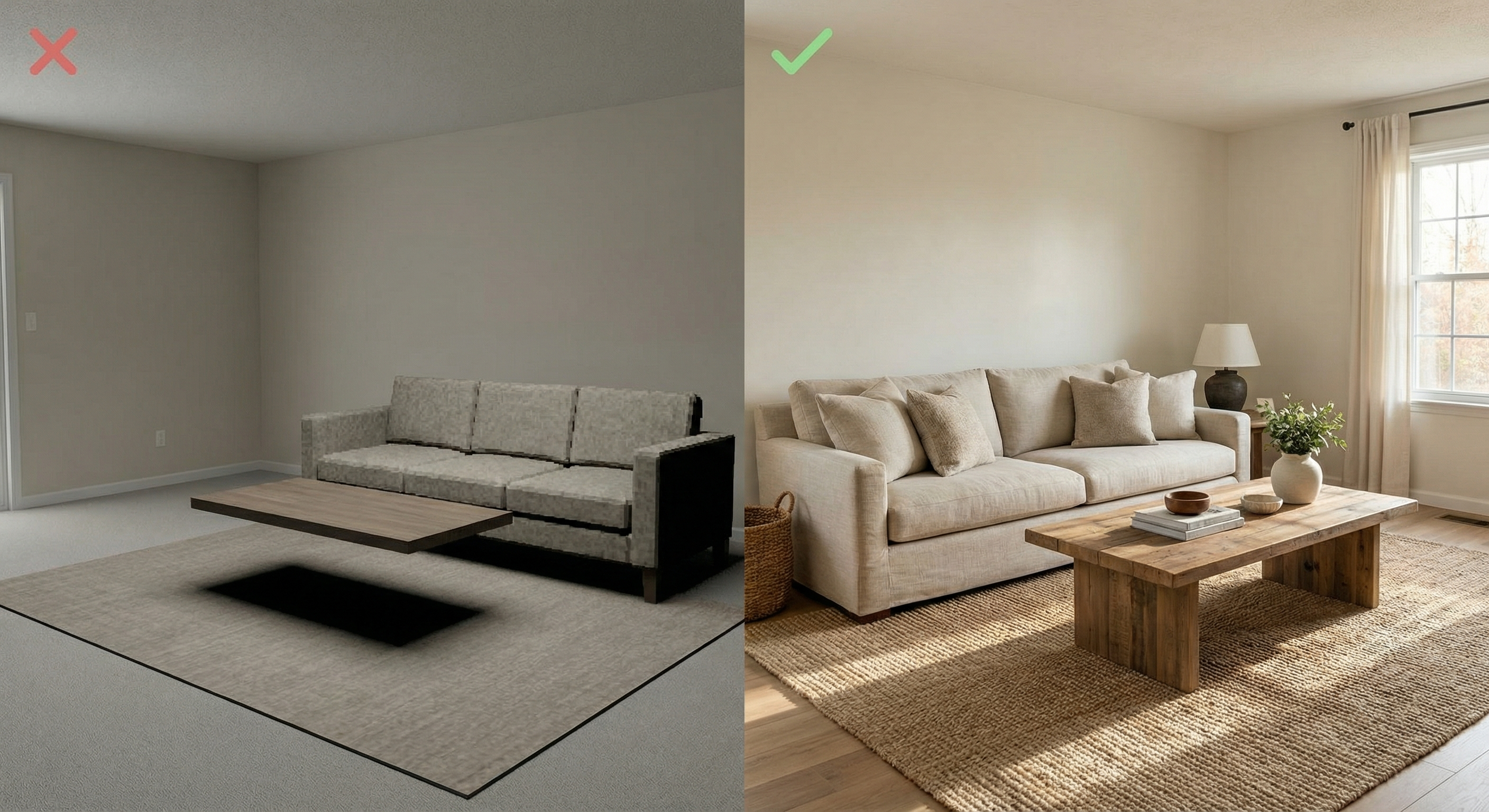
Virtual staging is a powerful tool—when done right. But poor-quality staging can backfire spectacularly, damaging buyer trust and costing you sales. In 2026, buyers have seen enough badly-staged listings to spot the red flags instantly.
Here are the five most common virtual staging mistakes that hurt your credibility—and how to avoid them.
1. Using Obvious, Low-Quality Rendering
The Mistake: Choosing cheap virtual staging services that produce cartoonish furniture, incorrect lighting, or mismatched shadows. The furniture looks pasted in rather than naturally integrated into the space.
Why It Fails: Buyers immediately recognize fake-looking staging. Instead of helping them visualize the space, it raises questions: “If they cut corners on staging, what else are they hiding?”
Poor-quality staging signals desperation and undermines the entire listing presentation.
The Fix: Use professional-grade AI staging platforms like RealEstage.ai that generate photorealistic renderings with proper lighting, shadows, reflections, and scale. Modern AI models trained on millions of real staged photos produce results indistinguishable from traditional staging.
RealEstage specifically uses advanced diffusion models that integrate furniture naturally into the original photograph, preserving lighting conditions and architectural details.
2. Overstaging Rooms
The Mistake: Cramming too much furniture into a room. Oversized sofas, unnecessary accent chairs, crowded coffee tables, and excessive decor that makes spaces feel smaller than they are.
Why It Fails: The entire point of staging is to help buyers visualize themselves in the space. Overstaging creates the opposite effect—rooms feel claustrophobic and unusable.
Buyers mentally subtract furniture when they see overstaged rooms, defeating the purpose of staging entirely.
The Fix: Less is more. Professional staging—virtual or traditional—uses minimal furniture to define the room’s function without overwhelming the space.
AI virtual staging tools like RealEstage.ai offer “minimal” and “cozy” style options specifically designed to enhance spaciousness rather than fill every corner.
Rule of thumb: If more than 40% of floor space is covered by furniture, you’ve overstaged.
3. Ignoring Architectural Accuracy
The Mistake: Adding furniture that doesn’t respect the room’s actual dimensions. Sofas that float in the middle of the room with no adjacent walls. Beds positioned where windows or doors would actually be. Furniture at impossible scales.
Why It Fails: Buyers visit properties in person. When the staged photos show furniture configurations that are physically impossible in the real room, trust evaporates instantly.
This is the fastest way to generate negative reviews and angry buyer feedback.
The Fix: Use virtual staging platforms that respect room geometry. RealEstage analyzes room dimensions, window placement, and door locations to ensure furniture placement is architecturally accurate.
Before finalizing staging, ask yourself: “Could this furniture actually fit in this space the way it’s shown?” If the answer is no, revise.
4. Mismatching Style to Market
The Mistake: Staging a suburban family home with ultra-modern minimalist furniture, or staging a downtown loft with traditional farmhouse decor. Ignoring the target buyer demographic.
Why It Fails: Staging should help the right buyers visualize themselves in the space. When staging style clashes with buyer expectations for that neighborhood or price point, it creates cognitive dissonance that slows sales.
The Fix: Match staging style to your target market:
- Suburban family homes: Warm, inviting, traditional or transitional styles
- Urban condos: Modern, minimalist, industrial aesthetics
- Luxury estates: Elegant, sophisticated, high-end contemporary
- Vacation properties: Relaxed, coastal, or resort-inspired staging
Platforms like RealEstage.ai offer market-specific staging templates designed for different property types and buyer demographics. Choose styles that align with who’s buying in your area.
5. Failing to Disclose Virtual Staging
The Mistake: Not clearly indicating that photos are virtually staged. Buyers arrive at showings expecting furnished rooms and find them empty—creating disappointment and distrust.
Why It Fails: This is both an ethical issue and, in many states, a legal disclosure requirement. Failing to disclose virtual staging can result in:
- Angry buyers who feel deceived
- Negative reviews and reputation damage
- Potential fair housing complaints
- Lost sales from buyers who lose trust
The Fix: Always include clear disclosure language in listings:
“Photos have been virtually staged to illustrate potential.”
Or:
“This property is vacant. Staging is for visualization purposes only.”
Most MLS systems have fields specifically for virtual staging disclosures. Use them. Professional platforms like RealEstage.ai automatically generate disclosure-ready captions for staged images.
Transparency builds trust. Buyers appreciate visualization tools when they’re presented honestly.
Quality Matters: Choose the Right Platform
Not all virtual staging services are created equal. The difference between amateur and professional results comes down to:
- AI model quality — Modern diffusion models vs. outdated template overlays
- Architectural accuracy — Geometry-aware placement vs. arbitrary positioning
- Lighting integration — Natural shadow and reflection rendering
- Style variety — Market-specific options vs. one-size-fits-all templates
RealEstage.ai was built specifically to address these quality gaps, offering real estate professionals photorealistic AI staging that rivals traditional staging in buyer engagement—without the logistical overhead.
The Bottom Line
Virtual staging is a powerful sales tool when executed professionally. Avoid these five mistakes—low-quality rendering, overstaging, architectural inaccuracy, style mismatches, and disclosure failures—and your virtually staged listings will outperform both empty and traditionally staged properties.
In 2026, buyers expect professional presentation across all marketing channels. Virtual staging platforms like RealEstage make that standard achievable for every listing, regardless of budget.
The agents who win are the ones who treat virtual staging as seriously as traditional photography—because buyers certainly do.
Master the fundamentals with our Complete Guide to AI Virtual Staging and understand the numbers in The ROI of Virtual Staging.
Frequently Asked Questions
What are the biggest virtual staging mistakes?
The five biggest mistakes are using low-quality rendering, over-staging rooms with unrealistic furniture, failing to disclose staged photos, inconsistent staging across a listing, and ignoring the target buyer demographic when selecting design styles.
How do I avoid bad virtual staging?
Use a professional AI staging platform like RealEstage.ai that produces photorealistic results, match staging styles to your target buyer, disclose all staged images per MLS rules, stage every room consistently, and always include original unedited photos.
Do buyers trust virtually staged photos?
Buyers trust virtual staging when it is done professionally and disclosed transparently. High-quality AI staging from platforms like RealEstage.ai produces results nearly indistinguishable from physical staging, building buyer confidence rather than eroding it.