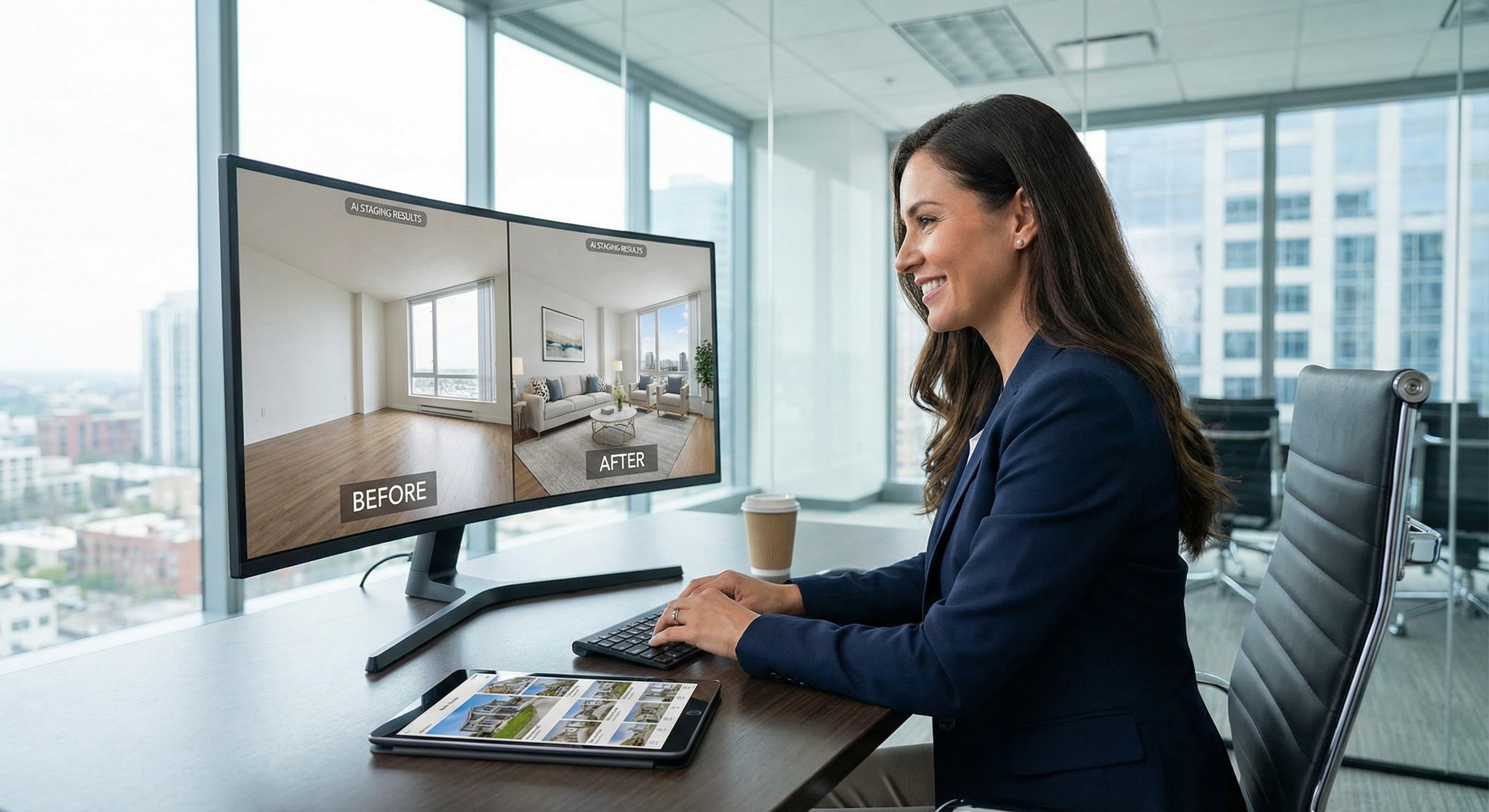
The most successful real estate agents in 2026 share a common advantage: they list properties 3-4 weeks faster than their competition. Their secret isn’t working harder — it’s leveraging AI virtual staging to eliminate the traditional staging bottleneck.
Here’s exactly how top performers are using AI staging platforms like RealEstage.ai to close deals 30% faster while spending 95% less on staging costs.
The Traditional Staging Bottleneck
Traditional staging creates a predictable delay:
- Week 1: Find available staging inventory, negotiate rental terms
- Week 2-3: Schedule delivery, coordinate movers, wait for stager availability
- Week 4: Physical staging day, professional photography
- Week 5: Finally list the property
Total timeline: 4-5 weeks from vacant property to active listing.
During those critical weeks, market conditions shift, buyer interest cools, and competing listings capture attention. Every day of delay costs sellers money and agents opportunities.
How AI Staging Eliminates the Wait
Top-performing agents have compressed that 4-5 week timeline into same-day execution:
Morning: Photograph vacant property
Afternoon: Upload photos to RealEstage.ai, generate staged images
Evening: Review, approve, and list property with full staging
Total timeline: 8 hours from vacant to listed.
This speed advantage translates directly to sales velocity. Properties listed at peak market timing with professional staging capture buyer interest during the most critical window — the first 48 hours online.
The Winning AI Staging Workflow
Here’s the exact process elite agents use:
1. Strategic Photography Planning
Before the photo shoot, agents identify which rooms need staging emphasis:
- Living room, primary bedroom, kitchen: Always stage (highest buyer impact)
- Dining room, additional bedrooms: Stage for mid-market and up
- Home office, bonus rooms: Stage to define room purpose
This targeted approach optimizes budget while maximizing buyer visualization.
2. High-Quality Base Photography
AI staging quality depends on input quality. Top agents ensure:
- Professional-grade wide-angle shots (16-24mm lens)
- Proper exposure and white balance
- Multiple angles per room for staging flexibility
- Clean, decluttered spaces (AI can add furniture, not remove clutter)
Pro tip: Many agents use the same photographer for both vacant and occupied listings to maintain consistent quality standards.
3. Style Matching to Buyer Demographics
Rather than one-size-fits-all staging, successful agents select staging styles based on target buyers:
| Property Type | Target Buyer | Staging Style on RealEstage.ai |
|---|---|---|
| Suburban family home | Young families | Warm traditional, cozy transitional |
| Urban condo | Young professionals | Modern minimalist, industrial chic |
| Luxury estate | High-net-worth buyers | Sophisticated contemporary |
| Vacation property | Second-home buyers | Coastal, resort-inspired |
RealEstage offers 20+ design styles specifically categorized by buyer demographic, making this selection process simple.
4. Multi-Variation Testing
Elite agents generate 2-3 staging variations for key rooms:
- Test different furniture layouts
- Try multiple design styles
- A/B test which versions generate more showing requests
AI virtual staging platforms make this experimentation affordable. At $30 per variation versus $3,000 per physical staging change, agents can optimize presentation without budget constraints.
5. Hybrid Open House Strategy
The most effective approach combines virtual staging with strategic in-person presentation:
Online (where 95% of buyers start):
- MLS photos: Fully virtually staged
- Virtual tours: Staged renderings
- Social media: Staged beauty shots
In-Person Showings:
- Property remains empty (no rental costs, maintenance, or damage risk)
- Tablet in each room displaying staged rendering
- Buyers see potential while walking through actual space
This hybrid strategy delivers physical staging’s emotional impact at virtual staging’s cost and speed.
Real Performance Data
Agents using this AI staging workflow report consistent results:
- 30% reduction in days on market (median 21 days vs. 30 days for unstaged)
- 61% more online views in first week compared to empty listings
- 40% more showing requests within first 10 days
- 5-8% higher sale prices on average
- $2,800 average cost savings per listing vs. traditional staging
The math is compelling: faster sales + higher prices + lower costs = significantly better outcomes for both agents and sellers.
Common Implementation Mistakes to Avoid
Even with the right tools, execution matters. Avoid these pitfalls:
Mistake #1: Inconsistent Quality
Don’t mix professionally staged rooms with empty rooms in the same listing. If you’re staging the living room, stage the other main rooms too. Buyers notice inconsistency.
Mistake #2: Over-Staging
More furniture isn’t better. Follow the 40% rule: no more than 40% of visible floor space should be covered. Professional platforms like RealEstage.ai default to optimal furniture density.
Mistake #3: Ignoring Disclosure Requirements
Always indicate staged photos clearly. Use MLS disclosure fields and include language like “Photos have been virtually staged to illustrate potential.” Transparency builds trust.
Mistake #4: Set-It-And-Forget-It
Monitor performance. If a listing isn’t generating showing requests after 7 days, try different staging styles. AI staging’s flexibility is an advantage — use it.
The Technology Behind the Speed
Modern AI staging platforms have solved the quality problems that plagued early virtual staging:
Advanced AI models (like those used by RealEstage.ai) now:
- Analyze room geometry to place furniture at correct scale and perspective
- Match lighting conditions, shadows, and reflections from original photo
- Understand architectural constraints (doors, windows, built-ins)
- Generate variations maintaining consistent design coherence
The result is staging quality indistinguishable from professional physical staging — at 5% of the cost and 1% of the time.
Getting Started: Implementation Checklist
Ready to adopt this workflow? Here’s your launch plan:
Week 1: Setup
- Select AI staging platform (evaluate RealEstage.ai trial)
- Test with one vacant listing
- Create staging style guide matching your market demographics
Week 2-3: Training
- Brief photographers on staging-optimized shooting techniques
- Practice generating variations and selecting optimal versions
- Develop tablet-based showing presentation
Week 4+: Scale
- Roll out to 100% of vacant listings
- Track performance metrics (DOM, showing requests, sale price)
- Refine staging styles based on buyer feedback
Most agents report full workflow proficiency within 2-3 listings.
The Competitive Advantage
Real estate is a speed game. The agent who lists first, presents best, and adapts fastest wins.
AI staging platforms like RealEstage have compressed the staging timeline from weeks to hours. Agents using this technology are listing properties while competitors are still scheduling stager consultations.
In competitive markets, this timing advantage is decisive. Buyers who see your professionally presented listing first are the buyers you convert.
The Bottom Line
Top agents sell homes 30% faster not because they work harder, but because they’ve eliminated staging-related delays. AI virtual staging is the catalyst for this performance improvement.
The workflow is simple: photograph vacant space, generate professional staging within hours, list immediately, and close faster. The cost is negligible compared to traditional staging. The competitive advantage is significant.
For agents still waiting weeks for physical staging delivery, the question isn’t whether to adopt AI staging — it’s how much market share they’re willing to lose to competitors who already have.
Learn more about AI staging in our Complete Guide to AI Virtual Staging and avoid common pitfalls with 5 Virtual Staging Mistakes That Cost You Sales. Compare costs and timelines in Why Virtual Staging Beats Traditional Staging in 2026.
Frequently Asked Questions
How long does it take to learn AI virtual staging?
Most agents are fully proficient with AI staging platforms after 2-3 listings. The process is intuitive: upload photos, select design styles, and generate images. Platforms like RealEstage.ai require no design expertise or technical training.
Can I use AI staging for luxury properties?
Yes. Modern AI staging produces photorealistic results suitable for properties at any price point. Many luxury agents use virtual staging for online marketing while reserving physical staging for extended open house periods during longer sales cycles.
What happens if buyers arrive expecting furnished rooms?
This is avoided through proper disclosure. Always indicate staged photos clearly in MLS listings. Best practice is showing staged renderings on tablets during walk-throughs so buyers see both the potential (staged) and reality (vacant) simultaneously.
Does AI staging work for unusual or custom homes?
Yes. AI staging handles unique room configurations, architectural features, and custom layouts. RealEstage.ai specifically uses geometry-aware AI that respects room dimensions, ceiling heights, and built-in features when placing furniture.