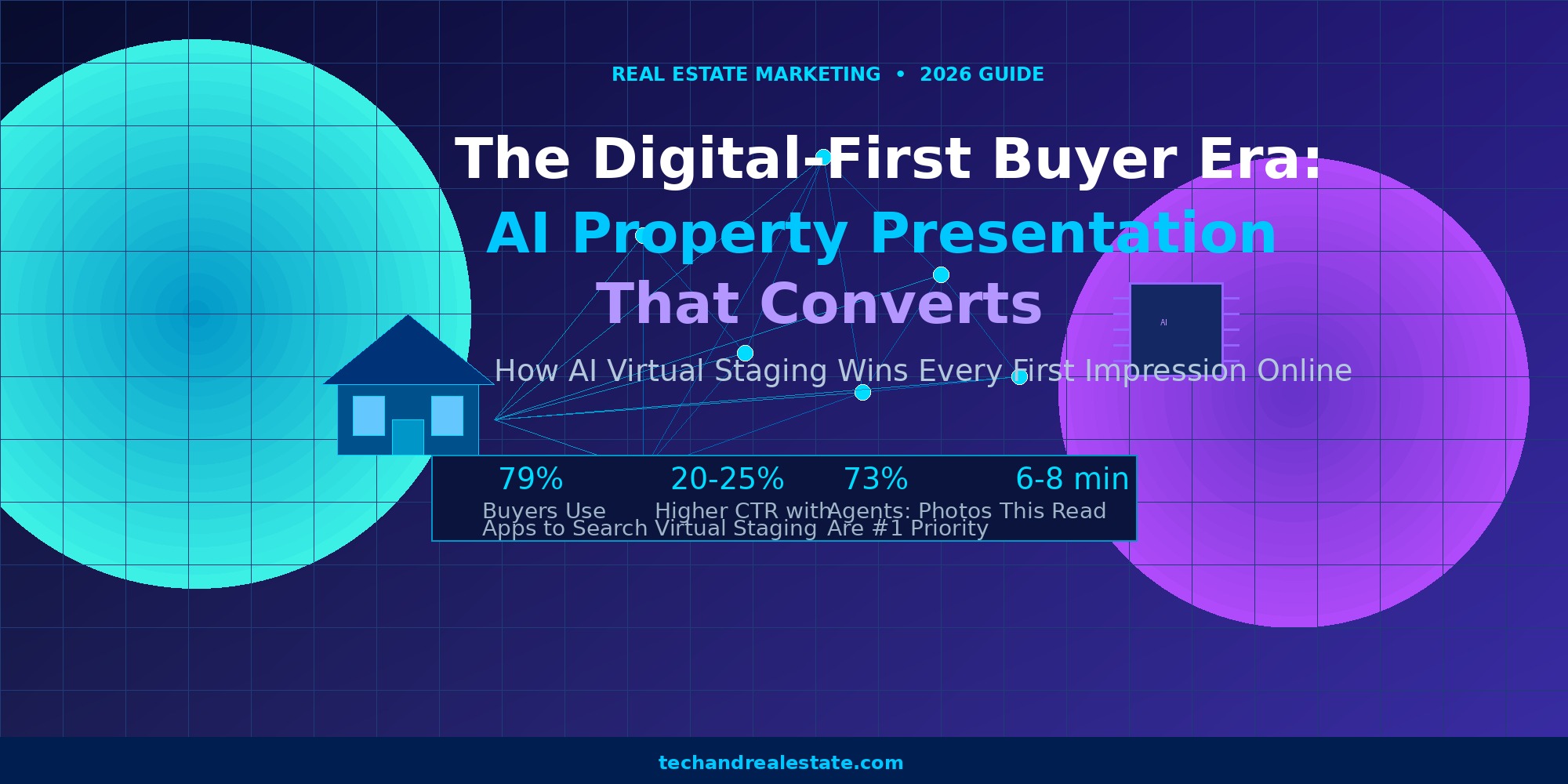
The numbers don’t lie, and they’re impossible for serious real estate agents to ignore: 79% of prospective buyers now use a real estate app during their home-buying journey, according to Zillow’s latest consumer research. Another 51% find their eventual home online first, per the National Association of Realtors. The living room couch has replaced the open house as the first showing — and your listing photos are doing the selling before a single human connection is made.
This is the digital-first buyer era, and it demands a fundamental rethink of property presentation. Agents who adapt their visual marketing strategy to meet buyers where they actually are — scrolling through portals on their phones at 11 PM — are winning listings, reducing days on market, and building the kind of reputation that generates referrals. Those who haven’t adapted are watching perfectly good properties languish.
The central tool driving this shift? AI-powered virtual staging — and the gap between agents who use it effectively and those who don’t is widening fast.
Why the First 3 Seconds Determine Everything
Real estate portals are extraordinarily competitive environments. A buyer scrolling through Zillow or Realtor.com spends an average of three seconds or less on a listing’s thumbnail before deciding to click or scroll past. This isn’t browsing — it’s a visual beauty contest conducted at machine speed.
In this environment, empty rooms are a conversion disaster. An unfurnished bedroom communicates “unloved,” “difficult to visualize,” and “probably cheap” — none of which is accurate, but all of which get communicated instantaneously before rational thought kicks in.
Furnished rooms, by contrast, tell a story. They answer the buyer’s most fundamental question: Can I imagine my life here? The faster you can make that imagination click into place, the faster a browser becomes an appointment.
This psychology is exactly why the NAR’s 2025 Profile of Home Staging found that 73% of buyers’ agents rated photos as the single most important element of a listing — ahead of video tours, floor plans, and even virtual tours. The still image remains the decisive moment of engagement.
The AI Virtual Staging Advantage: What’s Actually Changed in 2026
Virtual staging as a concept has existed for over a decade — but the results from early tools were unconvincing. Furniture looked pasted-in. Lighting didn’t match. Buyers could spot the artificiality, and savvy agents knew it undermined rather than enhanced trust.
That era is over.
Modern AI staging platforms — like RealEstage.ai — have fundamentally solved the photorealism problem. By training on millions of real interior photographs and learning to understand spatial depth, natural lighting conditions, surface materials, and architectural proportions, today’s AI staging produces images that are genuinely indistinguishable from professional interior photography to the average buyer.
The practical implications are significant:
Speed: Hours to Minutes
Traditional virtual staging by a skilled designer took 24-72 hours per image and required detailed briefings about style preferences. AI staging delivers photorealistic results in minutes, not days. An agent photographing a property at 10 AM can have a fully staged, portal-ready listing by noon.
Cost: $200–$500 vs. Thousands
Physical staging for a vacant three-bedroom home can cost $2,000–$5,000 per month. Professional virtual staging with human designers runs $100–$300 per image. AI virtual staging through platforms like RealEstage.ai costs a fraction of that — often $10–$30 per image with batch pricing — making high-quality presentation accessible for every listing, not just luxury properties.
Flexibility: Multiple Styles in One Session
One of the most underappreciated advantages of AI staging is the ability to generate multiple design styles from the same photograph. A single vacant room can be staged in Scandinavian minimalist, warm contemporary, modern farmhouse, and urban loft aesthetics — each targeting a different buyer demographic. This A/B testing capability for listing photos is simply impossible with traditional staging.
Consistency: Every Room, Every Time
Physical staging prioritizes high-traffic rooms and often ignores secondary bedrooms, laundry rooms, and utility spaces. AI staging allows agents to economically present every room of a property at its potential best — creating a more complete and compelling listing package.
The Conversion Math: What the Data Shows
The case for AI virtual staging isn’t just qualitative — the performance data is compelling:
- 20-25% higher click-through rates on listings with virtual staging vs. empty room photos (MarketingLTB, 2025)
- 29% of agents report staged listings receive 1–10% higher offers from buyers (NAR, 2025)
- Staged homes sell faster — fewer days on market mean lower carrying costs for sellers and fewer price reductions
- Higher-quality listing photos correlate directly with increased time-on-listing, which signals greater buyer engagement and interest to portals’ ranking algorithms
When a $500,000 home sells for 5% more because the listing commanded attention and sparked emotional investment, that’s $25,000 in additional value creation — from photos that cost the agent a few hundred dollars. The ROI mathematics are almost absurdly favorable.
Building a Digital-First Listing Presentation Strategy
Understanding the technology is step one. Building a repeatable system around it is where agents genuinely separate themselves. Here’s how high-performing agents are structuring their digital-first presentation workflow in 2026:
Step 1: Pre-Photography Preparation
Before the photographer even arrives, successful agents are thinking in terms of portal performance. This means:
- Declutter aggressively — AI staging can’t fix physical clutter in the actual photos
- Identify hero shots — the 3-5 images that will appear in the portal thumbnail carousel
- Plan staging by room type — living rooms and primary bedrooms carry the most weight
- Capture at optimal light — AI staging works best with good natural light source photos
Step 2: AI Staging at Scale
After photography, the modern workflow feeds images directly into an AI virtual staging platform to furnish vacant rooms, remove existing furniture from cluttered spaces, and generate style variants for testing. The goal is a complete, photorealistic listing package within 24 hours of the photo shoot.
Step 3: Hero Image Selection
Not all staged photos are created equal. The best agents develop an eye for which images will perform in portal thumbnails — typically wide-angle living room or kitchen shots with warm lighting, visible depth, and aspirational but not over-the-top styling. Test with colleagues or clients before finalizing the hero image.
Step 4: Listing Copy Optimization
Photos drive the click; copy drives the showing request. Modern AI tools — including features integrated into platforms like RealEstage.ai — can generate compelling listing descriptions that reflect the aesthetic story your staging tells. Consistent visual-verbal branding increases trust.
Step 5: Multi-Channel Distribution
A staged listing package shouldn’t stop at the MLS. High-performing agents distribute staged images across Instagram, Facebook Marketplace, LinkedIn (for investment properties), and email campaigns to their buyer prospect lists. AI staging makes it economically viable to create social-optimized cropped versions of the same images for different platforms.
The Disclosure Question: Transparency as a Trust Signal
A legitimate question agents face: how do you disclose AI-staged images ethically without undermining their impact?
The answer is simpler than most agents fear. Industry best practice — and increasingly, regulatory expectation — is a brief disclosure in the listing description: “Some photos may include virtually staged furnishings to help buyers visualize the space.” This language is:
- Legally protective — transparent disclosure protects agents and sellers from misrepresentation claims
- Buyer-trusted — modern buyers are sophisticated and expect digital enhancement; transparency builds credibility
- Practically inconsequential — disclosed or not, buyers respond to beautiful photos; the emotional engagement happens before the fine print is read
The agents most nervous about disclosure are usually those who haven’t seen high-quality AI staging results. Once you’ve seen what RealEstage.ai’s virtual staging produces, the disclosure anxiety disappears — the images speak for themselves.
Beyond Staging: The Full AI Property Marketing Stack
Virtual staging is the most visible application of AI in property presentation, but it’s part of a broader transformation in how listings are marketed. Forward-thinking agents are building comprehensive AI-powered marketing workflows:
Property Description Generation: AI analyzes listing details, neighborhood data, and target buyer demographics to generate multiple versions of listing copy optimized for different platforms and buyer personas.
Market-Appropriate Staging Styles: AI tools increasingly analyze comparable sold properties in a neighborhood to recommend staging aesthetics that have resonated with local buyers — reducing guesswork and increasing relevance.
Automated Social Media Content: AI generates caption variations, hashtag strategies, and story formats from the same base images, dramatically reducing the time agents spend on content creation.
Predictive Buyer Matching: Advanced platforms analyze buyer search behavior to identify which prospects are most likely to engage with a specific property — allowing for more targeted digital outreach.
Agents who adopt this full-stack approach aren’t just saving time — they’re systematically building a competitive advantage that compounds with every listing. RealEstage.ai’s comprehensive platform is designed to support agents at each stage of this workflow, from initial staging through marketing distribution.
What Sellers Are Asking For
One shift that often surprises agents: sellers are now driving the demand for AI staging. Sellers have done their own research. They’ve seen beautiful AI-staged listings and watched properties nearby sell quickly. They’re asking agents directly: “Are you going to stage it virtually?”
This creates a significant listing presentation opportunity. Agents who can demonstrate a concrete AI-powered marketing workflow — walk into a listing appointment with examples of their past AI-staged listings and the sale performance behind them — win listings against competitors who are still presenting the same-old marketing deck.
The value proposition to sellers is clear:
- Lower upfront cost than physical staging
- Faster time to market — no waiting for furniture delivery
- Higher-quality photos that perform on portals
- Proven results — higher offer prices and fewer days on market
Agents using RealEstage.ai can incorporate specific platform results and case studies into their listing presentations, making the pitch concrete and credible.
Getting Started: Your 30-Day AI Presentation Upgrade
For agents ready to upgrade their listing presentation strategy, here’s a practical 30-day roadmap:
Week 1: Benchmark Your Current Performance Pull analytics on your last 5-10 listings: click-through rates, days on market, list-to-sale price ratios. This is your baseline. You need it to measure the improvement AI staging delivers.
Week 2: Pilot with One Listing Choose an upcoming vacant or minimally furnished listing and commit to a full AI staging treatment. Use a platform like RealEstage.ai to stage every key room in 2-3 style variations. Compare click performance against your baseline listings.
Week 3: Build Your Listing Presentation Story Document your pilot results and build them into your listing appointment presentation. Before-and-after photos, click data, final sale price — make the case visually and with numbers.
Week 4: Systematize and Scale Establish a consistent workflow: photography → AI staging → hero image selection → portal upload → social distribution. What took you 3 days in week 2 should take 4 hours by week 4. The system compounds.
The Bottom Line
The digital-first buyer era isn’t coming — it’s here. With 79% of buyers starting their search on apps and portals, the quality of a listing’s visual presentation is now the primary determinant of showing requests, competitive offers, and sale prices. Agents who treat property photography as a checkbox are leaving money on the table — theirs and their clients’.
AI virtual staging has solved the accessibility problem that limited this technology to luxury listings a few years ago. The photorealism is there. The speed is there. The economics are extraordinarily favorable. The only missing ingredient is the agent’s decision to commit to a digital-first presentation standard.
The buyers are already digital-first. It’s time for the listings to catch up.
Ready to transform your listing presentation? Start your free trial with RealEstage.ai and see the difference AI staging makes on your next listing — today.
Sources: Zillow Consumer Housing Trends Report 2025; National Association of Realtors Profile of Home Staging 2025; MarketingLTB Real Estate Marketing Statistics 2025; Florida Realtors “The Next Era in Real Estate Marketing” 2026.