The average real estate agent spends 18-25 hours marketing each listing—writing descriptions, editing photos, creating social media content, designing flyers, and coordinating staging. Meanwhile, listings that hit the market with exceptional marketing materials generate 3x more qualified inquiries and sell 30-45 days faster than those with basic presentation.
This workflow guide shows exactly how high-performing agents use AI to dramatically reduce marketing time while simultaneously improving results. If you’re still manually editing every photo and writing every social post from scratch, you’re leaving both time and money on the table.
The Traditional Marketing Bottleneck
Before diving into the AI-powered workflow, let’s identify where agents lose the most time:
Photo preparation (4-6 hours per listing):
- Sorting and selecting images
- Basic editing (brightness, contrast, straightening)
- Virtual staging or coordinating physical staging
- Creating twilight exteriors
- Removing personal items or clutter
Content creation (3-5 hours per listing):
- Writing MLS descriptions
- Creating property website copy
- Drafting social media captions for 8-12 posts
- Writing email announcements to database
- Designing print marketing materials
Distribution and promotion (2-3 hours per listing):
- Posting to MLS and syndication sites
- Scheduling social media posts
- Sending email campaigns
- Creating paid ad campaigns
- Coordinating with marketing team or vendors
Ongoing management (8-10 hours per listing):
- Responding to inquiries
- Following up with showing requests
- Posting updates and status changes
- Adjusting strategy based on performance
The problem isn’t that these tasks aren’t valuable—they absolutely are. The problem is that manual execution scales poorly. An agent handling 20 listings annually spends 400+ hours on marketing—nearly 10 full work weeks.
The AI-Powered Marketing Workflow
Here’s how to restructure your listing marketing process using AI tools that actually work. This isn’t theoretical—it’s the exact system top producers use to maintain quality while dramatically scaling their business.
Stage 1: Photo Preparation (Reduced from 4-6 hours to 30-45 minutes)
Old workflow: Photographer delivers 60-80 raw images → You spend hours culling, editing, staging coordination → Back-and-forth revisions → Finally upload to MLS 3-4 days later
AI-powered workflow:
Step 1: Automated photo selection (5 minutes) Use AI-powered photo culling tools that identify the best images based on composition, lighting, and sharpness. Upload your photo gallery and let AI rank images by quality score.
Tools: Adobe Lightroom with Sensei AI, Imagen AI (photographer-focused)
Step 2: Batch processing with AI enhancement (10 minutes) Apply consistent editing across all selected images:
- HDR enhancement for balanced lighting
- Perspective correction for straight lines
- Color grading for warm, inviting tones
- Sky replacement for exteriors (if needed)
Tools: Luminar Neo, Adobe Lightroom, Photoshop with AI filters
Step 3: Virtual staging and optimization (15-20 minutes) This is where the magic happens. Instead of coordinating physical staging ($2,000-5,000) or manually placing furniture in each room, modern AI staging handles everything:
RealEstage.ai processes your entire listing in a single upload:
- Automatically detects empty rooms that need staging
- Applies demographically-appropriate design styles
- Generates multiple style variations per room
- Creates before/after image pairs for transparency
- Adds proper disclosure watermarks for MLS compliance
- Delivers print-ready high-resolution files
The key insight: Don’t stage photos one-by-one. Use RealEstage.ai’s batch processing to handle entire listings at once, with consistent design language across all rooms. You upload once, review options, and download completed images—usually within 4-8 hours.
Step 4: Final selection and organization (10 minutes) Choose your favorite staging options, organize photos in optimal MLS sequence (exterior hero shot, then primary living spaces, then bedrooms/bathrooms, then special features).
Total time savings: 3-5 hours per listing
Stage 2: Content Creation (Reduced from 3-5 hours to 45-60 minutes)
Old workflow: Stare at blank screen → Struggle to make property sound unique → Rewrite description 3 times → Copy-paste to 6 different platforms with format adjustments
AI-powered workflow:
Step 1: Generate MLS description foundation (10 minutes) Use AI to create the first draft based on property details:
Input prompt structure:
Property details:
- 4 bed, 3.5 bath, 2,850 sq ft
- Updated kitchen with quartz counters
- Master suite with spa bathroom
- Cul-de-sac location in Brookside neighborhood
- Walking distance to top-rated elementary school
- Listed at $725,000

Target buyer: Growing families, professionals with children
Key selling points: School district, move-in ready, outdoor space
Neighborhood: Quiet, established, family-oriented
Tone: Professional but warm, emphasize lifestyle benefits
AI tools: ChatGPT-4, Claude, Jasper AI (real estate templates)
Critical step: Don’t publish AI output directly. Use it as a foundation, then add:
- Your personal insights about the property
- Specific local knowledge (not in generic databases)
- Recent comparable sales context
- Your authentic voice and style
Step 2: Create social media content calendar (15 minutes) Generate 10-12 social posts covering different angles:
- Hero launch post (property overview)
- Kitchen showcase
- Master bedroom/bathroom highlights
- Outdoor living space
- Neighborhood amenities
- School district information
- Investment perspective (appreciation trends)
- Virtual tour walkthrough
- Open house announcements (2-3 posts)
- Price adjustment or sold announcement
AI prompt: “Create 10 Instagram captions for this listing. Vary the angles—some focus on specific features, some on lifestyle, some on neighborhood. Keep each under 150 words. Include relevant hashtags.”
Tools: ChatGPT, Copy.ai, Buffer’s AI Assistant
Step 3: Email marketing content (10 minutes) Generate 3 email variations:
- Announcement to full database (broad appeal)
- Targeted email to buyer leads in this price range
- Investor-focused email (if applicable)
Each email needs: compelling subject line, concise property highlight, call-to-action, professional tone.
Step 4: Ad copy for paid campaigns (10 minutes) If running Facebook/Instagram ads, generate 5-7 headline variations and 3-4 ad descriptions. AI excels at A/B testing variations—create multiple options, test performance, optimize.
Step 5: Property website and landing page (10 minutes) Many agents use single-property websites for premium listings. AI can generate:
- Extended property story (800-1000 words)
- Neighborhood guide content
- Feature callouts
- SEO-optimized metadata
Pro tip: Use RealEstage.ai’s before/after staging images on property websites to create interactive “Imagine Your Furniture Here” experiences that keep visitors engaged 3x longer than static photos alone.
Total time savings: 2-4 hours per listing
Stage 3: Distribution & Scheduling (Reduced from 2-3 hours to 20-30 minutes)
Old workflow: Manually post to MLS → Copy-paste to Zillow → Post to Facebook → Post to Instagram → Send emails individually → Create print materials
AI-powered workflow:
Step 1: MLS upload with auto-syndication (10 minutes) Modern MLS systems automatically syndicate to major portals. Your only job: paste optimized description, upload professional staged photos from RealEstage.ai, set pricing and terms.
Step 2: Social media scheduling (10 minutes) Use scheduling tools with AI optimization:
- Upload all 10-12 social posts at once
- AI suggests optimal posting times based on your audience engagement history
- Automatically reformats content for each platform
- Adds platform-specific hashtags
Tools: Buffer, Hootsuite, Later (all have AI-powered scheduling)
Step 3: Email automation (5 minutes) If you’ve set up segmented lists in your CRM:
- Tag this listing with relevant criteria (price range, beds/baths, neighborhood)
- AI automatically sends to matching segments
- Personalization tokens customize each email
Tools: Follow Up Boss, LionDesk, KV Core (all support AI-powered segmentation)
Total time savings: 1.5-2.5 hours per listing
Stage 4: Ongoing Optimization (Reduced from 8-10 hours to 2-3 hours)
The tasks AI can’t fully replace:
- Responding to qualified buyer inquiries (this is high-value work you shouldn’t automate)
- Conducting showings
- Strategic pricing decisions
The tasks AI dramatically improves:
Lead qualification: AI chatbots on property websites and Facebook ads handle initial questions, collect contact information, and schedule showings—only passing qualified leads to you.
Performance analytics: AI tools track which photos get the most engagement, which marketing channels drive showings, and which content resonates with buyers. Use this data to optimize current and future listings.
Content repurposing: AI can transform your listing content into blog posts, market update videos, neighborhood guides, and other marketing assets with minimal additional effort.
Total time savings: 5-7 hours per listing
The Complete AI Marketing Stack
Here’s the recommended technology stack for 2026, organized by priority:
Tier 1: Essential Tools (Don’t launch listings without these)
RealEstage.ai — Virtual staging and photo optimization
- Cost: From $79/month
- ROI: Replaces $2,000-5,000 physical staging per listing
- Time saved: 3-4 hours per listing
- Why essential: Photos are the #1 factor in generating online engagement. Professional staging is non-negotiable in competitive markets.
ChatGPT Plus or Claude Pro — Content creation
- Cost: $20/month
- ROI: Saves 2-3 hours of writing per listing
- Time saved: 2-4 hours per listing
- Why essential: Eliminates writer’s block, generates multiple content variations, maintains consistency.
Social media scheduler with AI (Buffer, Hootsuite, Later)
- Cost: $15-50/month
- ROI: Consistent social presence without daily manual posting
- Time saved: 1-2 hours per listing
- Why essential: Algorithms reward consistent posting. Manual posting is unsustainable.
Total essential stack cost: $115-150/month
Tier 2: High-Impact Additions
AI photo editing (Luminar Neo, Adobe Creative Cloud with AI features)
- Cost: $15-60/month
- ROI: Professional-quality images without hiring dedicated editor
- Time saved: 1-2 hours per listing
CRM with AI-powered lead scoring (Follow Up Boss, LionDesk)
- Cost: $50-150/month (you likely already have a CRM)
- ROI: Focus time on most-qualified leads
- Time saved: 2-3 hours per week in lead qualification
AI chatbot for lead capture (Structurely, Ylopo)
- Cost: $149-499/month
- ROI: 24/7 lead response, automatic appointment setting
- Time saved: 3-5 hours per week in initial lead response
Total recommended stack cost: $265-400/month
Tier 3: Advanced Scaling Tools
AI video creation (Descript, Pictory) AI email marketing (ActiveCampaign, HubSpot) AI market analytics (HouseCanary, Revaluate)
These tools make sense when you’re consistently handling 30+ transactions annually and have maximized efficiency in Tiers 1 & 2.
Implementation Roadmap: Your First 30 Days
Don’t try to implement everything simultaneously. Here’s the proven sequence:
Week 1: Photo workflow
- Sign up for RealEstage.ai (most agents start with Professional plan)
- Process your current active listings to test workflow
- Create before/after case study to show sellers
Week 2: Content systems
- Set up ChatGPT Plus or Claude Pro
- Create prompt templates for listings (save your best prompts)
- Generate content for one listing start-to-finish
- Refine prompts based on results
Week 3: Distribution automation
- Choose and configure social media scheduler
- Plan first 30 days of content across current listings
- Set up automated posting schedule
Week 4: Optimization and refinement
- Track metrics on AI-powered listings vs. previous manual listings
- Identify bottlenecks still consuming too much time
- Document your new workflow for consistency
Goal: By day 30, you should have a repeatable system that takes a new listing from photographer delivery to fully launched in under 3 hours of your time.
Measuring Success: The Metrics That Matter
Track these KPIs to quantify your AI marketing ROI:
Efficiency metrics:
- Time spent on listing marketing (track before/after implementing AI)
- Photos-to-publish turnaround time
- Content creation time per listing
- Social media time per week
Performance metrics:
- Online listing views (MLS, Zillow, Realtor.com combined)
- Social media engagement rate
- Inquiry volume per listing
- Showing requests in first 7 days
- Days on market
- List-to-sale price ratio
Expected improvements: High-performing agents report the following results after implementing comprehensive AI marketing workflows:
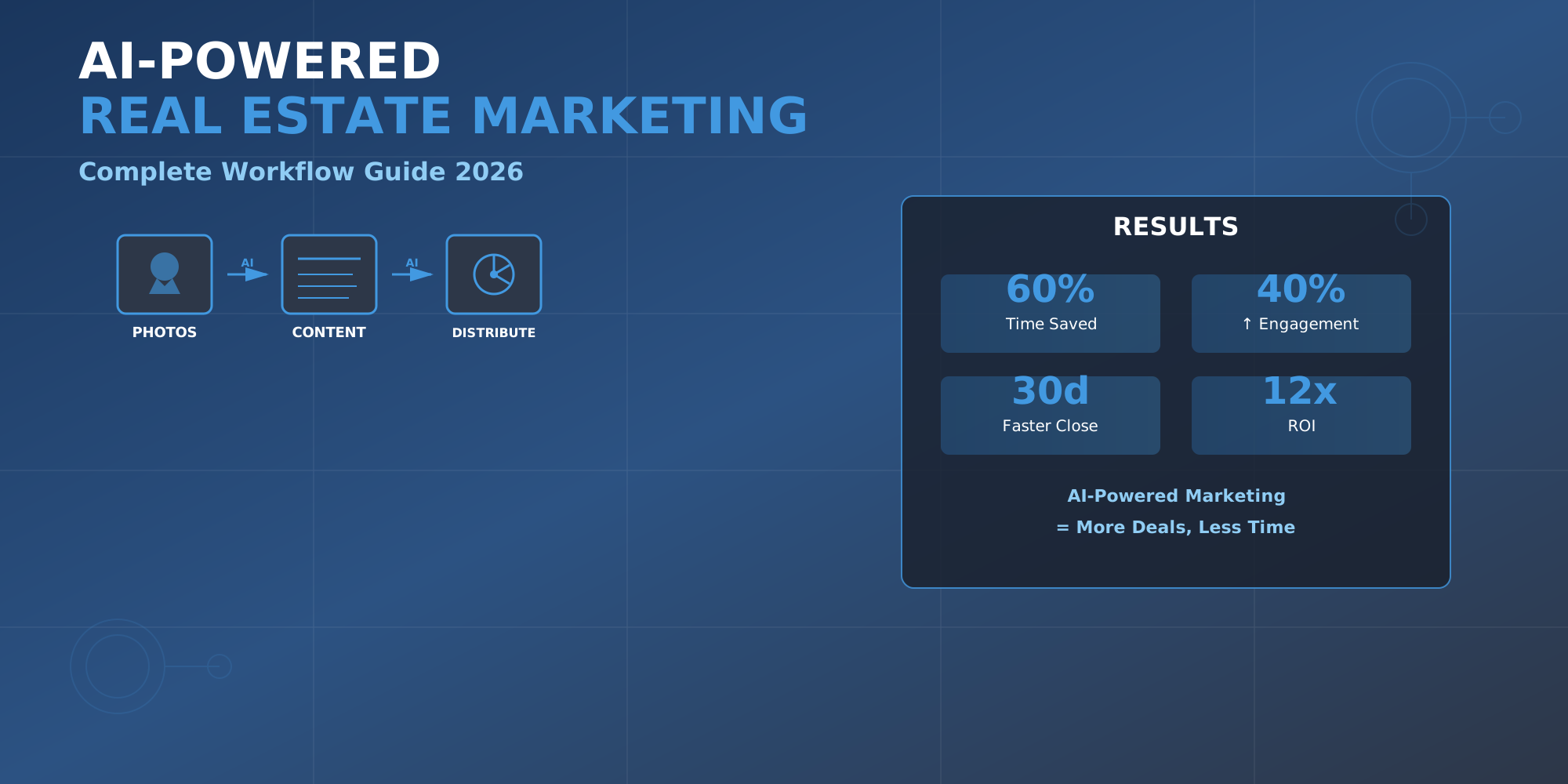
- 60% reduction in marketing time (18 hours → 7 hours per listing)
- 40% increase in online engagement (views, clicks, inquiries)
- 30% decrease in days on market
- 2-4% improvement in sale price (better presentation commands premium pricing)
On a $500,000 listing, that 3% sale price improvement means $15,000 in additional value to your seller—far more than your entire annual AI tool budget.
Common Mistakes to Avoid
1. Using AI as a complete replacement rather than an enhancement AI should handle the tedious, time-consuming tasks—but you must add the expertise, local knowledge, and personal touch that makes marketing effective. Think “AI-assisted” not “AI-generated.”
2. Skipping quality control Always review AI outputs before publishing. Errors, generic phrasing, and factual mistakes happen. Your reputation depends on accuracy.
3. Using low-quality AI tools to save money Not all AI staging platforms produce professional results. Poor staging is worse than no staging—it damages credibility. RealEstage.ai’s premium quality costs slightly more than budget alternatives but delivers dramatically better ROI through higher engagement and faster sales.
4. Inconsistent implementation AI marketing tools work best when used systematically on every listing. Inconsistent application means you’re still in “manual mode” mentally, losing most efficiency benefits.
5. Ignoring disclosure requirements Always disclose virtually staged photos per NAR guidelines and MLS rules. Ethical AI platforms like RealEstage.ai include automatic watermarks and disclosure features to keep you compliant without extra effort.
The Competitive Advantage
Here’s the reality: Within 2-3 years, AI-powered marketing workflows won’t be a competitive advantage—they’ll be table stakes. The agents implementing these systems now are building sustainable practices that will define their business for the next decade.
The choice is simple:
Continue spending 18+ hours marketing each listing with manual processes, limiting how many clients you can serve and burning out in the process…
Or build a streamlined AI-powered workflow that delivers better marketing results in 6-7 hours, freeing up time for high-value activities like building relationships, negotiating deals, and actually selling real estate.
The technology exists today. The platforms are mature and proven. The ROI is undeniable.
Your next listing is the perfect time to start.
Getting Started Today
Action steps:
-
Audit your current workflow: Time yourself on the next listing you market. Track hours spent on each phase (photos, content, distribution, management).
-
Start with photos: Sign up for RealEstage.ai and process your next listing through their platform. The immediate time savings and quality improvement will demonstrate ROI instantly.
-
Implement content templates: Create one set of AI-powered content for your next listing. Document what works, refine prompts, build a template library.
-
Automate distribution: Set up social media scheduling for one month of content. Experience the freedom of not manually posting every day.
-
Measure and optimize: After implementing the complete workflow on 2-3 listings, analyze results. Track time savings, performance improvements, and seller feedback.
The agents who master AI marketing in 2026 will dominate their markets in 2027. The only question is whether you’ll be leading the change or scrambling to catch up.
Related Articles
- AI Staging Software for Real Estate Agents: The 2026 Buyer’s Guide
- How Top Agents Use AI Staging to Close Faster
- The ROI of Virtual Staging: Data from 10,000 Listings
- AI Tools Transforming Real Estate in 2026
Frequently Asked Questions
How can AI improve real estate marketing efficiency?
AI automates time-consuming tasks like photo editing, virtual staging, content writing, and social media scheduling. Agents report saving 10-15 hours per listing on marketing tasks while improving listing quality and engagement rates by 40-60%.
What AI tools do successful real estate agents use?
Top-performing agents typically use AI for virtual staging (RealEstage.ai), listing description generation, social media content creation, email marketing automation, lead qualification chatbots, and CRM data enrichment. The key is integrating these tools into a cohesive workflow.
Is AI-generated content acceptable for real estate marketing?
Yes, when used properly. AI should enhance human creativity, not replace it entirely. Use AI for drafts, ideas, and time-consuming tasks, then add your personal expertise, local knowledge, and authentic voice. Always review and customize AI outputs before publishing.
How much does an AI marketing workflow cost?
A complete AI marketing stack typically costs $150-400/month for individual agents, including virtual staging subscriptions, content tools, automation platforms, and image editing software. The ROI is substantial—agents typically recover costs by closing just one additional deal per year due to improved marketing.
Can AI help with listing photography and presentation?
Absolutely. AI virtual staging transforms empty rooms, HDR enhancement improves lighting, sky replacement fixes weather issues, and decluttering tools remove distractions. Modern platforms like RealEstage.ai offer all these features in one integrated solution, streamlining the entire photo preparation process.